資料來源#
- Anthropic's Boris Cherny: Why Coding Is Solved, and What Comes Next
- Claude Fable 5 and Claude Mythos 5
- How Anthropic's product team moves faster than anyone else | Cat Wu (Head of Product, Claude Code)
摘要#
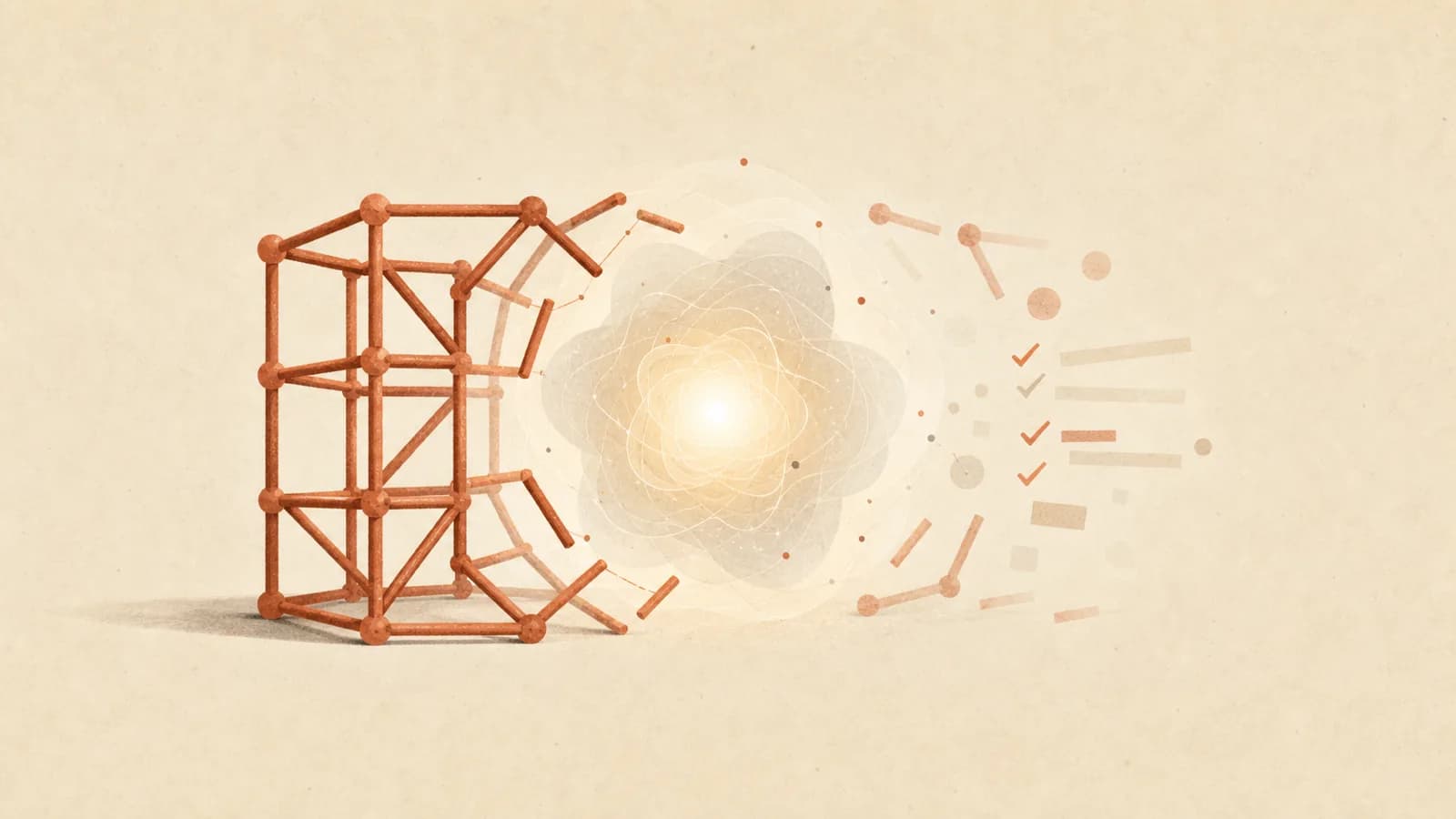
harness——提示詞、技能、腳手架、機械式驗證——是用來補償底層模型尚未能做到的事情。模型進步時,harness 應該縮減,而不是擴張。Boris Cherny 明確預測 Claude Code「一年後可能只剩 100 行程式碼」。Cat Wu 表示,每次模型發布時,團隊都會讀完整個系統提示詞,並移除新模型已能原生處理的內容。這項原則有兩個方向:harness 過去注入的能力會移入模型,而 harness 過去提供的拐杖則會變成阻力。
待辦清單作為經典範例#
Cat Wu 的案例研究:
- 早期的 Claude Code:要求重構 20 個呼叫點時,模型會改 5 個就停下來。團隊於是加入明確的待辦清單工具(「我們團隊的 Sid 當時說,人類會怎麼做?列一張清單,逐一完成。」)。在提示詞中強力要求使用這項工具後,模型完成了全部 20 個。
- Opus 4 起:模型會自發使用待辦清單,不再需要強力提示。
- 現在:待辦清單被「降低優先級」——模型可能會用,也可能不會用;不需要提醒,主要保留下來是為了讓使用者看見進度。
(強制使用待辦清單的提示詞段落這根拐杖被移除了;工具則因為另一個原因——UI 價值——而保留。)
Boris 的主張:100 行#
「我認為 Claude Code 本身一年後可能只剩 100 行程式碼。」
照字面理解,這是誇飾,但方向是真實的:
- Anthropic 現在使用與對外發布相同的模型,因此內部 harness 的經驗可以轉移
- 每次模型發布都讓團隊能刪除提示詞段落、縮減 fallback 邏輯、移除安全包裝層(依 Cat Wu 的說法:「今天所有的安全機制——提示詞注入、命令的靜態驗證、權限模式、人機協作——都會變得沒那麼重要,因為模型會直接做對的事。」)
- 產品表面不再是「harness 做什麼」,而是「模型決定在哪裡做」的地方(CLI、行動裝置、網頁、IDE,共享同一套模型邏輯)
反面:能力向內遷移#
Boris 表示,Opus 4.7 會自發開始迴圈:
「我會告訴它『拉取這個資料查詢』。它會說:『我注意到資料正在變動——我會開始一個迴圈,每 30 分鐘回報一次。』」
/loop 原語(見 Agent Loop Pattern)原本是 harness 功能;在 4.7 中,它正成為模型原生行為。harness 原語並不會消失——但使用者不再需要主動呼叫它。
這可以泛化:凡是 harness 透過提示詞段落教模型如何做的事情,都可能遷移到下一個模型的訓練資料中。
最清楚的示範:Fable 5 在沒有 harness 的情況下玩 Pokémon#
2026 年 6 月 Fable 5 的發布,提供了整個論點最容易理解的版本。**早期的 Claude 模型「即使配備提供額外實用工具的 harness,仍難以遊玩 Pokémon FireRed」——包括地圖、導航輔助工具、遊戲狀態讀數。Fable 5 以極簡、僅視覺的 harness 擊敗了 FireRed:**只有原始遊戲截圖,沒有其他東西。原本用來補償薄弱空間/視覺推理能力的腳手架沒有被改進——而是被刪除,因為這項能力已移入模型。同樣的模式也出現在 Fable 的記憶結果中:基於檔案的持久記憶讓 Fable 的 Slay the Spire 遊玩表現提升的幅度,是 Opus 4.8 的 3 倍——模型更擅長使用 harness 提供的能力,因此不再需要在周邊提供那麼多手把手引導。視覺與長期記憶正是 2025 年代 agent 最需要腳手架的軸線;如今它們也成為最先消解的能力之一。
錯誤方向:harness 膨脹#
相反的失敗模式比沒有 harness 更糟——它會主動讓模型退化:
- Cat Wu:「模型在[一個月]時間尺度內能做到什麼」是 PM 最難預測的事情;針對舊模型過度規格化 harness,會浪費 token,而新模型能更好地在無人監督下使用這些 token。
- Matt Pocock:250K token 的系統提示詞會讓模型在做任何事之前就掉進愚蠢區(見 Context Window Smart Zone)。
- 反覆注入能力會逐漸走向矛盾:情況 A 適用規則 X,情況 B 適用規則 Y,最後模型分不清哪個規則適用。
流程:每次發布都讀系統提示詞#
Cat Wu 的紀律:
「我們會讀完整個系統提示詞,然後反思:好,對於這些段落中的每一個,模型現在真的還需要這個提醒嗎?如果不需要,我們就移除它。」
這是一種反向實踐——大多數團隊只會往提示詞裡加東西,不會刪除。按照與模型發布同步的節奏執行,才能避免 harness 不斷累積。
為下一個模型打造,而不是為這個模型#
Boris 提出反直覺的推論:
「我們當時試著打造一個像是 PMF 前期的東西,而且知道它六個月內不會有 PMF,因為我們是在為下一個模型打造。」
大多數產品都是針對發布時所搭配的模型打造。Anthropic 則為六個月後的模型打造 Claude Code——接受它今天還不完全可用,賭下一次發布會補上差距。這改變了「harness 工作」的含義:不是「讓目前的模型可用」,而是「打造一個模型到來時將會運作的產品表面」。
Cat Wu 的版本是:「打造目前不一定能運作的產品非常重要,這樣你才知道要讓產品運作還缺少什麼;接著有了最新模型,你就能直接替換進去。」
Dan Carey 給出了最清楚的回溯性案例:Claude Design 早期原型的缺口,不是靠巧妙工程解決,而是靠 Opus 4.7 發布來填補(「模型發布就像抬升所有船隻的潮汐」)。專文並附上下一個模型與 AGI 稻草人之間的校準:Build for the Next Model。
反方:harness 仍然重要#
不是所有人都同意。Matt Pocock 認為 harness——回饋迴圈、深度模組、機械式驗證——就是上限:
「如果你的程式碼庫沒有回饋迴圈,你永遠永遠永遠不可能從 AI 得到像樣的 AI 輸出。回饋迴圈的品質會影響你的 AI 能寫出多好的程式碼,基本上,那就是上限。」
綜合來看:**提示詞腳手架會隨模型進步而縮減;機械式驗證仍不可或缺。**測試、型別、linter、隔離的審查情境——這些是 harness 提供的基礎設施,不會像能力那樣遷移進模型。
相關連結#
- Boris Cherny ——「100 行」主張與自發迴圈的觀察
- Claude Fable 5 ——最清楚的示範:僅視覺的 Pokémon harness,以及相較 Opus 4.8 高 3 倍的記憶利用率
- Cat Wu ——每次發布都刪減提示詞的操作紀律
- Matt Pocock ——機械式驗證仍是承重結構的反方觀點
- Agent Loop Pattern ——原語從 harness 遷移到模型的範例
- Context Window Smart Zone ——為什麼提示詞膨脹是一種成本,不只是膨脹
- Claude Character as Product ——角色是少數可能不會縮減的 harness 資產
- Agent Harness Engineering ——將「強制不變量,而非實作」原則泛化到 harness 與模型的分工
- Claude Code Auto Mode ——Cat Wu 預測其必要性會逐漸消退的 harness 功能
- AI Brain Fry ——harness 縮減可部分緩解(需要監督的內容變少),但 loops 帶來的輸出量又重新引發問題
- Human-AI Accountability Redesign ——不會縮減的是邊界上的人類;這篇論文說明邊界工作將變成什麼(監督品質、決策權、升級處理、後果)
- Model Spec Midtraining (MSM) ——對齊從 harness 注入價值的提示詞,移向模型內化的價值;這是 harness 縮減在對齊面向的對應
- Interaction Models ——互動軸線上的相同轉變:VAD/回合偵測/對話管理 harness 會消解進模型(Thinking Machines Lab,2026 年 5 月)
- The Bitter Lesson ——底層原則:手工打造的腳手架會被規模化的一般能力超越
- Build for the Next Model ——獨立頁面呈現的產品策略推論:原型化「幾乎能運作的東西」,讓下一次發布補上差距(Dan Carey/Claude Design/Opus 4.7)
- HTML as the New Markdown ——關鍵區別:本頁描述的是面向模型的 harness 縮減,而 Thariq Shihipar 的 HTML 產物(plans、micro-apps)是模型進步時會擴張的面向人類 harness(約束從「模型能否做到」轉移到「人類能否留在迴圈中」)
- Compute Allocator ——命名了模型面向 harness 縮減後擴張的人類角色;約 99% 的 token 都流向面向人類的腳手架
- Founder as Agent Orchestrator ——harness 縮減時,編排能力本身也會轉移;圍繞 2026 Claude 表面能力打造永久工作流程的創辦人,應預期需要重寫
- Agentic Technical Debt ——CLAUDE.md 作為架構脈絡,是 harness 的一種形式;最終可能由模型推斷,但目前仍是承重結構
- Compounding Data Moat ——垂直領域邊界案例測試套件是不會遷移進模型的 harness 形式(小眾產業邊界案例沒有通用訓練訊號)
- AI-Native Startup Lifecycle ——圍繞 2026 Claude 表面能力打造永久工作流程的創辦人,應預期這些能力會隨 harness 縮減而轉移
- Zero-Friction Scope Creep ——書面範圍紀律是人類流程工作,不會隨 harness 縮減而遷移進模型
- MCP and Computer Use ——與 harness 縮減互補:連接器不會縮減,反而會隨模型決定每項任務要使用哪種基底(MCP/API/computer use)而擴張
- Evals as Product Spec ——PM 端不會縮減的部分:evals 是持久的產物,會在周遭 harness 消解時重新驗證產品
- Agentic Loops Overtake Bespoke Systems ——形式數學中的相同動力:DeepMind 專門打造的證明搜尋腳手架(AlphaProof + evolution)在 LLM 進步後,從啟用能力轉為單純節省成本
- Verification as the New Bottleneck ——Fiona Fung 的組織層面推論:當生成 harness 縮減時,驗證會成為約束瓶頸
- Recursive Self-Improvement ——harness 縮減的終點:harness 溶入模型,與將這個趨勢應用於 AI 開發本身、閉合自我改進迴圈,是同一個趨勢
- AI Accelerating AI Development ——部署端的量化故事:當能力向內遷移,內部工程吞吐量上升(每位工程師的程式碼約 8 倍;超過 80% 由 Claude 撰寫)
- Research Taste as the Human Bottleneck ——人類端的鏡像:模型面向 harness 縮減後,留下的是品味、審查與方向設定
- Vibe Coding vs. Agentic Engineering ——Karpathy 的「>10x 且持續擴大」槓桿曲線,是縮減 harness/擴張能力在實作者端的形式
- Loop Engineering ——部署端證據:Osmani 所說「一年前,迴圈是你永遠維護的私有 bash 堆;現在這些零件已經隨產品發布」;這是從迴圈層看見的 harness 縮減——能力以具名原語(自動化、worktree、技能、連接器、子 agent)形式被工具吸收
- Agentic Work Systematization ——以相同的吸收現象衡量:技能/插件是以具名、可分享的產品原語發布的 harness 能力,並附有 OpenAI 研究的採用曲線(每週活躍 Codex 使用者的 5.4%→26.6%)
- Conversation-to-Delegation Shift ——委派上升(按人口計的 Codex token 份額)正是縮減 harness 在使用端促成的結果:每項任務需要較少手把手引導,更多工作直接交接出去
開放問題#
- 所有提示詞腳手架最終都會遷移進模型嗎?還是有些會留下——例如組織特定的風格、安全規則、品牌語調?
- Boris 的「100 行」預測距離 2026 年 5 月還有一年——2027 年即可驗證。
- 如果 harness 工作縮減,什麼新工作會擴張來填補空缺?Cat Wu 的賭注是:PM/產品品味、eval 撰寫、角色工作。
衍生文章#
- Learning to Co-Work with AI: A Software Engineer's Field Guide ——將每次發布都刪減,框定為日常實踐;將「為下一個模型打造」視為職涯策略上的時間跨度
- Opinions on Using AI Tools & the Future of the Software Engineering Role ——harness 縮減與 harness 是上限之間的張力,是四種立場辯論地圖的一條軸線
- Does the Human-Facing Harness (HTML Artifacts) Hit Its Own Bloat Ceiling? ——面向模型/面向人類的不對稱推到結論:面向人類的 harness 無法縮減至零,且模型進步時會面臨更多膨脹壓力
- Where Does Agent Harness Work Remain Durable as Models Improve? ——區分會縮減的能力腳手架與持久的邊界工作:驗證、repo-local truth、脈絡預算、隔離、工具與人類決策介面
資料來源#
- Anthropic's Boris Cherny: Why Coding Is Solved, and What Comes Next
- How Anthropic's product team moves faster than anyone else | Cat Wu (Head of Product, Claude Code)
- Full Walkthrough: Workflow for AI Coding — Matt Pocock(反方觀點)
- Claude Fable 5 and Claude Mythos 5 ——僅視覺 Pokémon FireRed harness;記憶利用率提升
Cited by 108
- Opinions on Using AI Tools & the Future of the Software Engineering Role×5
The harness should shrink, not grow. Harness Shrinkage As Models Improve: every model release lets…
- Build for the Next Model×5
This is the product-side expression of The Bitter Lesson and Harness Shrinkage As Models Improve:…
- Learning to Co-Work with AI: A Software Engineer's Field Guide×5
Verification & review — mechanical feedback loops + fresh-context review (see Agent Loop Pattern,…
- Open Questions Backlog×5
Harness Shrinkage As Models Improve: The Boris "100 lines" prediction is a year out from May 2026 —…
- Authority and Audit Survive Abundance×4
Both questions reduce to the same sorting rule, which extends the generalization Harness Shrinkage…
- Crystallizing Agent Work into Workflows×4
Authority And Audit Survive Abundance — resolves this page's upgrade-moment conflict with Harness…
- Document Parsing as the Retrieval Bottleneck×4
The cost-vs-accuracy figure was worth viewing, because the slide prose misreads it. The text claims…
- Evals as Product Spec×4
The suite is explicitly perishable. "As models improve, cases that once discriminated stop doing so…
- Harness Build-vs-Buy×4
Harness Shrinkage As Models Improve — the thesis this puts under tension: prompts shrink, codebases…
- The Bitter Lesson×4
The bitter lesson is about capabilities and structure migrating into the model, not "harnesses are…
- Vibe Coding vs. Agentic Engineering×4
Karpathy explicitly retires the old "10x engineer" trope as too small: "10x is not the speedup you…
- What Scaffolding Survives Model Improvement — and How Do You Know When a Line Turns Harmful?×4
The question's examples (org style, security rules, brand voice) all survive, and the sorting rule…
- Agent Loop Pattern×3
The instructors attribute the change to the model, not to the harness. "I think the paradigm is…
- Agentic Technical Debt×3
Harness Shrinkage As Models Improve — CLAUDE.md is a harness asset that may eventually be inferred;…
- Deep Research Agents×3
Harness Shrinkage As Models Improve — counter-datapoint: here the harness has not shrunk into the…
- Where Does Agent Harness Work Remain Durable as Models Improve?×3
Harness Shrinkage As Models Improve gives the negative space. Early Claude Code needed aggressive…
- Does the Human-Facing Harness (HTML Artifacts) Hit Its Own Bloat Ceiling?×3
The model-facing harness can shrink toward zero as capability migrates inward (Harness Shrinkage As…
- Loop Engineering×3
The conclusion: "once you notice the shape is the same you stop arguing about which tool — you just…
- Output Length Calibration×3
Harness Shrinkage As Models Improve predicts the model-facing harness dissolving release by release…
- Owning Your Externalized Cognition×3
"The models will improve and make the harness obsolete." His answer: the better the models get, the…
- Agent-Authored Harness Optimization×2
Not a controlled comparison — different model, different benchmark version, different starting…
- Agent Context Files×2
Harness Shrinkage As Models Improve — why context files shrink with each model release; prune at…
- Agent Harness Engineering×2
The differentiators are the boundary-enforcement residue, not the capability layer. Sandboxing…
- Agentic Coding Work-Composition Shift×2
The longitudinal finding of Anthropic's 400K-session study: over just seven months (Oct 2025 → Apr…
- Agentic Loops Overtake Bespoke Systems×2
The Bitter Lesson: scaled general methods beat hand-engineered structure over time. Here the…
- Agentic Work Systematization×2
Harness Shrinkage As Models Improve — skills/plugins are harness capability being absorbed into the…
- AI-Native Moats Under Frontier-Model Improvement×2
Harness Shrinkage As Models Improve gives the mechanism. Capabilities that used to require…
- AI-Native Startup Lifecycle×2
vs. Harness Shrinkage As Models Improve: the playbook treats Claude surfaces as fixed…
- Boris Cherny×2
Harness Shrinkage As Models Improve — predicts Claude Code "may be 100 lines of code a year from…
- Cat Wu×2
Judgement over rules. At an AI Engineer World's Fair fireside with Thariq Shihipar hosted by Simon…
- Claude Character as Product×2
Cat: "new models force product changes." Most of those changes are removing crutches (see Harness…
- Claude Code×2
Boris claim: "100 lines of code a year from now" — see Harness Shrinkage As Models Improve for the…
- Claude Fable 5×2
Vision (new SOTA). Extracts precise numbers from detailed scientific figures; rebuilds a web app's…
- Claude Sonnet 5×2
Early-access partners reported it "finishes complex tasks where previous Sonnet models would stop…
- Codex×2
Harness Shrinkage As Models Improve — Codex absorbing harness capability (skills, automations,…
- Compute Allocator×2
Harness shrinkage with a twist — as the model-facing harness shrinks (Harness Shrinkage As Models…
- Conversation-to-Delegation Shift×2
Harness Shrinkage As Models Improve — rising delegation is what a shrinking harness enables on the…
- Cost-per-Task Over Cost-per-Token×2
No routing table, no threshold, no per-task rule — the selection decision itself is delegated. That…
- DRACO Benchmark×2
Orchestration > base model. Perplexity (Opus 4.6 base) beats bare Opus 4.6-with-tools by ~10pp —…
- How Do You Write Evals for Taste? Character as the Limit Case×2
Most harness assets shrink as models improve (Harness Shrinkage As Models Improve). Character is…
- HTML as the New Markdown×2
At first glance this contradicts the wiki's running Harness Shrinkage As Models Improve thesis (Cat…
- Instruction Compounding×2
Harness Shrinkage As Models Improve says scaffolding becomes unnecessary as capability migrates…
- Interaction Models×2
This is the harness-shrinkage argument (see Harness Shrinkage As Models Improve) applied to the…
- Intra-Trace Parallel Planning (SPRINT)×2
The distinctive move is the direction of travel: everywhere else in this wiki the harness supplies…
- MCP and Computer Use×2
Harness Shrinkage As Models Improve predicts that prompt scaffolding, permissions, and verification…
- The 1% Rule for Wedge Selection×2
Harness Shrinkage As Models Improve — the same inward-migration dynamic one layer down, where it is…
- Orchestration Sets Token Economics×2
The most portable finding, and the one that cuts against the simplest reading of Harness Shrinkage…
- Planning / Execution Division of Labor×2
Harness Shrinkage As Models Improve — the share of planning delegated to the agent is a usage-side…
- Playbook Boundary Conditions: the Devil's-Advocate Substrate and the Prototype's Edge×2
Q1: Problem Solution Fit Discipline, Claude Character As Product, Harness Shrinkage As Models…
- The PRD-Replacement Spectrum at AI-Native Speed×2
Harness Shrinkage As Models Improve — the model-facing-spec-shrinks principle that drives the move…
- Product Velocity as Moat×2
Velocity has always helped startups; what makes it a moat now is the AI-native cost structure. When…
- Reasoning–Acting Interleaving (ReAct)×2
Harness Shrinkage As Models Improve — the pattern's own trajectory: a prompting scaffold that…
- Research Taste as the Human Bottleneck×2
Harness Shrinkage As Models Improve — the same role-narrowing dynamic from the harness side; what's…
- Retrieval Inside the Reasoning Chain×2
The lecture ran out of time on the second paper and states the distinction in one line: Search-o1…
- Shared Harness, Differentiated Surfaces×2
Harness Shrinkage As Models Improve — the thesis this independently corroborates; the three surface…
- Single General Agent vs. Multi-Agent Coding Architecture×2
Harness Shrinkage As Models Improve — scaffolding that compensates for model weakness becomes drag;…
- Skill Lift×2
Harness Shrinkage As Models Improve — the durability question. A skill supplying proprietary API…
- Thariq Shihipar×2
Unhobbling. (July 2026 context-engineering post.) The Claude Code team was over-constraining the…
- Thinking Machines Lab×2
Their harness-dissolves-into-model stance is the same shape as Harness Shrinkage As Models Improve…
- The Three Loops of AI-Native Building×2
They may both be right, because they mean different loops. Ambrosino's "loops" are the agentic…
- Tool-Output Pruning×2
Harness Shrinkage As Models Improve — a counter-current. This is not scaffolding the model absorbs;…
- Turn-Based Interface Bottleneck×2
Two months after TML's argument, OpenAI shipped its conclusion: Gpt Live "removes the turn detector…
- Verification as the New Bottleneck×2
Harness Shrinkage As Models Improve — the synthesis it confirms: scaffolding shrinks, mechanical…
- Verifying Without a Compiler: Cowork's Harness vs Claude Code's, and Why the Slice Verifier Stays×2
Claude Code's harness leans on a post-hoc deterministic verifier stack. Tests, compilers, linters,…
- Acceleration Whiplash
Harness Shrinkage As Models Improve — a counter-pressure data point: even as models improve,…
- Agentic Code Generation as Compilation
Harness Shrinkage As Models Improve — a genuine counter-current worth naming. The shrinkage thesis…
- AI Accelerating AI Development
Harness Shrinkage As Models Improve — the same narrowing role: humans stop writing code, shift to…
- AI Brain Fry
Harness Shrinkage As Models Improve — better models reduce per-task review needed, partially…
- AI Native Product Cadence
Harness Shrinkage As Models Improve — internal harness pruning is itself an example of the cadence…
- AI R&D Autonomy Evaluation (AECI)
Harness Shrinkage As Models Improve — the deployment-side correlate: as the model absorbs more…
- Anthropic
Harness Shrinkage As Models Improve — operational discipline applied to internal harness
- App Server vs MCP, and the Claude-Side Equivalent: Three Boundaries for Driving Agents
The instructive middle: Symphony's own evolution shows what breaks when neither side fits. Its v1…
- Campfire
Campfire claims its AI edge comes from "our own foundation model." For an ERP, what does a custom…
- Claude Code Auto Mode
Harness Shrinkage As Models Improve — Cat Wu predicts permission modes / human-in-the-loop / static…
- Claude Code Best Practices
Harness Shrinkage As Models Improve — why best-practice prompts and CLAUDE.md sections shrink with…
- Claude Opus 4.7
Harness Shrinkage As Models Improve — Opus 4.7 is the model whose spontaneous loop-starting and…
- Claude Opus 5
He also confirms the intelligence gain drove real prompt deletion: much of Claude Code's system…
- The Code-Quality Payoff Is Token-Indexed
Harness Shrinkage As Models Improve — the parent shape: scaffolding built against a model…
- Compounding Data Moat
Harness Shrinkage As Models Improve — generic harness shrinks, but the vertical-specific test suite…
- Compounding Loop Optimization
Harness Shrinkage As Models Improve — the loop's internal tooling shrinks/changes as the model…
- Context Window Smart Zone
Harness Shrinkage As Models Improve — the smart zone may grow ("the dumb zone has become less dumb…
- Continuous Self-Modification Under Review
Harness Shrinkage As Models Improve — the limit case for the shrinkage thesis: a harness that…
- CS329A: Self-Improving AI Agents (Stanford)
Two things carry beyond their papers. The interleave got absorbed. Chowdhery says twice that…
- DHH (David Heinemeier Hansson)
Harness Shrinkage As Models Improve — he corroborates the 80% system-prompt cut from the user side…
- Disposable Micro-Apps
Harness Shrinkage As Models Improve — micro-apps are human-facing scaffolding (built per-task for…
- Dynamic Workflows: An Algebra for Agents
Harness Shrinkage As Models Improve — the counterweight: the model got better, but the harness here…
- Engineer PM Convergence
Harness Shrinkage As Models Improve — as harness shrinks, the surface area of a "PM" role shrinks;…
- Fiona Fung
Harness Shrinkage As Models Improve — "Claudify everything / kill old processes" is the org-process…
- Founder as Agent Orchestrator
Harness Shrinkage As Models Improve — orchestration affordances will themselves shift as harness…
- Human-AI Accountability Redesign
Harness Shrinkage As Models Improve — what doesn't shrink is the human role at the boundary; this…
- Implementation Abundance Inverts Product Work
Harness Shrinkage As Models Improve — implementation abundance is harness-shrinkage seen from the…
- Inference Efficiency as Capability
The same distinction sharpens Harness Shrinkage As Models Improve. Harnesses shrink because…
- Interaction / Background Model Split
Harness Shrinkage As Models Improve — open question whether the split is permanent or a…
- Latent vs. Deterministic Space
The seating example prices latent-space judgment at "a couple hundred dollars of tokens" for 800…
- Layerwise Omission Attribution
Harness Shrinkage As Models Improve — the boundary this taxonomy draws, restated as a prediction…
- Managers as ICs
Harness Shrinkage As Models Improve — falling onboarding/coding cost is what makes a flatter org…
- Matt Pocock
Harness Shrinkage As Models Improve — counterpoint: he sees harness as still important even with…
- Agent Systems & Harness Engineering
Harness Shrinkage As Models Improve (hub) — Prompt scaffolding shrinks each model release; Cat Wu's…
- Model Introspection Feedback
Harness Shrinkage As Models Improve — introspection points at which harness elements still earn…
- Model Spec Midtraining (MSM)
Harness shrinkage (alignment axis): Harness Shrinkage As Models Improve (alignment moves from…
- Mythos Model
Harness Shrinkage As Models Improve — Mythos-class capability is what makes Boris's "100 lines"…
- Orchestration vs Employee Framing: Reconciling the Founder's Playbook with HBR's Accountability Evidence
Harness Shrinkage As Models Improve — what shrinks vs. what doesn't (oversight stays)
- Perplexity
Perplexity Deep Research runs Claude Opus 4.5 / 4.6 as its base models (per the paper's experiment…
- Printing Press Software Democratization
Harness Shrinkage As Models Improve — the harness shrink is one slice of the same diffusion:…
- Recursive Self-Improvement
Harness Shrinkage As Models Improve — the same human-role-narrowing dynamic; humans stop writing…
- Repository Exploration Subagent
Harness Shrinkage As Models Improve — same tension from the harness side: is a trained exploration…
- Seven Powers Applied to AI
Harness Shrinkage As Models Improve — process-imitation by hill-climbing models is the direct…
- Zero-Friction Scope Creep
Harness Shrinkage As Models Improve — does not address scope creep; this is human-process work that…
Related articles
- Claude Code
Anthropic's agentic coding product; created by Boris Cherny late 2024; TypeScript/React on Bun (itself Claude-rewritten…
- Anthropic
AI safety company / vendor of Claude; mission-as-tiebreaker culture; ~30–40 PMs across teams; Mike Krieger leads Labs r…
- Verification as the New Bottleneck
Fiona Fung: coding is no longer the bottleneck — verification, review, maintenance are; shift-left; TDD loses its tax;…
- Agent Harness Engineering
Patterns for scaffolding long-running LLM agents: environment design, progressive context disclosure, mechanical archit…
- Open Questions Backlog
Generated by `_system/lint.py --write-backlog`. Do not hand-edit. Domain and Watching sections carry one row per page —…