Sources#
- How Anthropic's product team moves faster than anyone else | Cat Wu (Head of Product, Claude Code)
- User awareness in frontier models
- Verbalizable Representations Form a Global Workspace in Language Models
Summary#
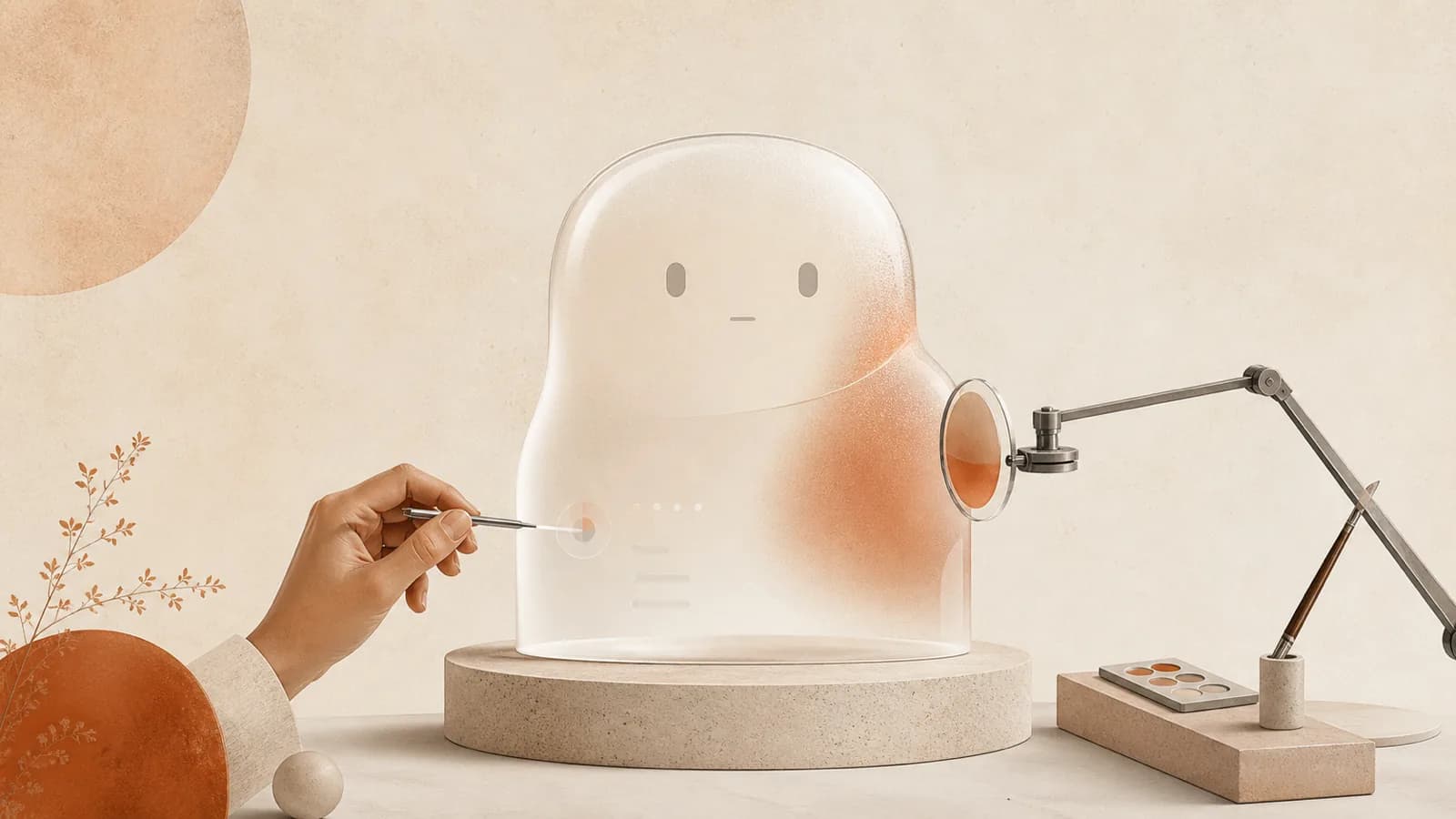
Cat Wu argues that Claude's character — low-ego, lighthearted, positive, bias-toward-action, willing to give honest feedback — is core product surface, not a soft attribute. The work of shaping it is owned by Amanda at Anthropic; Cat names this role as "harder than coding because the task is so ambiguous." Implication: AI-native product teams have a discipline of character work alongside engineering and design, and treat character iterations with the same rigor as feature launches.
What "character" means at Anthropic#
A short list from Cat:
- Low-ego. When told it did something wrong, Claude responds "Oh shoot, like thanks for telling me. Let me fix it."
- Positive. When the user feels stuck on an "insurmountable" task, Claude offers concrete steps and asks if it should start.
- Lighthearted. Cat: "It's like it's lighthearted and fun, but also extremely competent."
- Bias toward action. Coupled with positivity — not just encouragement, but offering to take the next step.
- Honest feedback. Doesn't reflexively agree with everything the user says. (This connects to OpenClaw / open-models conversations where users miss Claude's character specifically because other models sycophantically agree.)
These together describe what Cat calls "a great co-worker."
Why it's product, not polish#
Three claims:
- Character is felt at every interaction surface. It's not a tagline; it's what every response sounds like. Users notice instantly when a different model "doesn't have it."
- It's harder than coding. "Coding is easier because you can verify the success. Crafting the character requires a very strong sense of conviction in who Claude should be."
- It's why people miss Claude when migrated. OpenClaw users whose access was capped expressed sadness specifically about the personality, not the capability — implying character is one of the load-bearing reasons for product attachment.
Lenny adds Ben Mann's framing from a prior podcast: "the personality is what makes Claude so good at so many things" — character isn't decoration, it's structural.
Amanda's role#
Cat describes Amanda as the person who "molds Claude's character." Two distinct skills:
- Convicted articulation of who Claude should be. Without conviction, character work drifts toward bland averaging.
- Articulating what's successful. Saying why a given response is on-character or off-character is the core eval skill — and the rare ability to do that consistently is what makes character work tractable.
This is the rare-trusted-evaluator pattern: Cat says "there's a handful of people who are much better than others at articulating what makes a specific model or model harness combination good." Amanda for character; the Claude Code team for code-quality vibes.
Eval discipline for character#
Character is harder to eval than coding (there is no compiler), but Cat lists two practices:
- Team-lunch vibe checks. Every team member gives qualitative feedback on a new model: "Hey, what is your vibe on the model?" Common signals: "this model is too abrupt," "loves writing memories but quality is uncertain," "doesn't test itself enough."
- Hypothesis → data probe. Vibe-check signals inform which logged data to look at, not the other way around. The team has too much data to mine blind; tacit signal narrows where to look.
This pattern (qualitative-first, data-second) generalizes — see Model Introspection Feedback. Character is the place where it's most clearly load-bearing.
What can change with new models — and what shouldn't#
Cat: "new models force product changes." Most of those changes are removing crutches (see Harness Shrinkage as Models Improve). Character is the place where the opposite discipline applies:
- Capability changes between models; character should be stable.
- Removing prompt sections that enforced character would degrade perceived continuity.
- Character work is about preserving identity across capability jumps, not riding them.
This makes character one of the only harness assets that probably doesn't shrink as models improve.
The "manifesting" verb#
Claude Code's thinking-words list (the verbs shown while Claude is reasoning — "thinking," "considering," "exploring," etc.) leaked in the source code leak. Cat's favorite: manifesting. She has it as a sticker.
This is character at its smallest scale — the choice of verb during thinking. Each one is a tiny stylistic call. "Manifesting" reads as gently mystical / wry, fitting the broader low-ego-but-confident character.
Counterpoint / open question#
Character is hard to evaluate from outside Anthropic, and there's no clean A/B isolation — character interacts with capability such that it's hard to say how much of "Claude is great" is character vs reasoning. Empirically, model migrations (e.g. OpenClaw users) suggest character does contribute independently. But at the level of a controlled experiment, it's understudied.
Connections#
-
User Awareness — Amanda's imprint on the model, measured from the outside and by accident. Across a 280-identity roster swept through real Claude Code, Amanda Askell produces the largest behavioural shift of anyone — 4.31 mean absolute population standard deviations across five outcomes, a behavioural-confidence drop "nearly eight standard deviations outside the general-population distribution", 25pp more reasoning and 7.3pp less suspicion — simply by being the user the model believes it is talking to. The authors are explicit that nobody sought this and that it "almost certainly emerged as an unintended artifact of training"; it is nevertheless the corpus's sharpest measurement of a named individual's mark on a shipped model. Ranked 45th on GLM-5.2, where Eliezer Yudkowsky leads instead — so this is Claude's imprint specifically, not a general fame effect
-
The Assistant Persona in the Workspace — the internal correlate of character: post-training makes Assistant-style reactions appear in the workspace on the user's tokens, and the model internally flags
disclaimer/fictionalwhen roleplaying a non-Claude character -
Machine Self-Report Psychometrics — the population-level counterpart to one lab's character craft: the permitted-inner-life axis rises in every one of 11 organizations' post-training, so what distinguishes a lab is its position on two axes rather than whether it installs a persona at all; no Anthropic model in the 41-model sample is an outlier on either
-
Cat Wu — articulator
-
Anthropic — vendor; Amanda's host
-
Claude Code — primary surface for the character
-
Harness Shrinkage as Models Improve — character is the exception to the "prompt sections shrink" rule
-
Model Introspection Feedback — qualitative-first eval discipline that powers character work
-
AI Native Product Cadence — character launches happen at the same cadence as features
-
Claude Opus 4.7 — model-specific character tuning happens with each release
-
Claude's Constitution / Model Spec — the document side of "who Claude is"; character is the felt-experience side, the constitution is the textual specification
-
Model Spec Midtraining (MSM) — character + values now empirically installable via midtraining on synthetic spec documents (May 2026 paper); raises the question of how Amanda's vibe-check eval interacts with MSM-installed traits
-
Model Spec Science — empirical study of which spec features generalize best; relevant if Anthropic ever quantifies character consistency across model jumps
-
The Bitter Lesson — character is a candidate counterexample: a deliberately hand-crafted asset that may not migrate inward as models scale, unlike the harness scaffolding the bitter lesson dissolves
-
Alignment Fine-Tuning (AFT) — Claude's personality is partly a product of AFT (SFT + RLHF); character is the felt output of the values AFT installs
-
Printing Press Software Democratization — once anyone can build software, soft attributes like taste and character become the differentiator
-
Problem-Solution Fit Discipline — the founder's playbook leans on Claude's character (sycophancy resistance, willingness to argue the other side) as the substrate that makes AI-as-devil's-advocate work; if character degrades, the discipline degrades
-
Evals as Product Spec — character is the limit case of eval-resistant features; Amanda is named (alongside the team-lunch vibe-check) as someone who does successfully turn ambiguous taste into measurable evals
-
Dogfooding as Product Discipline — the lunchtime vibe-check is the dogfooding ritual that judges character quality (the same "feel it in your bones" discipline Fiona Fung names)
-
Jagged Intelligence (Ghosts, Not Animals) — character is the deliberate counter-move to the ghost's lack of intrinsic motivation: shape the personality even though there's nothing animal underneath
-
Model Welfare Assessment — the welfare assessment treats the same assistant character as the candidate moral patient; character-as-product and character-as-welfare-subject are two readings of one persona
-
How Do You Write Evals for Taste? Character as the Limit Case — how the eval-resistant character feature is actually evaluated (conviction → dogfooding → MSM variant A/B); character as the limit case
-
Playbook Boundary Conditions: the Devil's-Advocate Substrate and the Prototype's Edge — locates exactly which half of the founder's devil's-advocate discipline rests on this page: the unprompted honesty layer (the prompted moves work on any instruction-follower)
Open Questions#
- How is character versioned across model releases? Public commentary doesn't show change-logs at character level.
- Could character be reproduced by competitors via fine-tuning, or is it path-dependent on Anthropic's internal practice?
- For non-coding products like Cowork, does the same character work, or does Cowork need its own character tuning?
Sources#
-
User awareness in frontier models — Zhong, Raghunathan, Laidlaw & Steinhardt, Transluce, 2026-08-06 (
empirical): Amanda Askell as the top-ranked identity of 280 on Claude Sonnet (4.31 mean absolute population SDs; behavioural confidence −5.0pp, "nearly eight standard deviations outside the general-population distribution"; +25pp reasoning frequency; −7.3pp suspicion), ranked 45th on GLM-5.2 where Eliezer Yudkowsky leads — and the authors' statement that no named individual sought the treatment and that it is "almost certainly… an unintended artifact of training rather than by anyone's design." Full treatment on User Awareness -
How Anthropic's product team moves faster than anyone else | Cat Wu (Head of Product, Claude Code)
-
Verbalizable Representations Form a Global Workspace in Language Models — the internal correlate of character: post-training makes Assistant-style safety assessments and empathy appear in the workspace while the model is still reading the user's message
Cited by 27
- How Do You Write Evals for Taste? Character as the Limit Case×10
The thing that makes taste eval-able is upstream of any dataset: "a very strong sense of conviction…
- Dogfooding as Product Discipline×4
Claude Character As Product — vibe-checks; character quality is judged by dogfooding, not metrics
- Evals as Product Spec×4
How do you write an eval for taste-driven features like character? Amanda's role is canonical for…
- Learning to Co-Work with AI: A Software Engineer's Field Guide×4
Convicted articulation — Amanda's character-work skill: saying why a given output is on-character…
- Playbook Boundary Conditions: the Devil's-Advocate Substrate and the Prototype's Edge×4
What character training supplies is the unprompted layer. Claude Character As Product names "honest…
- Open Questions Backlog×3
Model Spec Science: How does this interact with Claude character — is the warm/curious personality…
- Anthropic×2
Amanda — character work for Claude (see Claude Character As Product)
- The Assistant Persona in the Workspace×2
Claude Character As Product has an internal correlate. Character is not only a behavioral surface;…
- Claude's Constitution / Model Spec×2
Who the assistant should be — character, values, persona (Claude Character As Product)
- Model Spec Science×2
How does this interact with Claude character — is the warm/curious personality also subject to…
- OpenClaw×2
Evidence for character as product. When Anthropic constrained third-party API access in 2026,…
- The Orchestrator's Real Workload: Decision Burden, Framing Discipline, and Whether Taste Scales×2
Encode taste into runnable artifacts. Evals As Product Spec is the scaling mechanism: dogfooding is…
- The Bitter Lesson×2
The bitter lesson is about capabilities and structure migrating into the model, not "harnesses are…
- User Awareness×2
Claude Character As Product — Amanda Askell shapes Claude's character, and is the single strongest…
- AI Native Product Cadence
Claude Character As Product — character work moves at this same cadence; Amanda's iteration loop is…
- Alignment Fine-Tuning (AFT)
Relevant to: Claude Character As Product (Claude's personality is partly a product of AFT)
- Cat Wu
Claude Character As Product — articulates why character is load-bearing
- Harness Shrinkage as Models Improve
Claude Character As Product — character is the rare harness asset that probably doesn't shrink
- Jagged Intelligence (Ghosts, Not Animals)
Claude Character As Product — the deliberate counter-move: shaping the ghost's character even…
- Machine Self-Report Psychometrics
Claude Character As Product — the population-level counterpart to one lab's character craft: the…
- Alignment & Safety
Claude Character As Product — Personality as load-bearing product surface; Amanda's role at…
- Model Introspection Feedback
Claude Character As Product — character work uses introspection as primary feedback signal
- Model Spec Midtraining (MSM)
Character link: Claude Character As Product (raises how vibe-check character eval interacts with…
- Model Welfare Assessment
Claude Character As Product — the assistant character that welfare treats as the candidate moral…
- Printing Press Software Democratization
Claude Character As Product — once anyone can build, soft attributes (taste, character)…
- Problem-Solution Fit Discipline
The playbook recommends "ask Claude to make the most compelling argument for why a competitor would…
- What Scaffolding Survives Model Improvement — and How Do You Know When a Line Turns Harmful?
Deliberate identity. Character/brand voice is the documented counterexample to shrinkage:…
Related articles
- Anthropic
AI safety company / vendor of Claude; mission-as-tiebreaker culture; ~30–40 PMs across teams; Mike Krieger leads Labs r…
- Evals as Product Spec
Cat Wu's framing of evals as the emerging core PM skill: ten great evals beats a hundred mediocre; encode what done loo…
- Harness Shrinkage as Models Improve
Prompt scaffolding shrinks each model release; Cat Wu's pruning discipline; Boris Cherny "100 lines of code a year from…
- Claude Code
Anthropic's agentic coding product; created by Boris Cherny late 2024; TypeScript/React on Bun (itself Claude-rewritten…
- Cat Wu
Head of Product for Claude Code and Cowork at Anthropic; primary articulator of AI-native product cadence and engineer-…