Sources#
- An open-source spec for Codex orchestration: Symphony.
- Anthropic's Boris Cherny: Why Coding Is Solved, and What Comes Next
- Auto mode for Claude Code
- Best Practices for Claude Code
- Fable's judgement
- Full Walkthrough: Workflow for AI Coding — Matt Pocock
- How Anthropic's product team moves faster than anyone else | Cat Wu (Head of Product, Claude Code)
- Introducing Claude Opus 4.7
- Prompt Design at Scale: How Format, Instruction Count, and Context Length Shape Instruction Adherence and Hallucination in Large Language Models
- Tips & Best Practices
- Tutorial: Team Telegram Assistant
Summary#
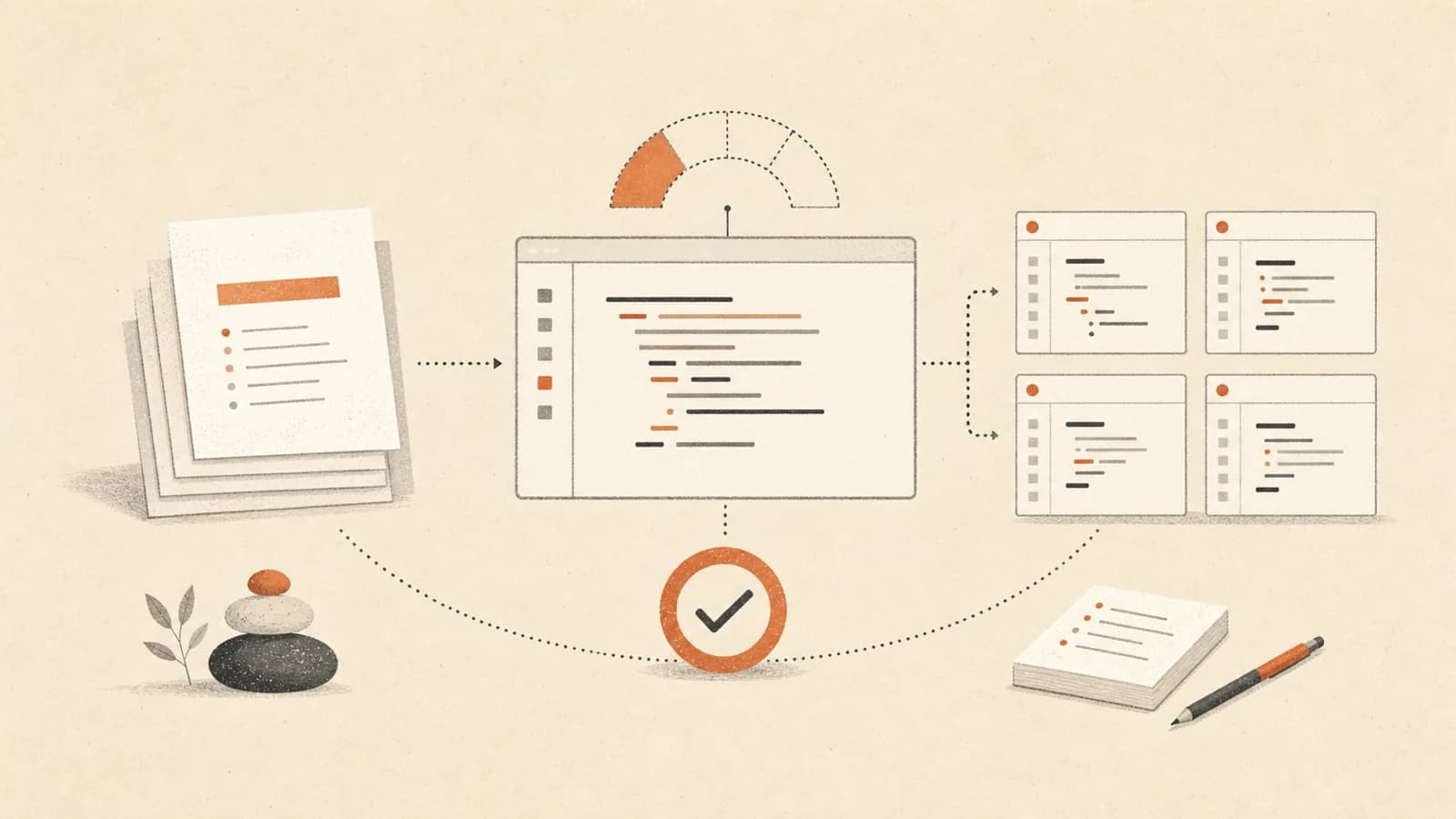
Anthropic's official guide to effective Claude Code usage, organized around a single core constraint: the context window fills up fast and performance degrades as it fills. All best practices flow from managing this scarce resource — through verification-driven development, structured context (CLAUDE.md), aggressive session management, and horizontal scaling via parallel sessions.
Details#
Context Window as Primary Constraint#
The context window holds the entire conversation: messages, file reads, command outputs. A single debugging session can consume tens of thousands of tokens. As context fills, Claude "forgets" earlier instructions and makes more mistakes. Every best practice is ultimately about managing this resource. See Context Window Smart Zone for the underlying mechanism (quadratic attention scaling, ~100K-token smart-zone marker).
Model-level amplifiers (introduced with Claude Opus 4.7, still current under Claude Opus 4.8): the updated tokenizer maps the same input to 1.0–1.35× more tokens, and Opus 4.7 "thinks more at higher effort levels" — especially on later turns in agentic settings. Claude Code's default effort has been raised to xhigh. These compound: a session that fit on 4.6 at high may be meaningfully tighter on 4.7 at xhigh. Measure on real traffic before trusting intuition carried over from 4.6. Counter-levers: lower effort, task budgets (API), explicit conciseness prompting, or brevity-style output caps (see Scale-Dependent Prompt Sensitivity).
Verification-Driven Development#
The single highest-leverage practice: give Claude a way to verify its own work. Provide tests, screenshots, expected outputs, or linter commands. Without verification, Claude produces plausible-looking but broken code and the human becomes the only feedback loop.
Key patterns:
- Provide concrete test cases with inputs and expected outputs
- For UI changes, paste screenshots and ask Claude to compare its result
- Address root causes by providing error messages, not just "the build is failing"
- Use the Claude in Chrome extension for automated UI testing
Explore → Plan → Code Workflow#
Separate research from implementation. Use Plan Mode for multi-file changes or unfamiliar code. Skip planning when the scope is clear and the diff can be described in one sentence.
A more aggressive variant: Design Concept Grilling (Matt Pocock's grill-me skill) replaces "ask the agent for a plan" with "let the agent interview you until you reach shared understanding before any plan exists." See also Vertical Slice Tracer Bullets for slicing the resulting PRD into agent-grabbable Kanban tickets, and Deep Modules for Agents for keeping the codebase shape agent-friendly.
Environment Configuration#
- CLAUDE.md: persistent instructions loaded every session. Include only what Claude can't infer from code — bash commands, non-default code style, workflow rules, architectural decisions, gotchas. Prune ruthlessly: if Claude already does something correctly without the instruction, delete it. Per-line pruning is necessary but not sufficient, and the missing constraint is now measured: Instruction Compounding records a capacity floor from Prompt Design at Scale: How Format, Instruction Count, and Context Length Shape Instruction Adherence and Hallucination in Large Language Models (
empirical, five models) where all-rules compliance is in steep decline by 40 simultaneous verifiable instructions and at zero by 80, identical across markdown / plain / prose / table rendering. Every rule in that experiment is distinct and individually satisfiable, so no per-line ablation would have caught it. Two corollaries for a CLAUDE.md: the binding unit is instruction count, not tokens, and format is not the lever — placement is the bigger one (moving an identical block between system prompt and user turn moved adherence by up to 8.7pp), with a sign that differs per model and must be tested rather than assumed. Treat like code — review when things go wrong, test by observing behavior changes. Use@pathimports for modularity. For founders / solo builders, the stricter discipline of starting each session with the CLAUDE.md as architectural context and ending each session by updating it is the primary defense against Agentic Technical Debt — debt that compounds (not just accumulates) because each session re-derives foundational decisions when context isn't persisted. - Skills (
.claude/skills/): domain knowledge and reusable workflows loaded on demand, not every session. Invoke with/skill-name. - Subagents (
.claude/agents/): specialized assistants running in isolated context with scoped tools. Useful for tasks that read many files without cluttering main context. - Hooks: deterministic scripts that run at specific points in Claude's workflow. Unlike CLAUDE.md (advisory), hooks guarantee execution.
- MCP servers: connect external tools (Notion, Figma, databases) via
claude mcp add. - Plugins: bundled skills + hooks + subagents + MCP from a marketplace.
- Permissions: auto mode (classifier-based approval, middle ground between default-prompt and
--dangerously-skip-permissions), allowlists, or OS-level sandboxing.
Session Management#
/clearbetween unrelated tasks — prevents context pollution/compact <instructions>— targeted summarization preserving specified context/rewindorEsc+Esc— restore conversation, code, or both to any checkpoint- Subagents for investigation — explore in separate context, report back summaries
/btw— side questions that never enter conversation history- After two failed corrections on the same issue,
/clearand rewrite the prompt incorporating what you learned
Scaling Patterns#
- Non-interactive mode:
claude -p "prompt"for CI, scripts, pre-commit hooks. Supports JSON and streaming output. - Parallel sessions: desktop app (isolated worktrees), web (isolated VMs), or agent teams (coordinated sessions with shared tasks).
- Writer/Reviewer pattern: one session implements, another reviews with fresh context (no bias toward own code).
- Fan-out: loop
claude -pacross files for large migrations. Use--allowedToolsto scope permissions. - Auto mode for unattended runs: classifier blocks risky actions, allows routine work. Aborts on repeated blocks in non-interactive mode.
- Loops and routines:
/loop(cron-scheduled repeat job, in-CLI) and routines (server-side variant). Drain a Kanban backlog AFK; primary mechanism for amortizing planning over many executions. See Agent Loop Pattern.
Parallel Ecosystems and Cross-Tool Concept Mapping#
Claude Code is one of several converging coding-agent ecosystems. Capability parallels with Hermes Agent (Nous Research) and Codex (OpenAI):
| Capability | Claude Code | Hermes | Codex |
|---|---|---|---|
| Project context file | CLAUDE.md | AGENTS.md (project) + SOUL.md (personality, separate) | AGENTS.md |
| Session compaction | /compact <instructions> | /compress | (via Codex App Server thread compaction) |
| Mid-session model switch | /model | /model | session-level config |
| Parallel subagents | Subagents in .claude/agents/ | delegate_task | Spawned via Symphony orchestrator |
| Non-interactive / programmatic | claude -p, Claude Agent SDK | hermes CLI in scripts | Codex App Server (JSON-RPC stdio) |
| Multi-user team deployment | per-session claude -p | Hermes Gateway (Telegram/Discord/Slack/WhatsApp) with allowlist or DM pairing | Symphony (issue-tracker-driven daemon) |
| Permission gating | auto mode classifier | per-pattern approvals (once/session/always/deny); skipped under container backend | implementation-defined per Symphony spec |
| Memory model | conversation + CLAUDE.md | bounded MEMORY.md (~2,200 chars) + USER.md (~1,375 chars) | filesystem-driven |
The shared structural insight across all three: agent behavior is configured via repo-versioned markdown files (CLAUDE.md / AGENTS.md / SOUL.md / WORKFLOW.md). This pattern is consistent enough across vendors to look like an emerging standard. (A dedicated Agent Context Files concept page is planned to formalize this.)
The most architectural divergence: Claude Code is session-first with optional non-interactive mode; Hermes Gateway and Symphony are daemon-first when deployed at team scale. The session-vs-daemon split is the dominant deployment-architecture choice in 2026.
Common Failure Patterns#
| Pattern | Fix |
|---|---|
| Kitchen sink session (mixed unrelated tasks) | /clear between tasks |
| Repeated corrections (>2 failed fixes) | /clear, rewrite prompt with lessons learned |
| Over-specified CLAUDE.md | Prune; convert to hooks if deterministic |
| Trust-then-verify gap | Always provide verification criteria |
| Infinite exploration | Scope narrowly or use subagents |
Connections#
- Agent Harness Engineering — Claude Code's CLAUDE.md, skills, and hooks are a practical implementation of the harness engineering patterns described by OpenAI and Anthropic's research teams
- LLM-as-Compiler Knowledge Base — CLAUDE.md files serve as the schema layer in this vault's LLM-as-compiler architecture
- LLM-Driven Vulnerability Research — Claude Code is the runtime for Anthropic's vulnerability research scaffold; all Mythos Preview findings used Claude Code's agentic capabilities
- Client-Side Agent Optimization — directly challenges the "use the strongest model" default: combinations where Claude Opus 4.6 is paired with a cheaper planner beat all-Opus by >40pp on HotpotQA. AgentOpt's httpx interception is compatible with
claude -pnon-interactive mode - Scale-Dependent Prompt Sensitivity — complements context-window management: brevity constraints both raise accuracy on overthinking-prone problems and preserve context budget. Verification-driven development is especially important when large-model verbosity can mask reasoning errors
- Claude Code Auto Mode — the full write-up of the "auto mode" permission option mentioned in Environment Configuration and Scaling Patterns
- Claude Opus 4.7 — introduced the literal instruction following and tokenizer inflation that reshape how CLAUDE.md and session management should be written
- Claude Opus 4.8 — the model most Claude Code work now targets (general access since 2026-05-28); a direct 4.7 upgrade, so the context-budget guidance above carries over unchanged. One caveat for the Environment Configuration section: 4.8 is less robust to prompt injection than 4.7, which raises the value of narrow tool permissions
- Hermes Agent — parallel ecosystem from Nous Research; many Claude Code patterns map directly (
/compress↔/compact,delegate_task↔ subagents,AGENTS.md↔CLAUDE.md); the differences (Gateway daemon, bounded memory files,SOUL.mdsplit) highlight design choices each made - Codex App Server Protocol — the OpenAI-side analog to
claude -p+ Claude Agent SDK; both let an external orchestrator drive sessions, but App Server is more explicit about a stable JSON-RPC stdio protocol - Symphony — the daemon-first deployment archetype; a Claude-Code analog would wire
claude -pplus subagents into an issue tracker the same way Symphony wires Codex to Linear - Ticket-Driven Agent Orchestration — the orchestration pattern that becomes natural once non-interactive mode is solid; bridges single-session best practices into team-scale deployment
- Context Window Smart Zone — the underlying constraint that motivates every context-management practice in this article
- Design Concept Grilling — more aggressive alignment-first variant of explore→plan→code
- Vertical Slice Tracer Bullets — task decomposition pattern that fills the Kanban backlog drained by the loop primitive
- Deep Modules for Agents — codebase shape that makes Claude Code's review and verification patterns reliable; push-vs-pull instruction delivery
- Agent Loop Pattern —
/loopand routines as the next-generation primitive replacing per-step prompting - Harness Shrinkage as Models Improve — why best-practice prompts and CLAUDE.md sections shrink with each model release; Cat Wu's discipline of pruning at every launch
- Claude Code — the entity-level page
- AI Native Product Cadence — these best-practice artifacts are the public output of a team operating at that internal cadence
- Engineer PM Convergence — the engineer-with-product-taste persona this guide implicitly targets
- Agentic Technical Debt — the failure mode CLAUDE.md primarily defends against; specifically named in the founder's playbook
- AI-Native Startup Lifecycle — the founder-stage framing that elevates CLAUDE.md from "best practice" to "MVP survival discipline"
- MCP and Computer Use — the connector substrate behind the "extend Claude Code with custom tools" scaling pattern; MCP and computer use are how external systems become part of the agent's action surface
- Evals as Product Spec — the strict form of "verification-driven development": ten great evals encode what done looks like at the feature level, complementing the workflow-level verification this article prescribes
Derived#
- When to Use Claude Opus 4.6 for Work — context-window-as-primary-constraint framing informs the Claude Code corollary: Opus verbosity consumes budget faster
- Opus 4.6 → 4.7 Changes and Multi-Agent Coding Considerations — subagents, Writer/Reviewer, and scaling-pattern guidance applied to Opus 4.7 multi-agent teams
- Learning to Co-Work with AI: A Software Engineer's Field Guide — best-practices distilled into a per-engineer skill-development field guide (six skill clusters, daily practices, anti-patterns, 90-day plan)
- App Server vs MCP, and the Claude-Side Equivalent: Three Boundaries for Driving Agents — situates
claude -p+ Agent SDK as the Claude-side bracket around Codex's App Server, with the drive-the-CLI vs build-on-SDK decision rule - Writer/Reviewer vs Agent-to-Agent Review — decomposes the Writer/Reviewer scaling pattern into four design variables and corrects its stated rationale: the own-code bias is a property of the model family, not of the session, so fresh context does not remove it (8.9pp of high-severity recall rides on cross-family routing instead)
Open Questions#
- Does the instruction-count ceiling hold for conditional policy, where only a handful of rules bear on any given turn? Every rule in Eliav's experiment applies to one generation simultaneously; a CLAUDE.md is mostly situational ("when editing migrations, …"), so N=80 is a floor on the harshest possible loading and says nothing about a 200-rule file of which five fire per turn. Falsifiable directly: hold the applicable subset fixed and grow the inapplicable remainder.
- How does the Writer/Reviewer pattern compare to agent-to-agent review (as in OpenAI's Codex workflow)? Partially answered (2026-09-02) by Writer/Reviewer vs Agent-to-Agent Review: the two are one architecture differing on venue, so the comparison decomposes into four variables, and the synthesis settles one of them. Reviewer lineage is the axis with a number — Greptile's paired 500-PR datasets put cross-model recall at 61.0% against same-model 52.1% on high-severity bugs, a clean crossover (dataset main effect 2.6pp, reviewer main effect 0.6pp) that the source's own compositional mechanism reproduces only ~7% of. That falsifies the parenthetical in this page's Scaling Patterns entry: the own-code bias is a property of the model family, not of the session, so "fresh context" does not buy "no bias toward own code" — route the reviewer to a different family for that. The information-boundary axis has the better design argument (Bun's diff-only reviewer, OpenCodeReview's falsification-only reflector, Cursor's unreported lens sweep) and no code-review measurement; gate position has one block rate (Ouroboros, 63.5%) and no outcome measurement; and outcomes are split across two constructs an order of magnitude apart (7.23–37.80% reference-match precision on AACR-Bench vs 71.4% developer resolution of 54,713 real agent review comments). What remains needs external evidence: nothing measures the two patterns head to head, the nearest thing compares three products against a baseline pinned 33 releases stale, and the venue itself (in-session second opinion vs PR-posted comment thread) is unmeasured in either direction. The settling experiment is specified on the derived page: information boundary × lineage × gate position on AACR-Bench, comment-volume instruction pre-registered and held fixed, both outcome constructs reported on the same comments.
- When does subagent overhead exceed the benefit of context isolation? Partially answered 2026-08-03 by Codex from 0 to 10M Users: Building ChatGPT Work - Akshay Nathan, OpenAI (
practitioner-opinion, no measurement) — a task-shape criterion rather than a crossover point. Akshay Nathan (OpenAI): multi-agent modes "are best for when you have tasks that are either incredibly complicated, like open explorations, or very paralyzable… but for most tasks, they don't fall into either of those buckets," so the default should be a single agent. Note the overheads he actually names are neither context nor tokens: rate-limit consumption (Ultra "can use more of your limits," which is why OpenAI moved it behind advanced settings post-launch) and human legibility (sub-agent transcripts hidden by default to avoid overwhelming users — see Shared Harness, Differentiated Surfaces). A practitioner counter-practice in the same episode pulls the other way: Vibhu reports telling every long-running task to "use sub-agents where possible" for wall-clock and for cost, fanning out to cheaper models — which Cost-per-Task Over Cost-per-Token argues is the wrong default. Second instance (2026-08-04): Willison runs the same practice with the tier choice itself delegated — "for all coding tasks use your judgement to decide an appropriate lower power model and run that in a subagent" — and reports only that his Fable allowance shrinks more slowly. Two practitioners now default to the fan-out; neither measures it. What remains open is the measured crossover, which no source in the corpus supplies.
Resolved Questions#
- What's the optimal CLAUDE.md length before instructions start getting lost? Is there a measurable threshold? Answered 2026-08-04 by Prompt Design at Scale: How Format, Instruction Count, and Context Length Shape Instruction Adherence and Hallucination in Large Language Models (Eliav, arXiv 2607.19257,
empirical) — full treatment at Instruction Compounding. Yes, there is a threshold, and it is count-shaped rather than length-shaped: across five models (including Claude Sonnet 5 and Haiku 4.5), the rate at which every instruction in the prompt is obeyed falls steeply by N≈40 simultaneous verifiable rules and hits zero by N≈80, holding through N=160 and identical across markdown, plain text, prose, and table renderings and across system-prompt vs. user-turn placement. The paper's own prescription is the answer in usable form: 40 simultaneous instructions is a redesign point, not a tuning point — past it, splitting across turns, tools, or a validation pass is the only thing that works, and reformatting is not. This also settles the residual the 2026-08-03 retag left behind (does aggregate size have an independent effect once each line passes ablation?): yes — every rule tested was distinct, non-redundant, and individually satisfiable, so per-line ablation non-inferiority would have cleared all of them and still missed the collapse. Two scope limits carried on the answer: "perfect response" is a strict conjunction, so some of the floor is the arithmetic of ANDing N checks rather than the model dropping the block, and every rule tested is a hard output constraint applied to a single generation. The conditional-policy case a real CLAUDE.md actually presents is now the successor question in Open Questions above.
Sources#
- Best Practices for Claude Code
- Auto mode for Claude Code — permission-mode expansion
- Introducing Claude Opus 4.7 — tokenizer/xhigh-default context-budget implications
- Prompt Design at Scale: How Format, Instruction Count, and Context Length Shape Instruction Adherence and Hallucination in Large Language Models — Netanel Eliav, arXiv 2607.19257, 2026-07-21 (
empirical, sole author, single lab, not peer reviewed): the instruction-count ceiling that answers the CLAUDE.md-length question, plus the placement lever. Parse warning: the paper's Table 1 model roster is cell-collapsed in the raw markdown and is not cited anywhere; see the Sources note on Instruction Compounding - Fable's judgement — Simon Willison, 2026-07-03 (
practitioner-opinion): the delegate-coding-to-a-self-chosen-cheaper-subagent practice, cited only against the subagent-overhead question above
Cited by 46
- Learning to Co-Work with AI: A Software Engineer's Field Guide×5
Build a CLAUDE.md / AGENTS.md for every project you own. Treat it like code: review when things go…
- Claude Code Auto Mode×4
Compared to OS-level sandboxing (mentioned in Claude Code Best Practices alongside auto mode),…
- Where Does Agent Harness Work Remain Durable as Models Improve?×3
Across Agent Harness Engineering, Claude Code Best Practices, and Hermes Agent, the stable work is:
- Open Questions Backlog×3
Claude Code Best Practices (37d) — Does the instruction-count ceiling hold for conditional policy,…
- Opus 4.6 → 4.7 Changes and Multi-Agent Coding Considerations×3
Claude Code Best Practices#Context Window as Primary Constraint applies to each agent in isolation.…
- Writer/Reviewer vs Agent-to-Agent Review×3
Codex, Claude Code, Claude Opus 4 7, Claude Code Best Practices — the two products' review surfaces…
- AI-Native Startup Lifecycle×2
vs. Claude Code Best Practices: the playbook recommends starting each Claude Code session with the…
- Opinions on Using AI Tools & the Future of the Software Engineering Role×2
This matches the official tooling guidance: Claude Code Best Practices and Agent Harness…
- App Server vs MCP, and the Claude-Side Equivalent: Three Boundaries for Driving Agents×2
The vault documents no Claude-side equivalent of the App Server protocol. The comparison the corpus…
- Claude Opus 4.7×2
Anthropic claims the net is favorable on their internal coding eval across effort levels, but…
- Code as Source of Truth×2
Checking the spec into the codebase isn't just freshness hygiene — it's what makes mechanical…
- Instruction Compounding×2
So the pruning obligation this page establishes is necessary but not sufficient: a context file…
- LLM-as-Compiler Knowledge Base×2
The schema layer (Karpathy's term) is the same artifact category as SPEC.md/WORKFLOW.md —…
- MCP and Computer Use×2
Hermes Agent — third-party agent product that consumes MCP (mentioned in cross-tool capability…
- Symphony×2
Symphony vs. Claude Code agents: parallel ecosystems. Symphony is daemon-first (always-on,…
- Ticket-Driven Agent Orchestration×2
Claude Code Best Practices — Claude Code's claude -p non-interactive mode is the building block for…
- When to Use Claude Opus 4.6 for Work×2
Claude Code Best Practices — context-window constraint, verification discipline, session management
- Agent Context Files
Claude Code Best Practices — the CLAUDE.md convention and the prune-ruthlessly discipline; the…
- Agent Control Plane Patterns: Tickets, Loops, Specs, and Memory Files
Layered agent control-plane synthesis: tickets as durable work graph, loops as execution primitive, specs/context files…
- Agent Harness Engineering
Claude Code Best Practices — practical application of many harness engineering principles in Claude…
- Agent Loop Pattern
Claude Code Best Practices — the best-practices guide treats /loop as a core workflow primitive
- Agentic Technical Debt
Claude Code Best Practices — official Anthropic guidance on CLAUDE.md; the playbook frames the same…
- AI Native Product Cadence
Claude Code Best Practices — the public artifacts of a team operating at this cadence
- Blast Radius (Agentic)
Claude Code Best Practices — sandboxed execution + write-access restrictions as a reference…
- Classifier Gates vs OS Sandboxing: The Defense-in-Depth Story for Auto Mode and Cowork
Unattended operation. AFK loops and fan-out are auto mode's raison d'être, and the human who would…
- Claude Code
Anthropic's agentic coding product; created by Boris Cherny late 2024; TypeScript/React on Bun (itself Claude-rewritten…
- Claude Sonnet 5
Sonnet 5 uses an updated tokenizer — the same kind of change Opus 4.7 introduced — so the same…
- Client-Side Agent Optimization
Claude Code Best Practices — directly challenges the implicit "use the strongest model" default.…
- Codex App Server Protocol
Claude Code Best Practices — Claude's claude -p non-interactive mode plus the Claude Agent SDK are…
- Cost-per-Task Over Cost-per-Token
Claude Code Best Practices — where this guidance is applied per session (effort defaults, context…
- Deep Modules for Agents
Claude Code Best Practices — module map in CLAUDE.md sits in the same family
- Design Concept Grilling
Claude Code Best Practices — the explore→plan→code workflow has the same shape; grill-me is the…
- Engineer PM Convergence
Claude Code Best Practices — engineer-with-taste is the user persona Claude Code targets
- Evals as Product Spec
Claude Code Best Practices — verification-driven development; evals as the strict version
- Hermes Agent
Claude Code Best Practices — Hermes is the closest parallel ecosystem; many concepts map directly…
- Least Agency
Claude Code Best Practices — Claude Code's deny-by-default permissions and write-access…
- LLM-Driven Vulnerability Research
Claude Code Best Practices — Claude Code is the runtime used for all vulnerability research; the…
- Agent Systems & Harness Engineering
Claude Code Best Practices (hub) — Anthropic's guide to effective Claude Code usage: context…
- Orchestration vs Employee Framing: Reconciling the Founder's Playbook with HBR's Accountability Evidence
Bounded parallelism (Cat Wu's "simple setups work better"; Claude Code Best Practices explicitly…
- Scale-Dependent Prompt Sensitivity
Claude Code Best Practices — the context-window-as-primary-constraint framing pairs naturally with…
- Shared Harness, Differentiated Surfaces
Claude Code Best Practices — the configure-don't-abstract pole on sub-agents (.claude/agents/…
- The Verifiability Thesis
RL training rewards verified outcomes, so the gradient flows hardest toward domains where…
- Vertical Slice Tracer Bullets
Claude Code Best Practices — the task-decomposition pattern that fills the Kanban backlog the loop…
- Vibe Coding vs. Agentic Engineering
Claude Code Best Practices — concrete agentic-engineering practice (explore→plan→code,…
- Xiaohongshu
The company also names two internal agent surfaces in the paper: context-gc (interactive chat…
- Zero Trust for AI Agents
Claude Code Best Practices — Claude Code's deny-by-default permissions, sandboxing, managed…
Related articles
- Agent Harness Engineering
Patterns for scaffolding long-running LLM agents: environment design, progressive context disclosure, mechanical archit…
- Harness Shrinkage as Models Improve
Prompt scaffolding shrinks each model release; Cat Wu's pruning discipline; Boris Cherny "100 lines of code a year from…
- Client-Side Agent Optimization
AgentOpt's framing of developer-controlled agent optimization (model-per-role, budget, routing) as distinct from server…
- Claude Code
Anthropic's agentic coding product; created by Boris Cherny late 2024; TypeScript/React on Bun (itself Claude-rewritten…
- Open Questions Backlog
Generated by `_system/lint.py --write-backlog`. Do not hand-edit. Domain and Watching sections carry one row per page —…