Sources#
- An open-source spec for Codex orchestration: Symphony.
- Codex App Server
- MCP Specification Changelog — 2026-07-28
Summary#
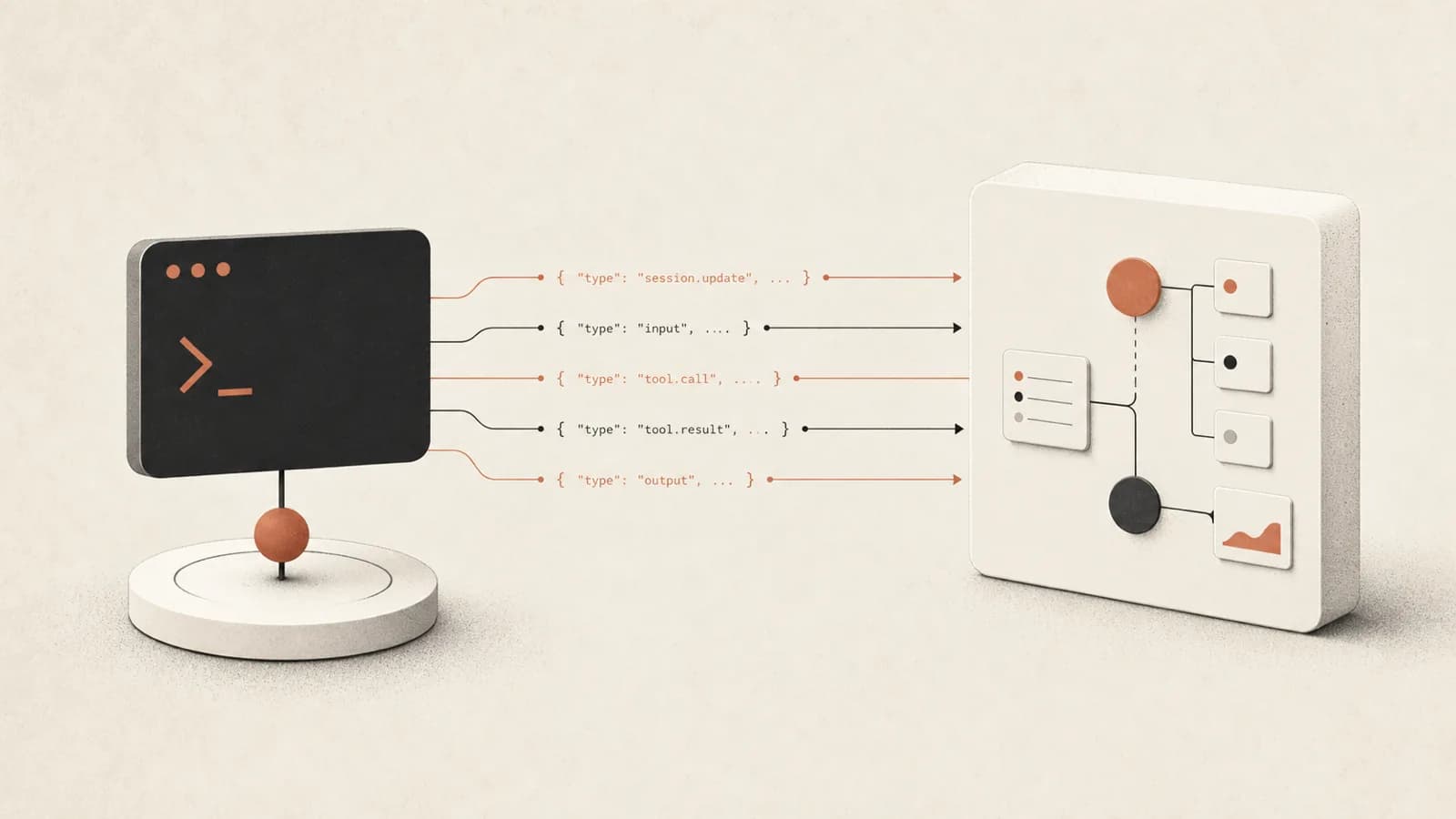
A line-delimited JSON-RPC-like protocol over stdio that lets external orchestrators drive a Codex coding-agent session programmatically. Documented at developers.openai.com/codex/app-server and exercised in detail by Symphony's SPEC.md. The orchestrator launches codex app-server (default command), exchanges a startup handshake, then streams turn events until the turn terminates. The same thread_id is reused across multiple turn/start requests for continuation, and dynamic tool calls allow the orchestrator to inject custom tools (e.g., linear_graphql) without exposing credentials to subagent containers.
Details#
Why a Protocol Instead of a CLI#
Symphony flagged the limitation directly: trying to drive Codex via CLI or tmux sessions doesn't scale to programmatic orchestration. The App Server is "a built-in headless mode for Codex" with a JSON-RPC API for things like starting a thread or reacting to turns. The orchestrator gets:
- Programmatic control over thread lifecycle without scraping terminal output.
- Hooks to inject custom tool implementations (dynamic tool calls).
- Structured events to drive observability, retry logic, and stall detection.
Launch Contract#
Subprocess launch parameters from Symphony's spec:
- Command:
codex.command(default:codex app-server) - Invocation:
bash -lc <command> - Working directory: per-issue workspace path (validated as a safety invariant —
cwd == workspace_pathbefore launch) - Stdout/stderr: separate streams. Only stdout is the protocol stream. Stderr is diagnostic-only — never parse it as JSON.
- Framing: line-delimited JSON, one message per line.
- Recommended max line size: 10 MB.
Startup Handshake#
Required message order, paraphrased from Symphony's illustrative transcript:
{"id":1,"method":"initialize","params":{"clientInfo":{"name":"symphony","version":"1.0"},"capabilities":{}}}
{"method":"initialized","params":{}}
{"id":2,"method":"thread/start","params":{"approvalPolicy":"...","sandbox":"...","cwd":"/abs/workspace"}}
{"id":3,"method":"turn/start","params":{"threadId":"<thread-id>","input":[{"type":"text","text":"<rendered prompt>"}],"cwd":"/abs/workspace","title":"ABC-123: Example","approvalPolicy":"...","sandboxPolicy":{"type":"..."}}}
Notes:
initializerequest —clientInfoandcapabilities. If the targeted Codex version requires capability negotiation for dynamic tools, declare it here.initializednotification — sent afterinitializeresponse.thread/start— establishes thread context including approval policy, sandbox mode, and cwd. Optional client-side tool specs (e.g.,linear_graphql) advertised here.turn/start— first turn carries the rendered prompt; subsequent continuation turns send only continuation guidance.
Session identifier composition:
thread_idfromthread/startresult (result.thread.id)turn_idfrom eachturn/startresult (result.turn.id)- Emitted
session_id=<thread_id>-<turn_id>
Continuation Turns (Reuse the Thread)#
A non-obvious but important property: continuation turns reuse the same thread_id with new turn/start requests on the same live subprocess. The first turn sends the full rendered task prompt; later turns send only continuation guidance, since the original prompt is already in thread history.
Symphony's worker logic:
- After each successful turn, re-check tracker state.
- If issue still active, issue another
turn/starton samethreadId, up toagent.max_turns(default 20). - Subprocess remains alive across continuation turns — only stopped when the worker run ends.
This is the primitive that makes ticket-driven multi-turn work practical: the agent maintains conversational state across what looks externally like discrete continuations.
Streaming Turn Events#
Termination conditions for a single turn:
| Condition | Outcome |
|---|---|
turn/completed | success |
turn/failed | failure |
turn/cancelled | failure |
Turn timeout (turn_timeout_ms, default 1h) | failure |
| Subprocess exit | failure |
Important emitted events Symphony's spec enumerates:
session_started, startup_failed, turn_completed, turn_failed, turn_cancelled, turn_ended_with_error, turn_input_required, approval_auto_approved, unsupported_tool_call, notification, other_message, malformed.
Three Independent Timeouts#
| Timeout | Default | Scope |
|---|---|---|
read_timeout_ms | 5 s | Request/response during startup and sync requests |
turn_timeout_ms | 1 h | Total turn-stream duration |
stall_timeout_ms | 5 m | Inactivity between events (orchestrator-enforced) |
Set stall_timeout_ms <= 0 to disable stall detection.
Approvals, Sandboxes, User Input#
Implementation-defined posture, but the spec mandates that approval requests and user-input-required events must not leave a run stalled indefinitely. An implementation chooses one of:
- Auto-approve (high-trust mode, e.g., command exec and file-change approvals auto-approved for the session).
- Surface to operator (interactive flow).
- Auto-resolve by policy.
- Hard-fail the run (Symphony reference does this for user-input-required turns).
Treating user-input-required as a hard failure is appropriate for unattended orchestration — there's no human in the loop to satisfy the request.
Dynamic Tool Calls (the Most Underrated Feature)#
Experimental feature — and, per the vendor reference below (2026-09-07), still one: dynamicTools on thread/start requires capabilities.experimentalApi = true. The agent can request item/tool/call for tools the orchestrator advertises during thread/start. If the tool isn't recognized, return a tool-failure response — the session continues rather than stalling.
The leverage: orchestrator-implemented tools can wrap credentials the subagent should never see.
Symphony's linear_graphql tool is the canonical example:
- Subagent containers don't get the Linear access token.
- Instead, the orchestrator advertises a
linear_graphqltool that proxies authenticated GraphQL queries. - Subagent calls the tool with
{ "query": "...", "variables": {...} }; orchestrator executes against the Linear endpoint using its own auth.
Contract for linear_graphql:
- Single non-empty GraphQL operation per call (multiple operations rejected).
- Optional
variablesobject. - Result semantics:
- Transport success + no GraphQL
errors→success=true - Top-level GraphQL
errors→success=false, but preserve response body - Invalid input / missing auth / transport failure →
success=falsewith error payload
This is architecturally parallel to MCP but lives inside the coding-agent's runtime rather than a separate process — orchestrator decides what tools to inject per session.
The two protocols diverged on statefulness (2026-07-28)#
The tool-plane / session-plane split that App Server vs MCP, and the Claude-Side Equivalent: Three Boundaries for Driving Agents argued from
observed division of labor is now MCP's own explicit position. Revision 2026-07-28
(MCP Specification Changelog — 2026-07-28, vendor-claim; ledger on MCP and Computer Use) removed
protocol-level sessions and the Mcp-Session-Id header from Streamable HTTP, deleted the
initialize / notifications/initialized handshake outright in favor of per-request version
negotiation in _meta, and pushed cross-call state out to server-minted handles passed as ordinary
tool arguments.
Every one of those is a thing the App Server keeps and builds on: the initialize/initialized
handshake, the thread_id reused across turn/start calls, the <thread_id>-<turn_id> session
identifier, and the streamed turn lifecycle. So the comparison sharpens rather than shifts — MCP
walked away from session semantics while the App Server's whole subject matter is session
semantics. Two smaller convergences are worth noting in the other direction: MCP's new MRTR
pattern (a server returns InputRequiredResult and the client retries with inputResponses) is
structurally the same shape as this protocol's turn_input_required event, and MCP's
UnsupportedProtocolVersionError on per-request version mismatch is a stricter answer to the same
problem Symphony's Compatibility Profile below solves by tolerating field-name drift.
Compatibility Profile#
Symphony's spec is unusually explicit about version tolerance:
"The normative contract is message ordering, required behaviors, and the logical fields that must be extracted. Exact JSON field names may vary slightly across compatible app-server versions. Implementations should tolerate equivalent payload shapes when they carry the same logical meaning."
Practical implication: don't bind tightly to specific JSON field names. Implementors are encouraged to inspect the installed Codex schema via codex app-server generate-json-schema --out <dir> and treat Codex-owned config (approval_policy, thread_sandbox, turn_sandbox_policy) as pass-through values.
What the vendor reference settles (snapshot 2026-09-07)#
Everything above was compiled from Symphony's spec, which reads the protocol from the client side. Codex App Server (vendor-claim; OpenAI's rolling reference, snapshotted 2026-09-07 — the developers.openai.com/codex/app-server URL now 308-redirects to learn.chatgpt.com/docs/app-server) is the server side, and it settles the three questions this page opened in April:
- Versioning is per-binary, and there is no registry. "You can generate a TypeScript schema or a JSON Schema bundle from the CLI. Each output is specific to the Codex version you ran, so the generated artifacts match that version exactly" (
generate-ts,generate-json-schema). No protocol-version field, no published schema package; the open-source implementation inopenai/codex(codex-rs/app-server) is the reference. Symphony's Compatibility Profile — tolerate equivalent payload shapes, dump the installed schema — is therefore not a workaround but the intended contract, and the contrast with MCP's per-request_metaversion negotiation above is a design difference, not a documentation gap. - "Experimental" is a capability gate, not a caveat.
capabilities.experimentalApi = trueininitializeopts a client into every experimental method and field; without it the server rejects them with<descriptor> requires experimentalApi capability.dynamicToolsonthread/startis one such field, and the same gate coversprocess/*,thread/turns/list,thread/items/list, background-terminal control,environment/info, collaboration modes,tool/requestUserInputand theparentThreadId/ancestorThreadIdthread filters. Two facts matter for Symphony's credential-proxy model: dynamic tools are persisted in the thread rollout metadata and restored onthread/resumeunless the client supplies new ones, and their invocations surface as a standarddynamicToolCallitem ({id, tool, arguments, status, contentItems?, success?, durationMs?}) — the item is on the stable surface while the declaration is behind the gate. No roadmap or graduation date is published;experimentalFeature/listexposes feature flags "with lifecycle stage metadata," the only machine-readable stability signal. - Turns are multimodal.
turn/startinput items aretext,image({url}) andlocalImage({path});userMessageitems carry the same three;model/listreportsinputModalitiesper model (missing → assume["text", "image"]); animageViewitem is emitted when the agent invokes its own image viewer. The "text-focused" reading came from Symphony's spec, whose orchestrator never sends an image.
Also surfaced, beyond the questions: transports beyond stdio (WebSocket, "experimental and unsupported"; a Unix socket via the HTTP Upgrade handshake; off); turn/start with toolOutput and an empty input, which feeds a client-run tool's result into the thread as a functionCallOutput item; an MCP server marked required that fails to initialize now fails thread/start/thread/resume rather than continuing without it; and resuming with a different model than the rollout recorded emits a warning and a one-time model-switch instruction on the next turn.
Recommended Error Categories#
For normalization across implementations:
codex_not_found, invalid_workspace_cwd, response_timeout, turn_timeout, port_exit, response_error, turn_failed, turn_cancelled, turn_input_required.
Token Accounting Subtlety#
Worth flagging because it's easy to get wrong. Agent events may include token counts in multiple shapes:
- Prefer absolute thread totals (e.g.,
thread/tokenUsage/updatedortotal_token_usagewithin token-count wrappers). - Ignore delta-style payloads (e.g.,
last_token_usage) for dashboards, or you'll double-count. - Don't treat generic
usagemaps as cumulative unless the event type defines them that way. - For absolute totals, track deltas relative to last reported totals.
Connections#
- Symphony — the canonical orchestrator built on this protocol; entity page with the lifecycle and operational details
- Ticket-Driven Agent Orchestration — continuation turns are what make multi-turn work-per-ticket practical; one ticket → one thread → many turns
- Agent Harness Engineering — the App Server protocol is the integration boundary that makes "harness as service" possible — orchestrator drives session lifecycle without scraping a CLI
- Claude Code Best Practices — Claude's
claude -pnon-interactive mode plus the Claude Agent SDK are the parallel ecosystem; both let an external orchestrator drive sessions, but Codex's App Server is more explicit about a stable JSON-RPC protocol - Client-Side Agent Optimization —
agent.max_turns,turn_timeout_ms,stall_timeout_ms, and the dynamic-tool-call cost (proxy round-trip vs. direct call) are operational instances of the budget lever AgentOpt formalizes
Open Questions#
- Does
dynamicToolsleave theexperimentalApigate before Symphony-style orchestrators standardize on it for credential proxying? Trigger: the field drops off the experimental list in the app-server reference, orexperimentalFeature/listreports it at a stable lifecycle stage.
Resolved Questions#
-
Is there a public schema registry so external orchestrators can target specific App Server versions without
generate-json-schema? Answered (2026-09-07): no — Codex App Server offers only per-binary schema dumps ("each output is specific to the Codex version you ran, so the generated artifacts match that version exactly"), no protocol-version field and no published package; theopenai/codexsource tree is the reference. Symphony's tolerate-equivalent-shapes profile is the intended client posture, not a stopgap. -
The "dynamic tool calls (experimental)" caveat — what's the stability roadmap? Symphony depends on this for its security model. Answered (2026-09-07): there is no published roadmap; the mechanism is a capability gate.
dynamicToolsonthread/startrequirescapabilities.experimentalApi = true, the same opt-in that coversprocess/*, turn/item listing and background-terminal control; declared tools persist in the rollout and survivethread/resume; invocations surface as the stabledynamicToolCallitem;experimentalFeature/listcarries lifecycle-stage metadata per flag. Graduation timing is now the#oq/waitabove (Codex App Server). -
How well does the protocol handle multi-modal turns (image inputs, screenshot attachments)? The spec is text-focused. Answered (2026-09-07): natively —
turn/startacceptstext,image(URL) andlocalImage(path) input items,userMessageitems carry all three, andmodel/listadvertisesinputModalitiesper model with["text", "image"]as the backward-compatible default (Codex App Server). The text-only impression was Symphony's, whose orchestrator never sends an image. -
How does the App Server protocol compare in detail to MCP? Both expose tools to a model, but App Server is inside the Codex runtime while MCP is outside. When does each win? Answered: App Server vs MCP, and the Claude-Side Equivalent: Three Boundaries for Driving Agents — they sit at different planes and mostly compose rather than compete: MCP is the model↔world tool plane (write once, consume on every surface, provider-operated), App Server is the orchestrator↔runtime session plane (thread lifecycle, turns, events, timeouts, token accounting — none of it in MCP's scope). The only overlap is dynamic tool calls, where the rule is: MCP for reusable cross-surface third-party capabilities; orchestrator-injected tools for session-scoped, credential-sensitive ones (the
linear_graphqltoken-isolation pattern, which also shrinks the poisoned-metadata/rug-pull attack surface to first-party code) — at the cost of experimental stability and zero ecosystem reuse. -
Is there an analogous protocol on the Claude side, or is Claude's equivalent exclusively the Agent SDK + tool-use API? Comparing the two would clarify when "drive an existing CLI" beats "build on the SDK." Answered: App Server vs MCP, and the Claude-Side Equivalent: Three Boundaries for Driving Agents — no documented Claude-side protocol; the offering brackets the App Server's position:
claude -p(drive the product, inherit the full harness — permissions with abort-don't-hang unattended behavior, skills, context files, MCP wiring — but get text, not structured events) and the Agent SDK (build a different product on the raw runtime — Claude Design's weekend prototype). Rule: drive the CLI when the product's harness is the value and orchestration is batch/fan-out shaped; build on the SDK when the agent is a different product with its own surface and tools. Symphony's own tmux→protocol evolution marks the middle layer (structured session control over the product harness) that the Claude side currently approximates from either end — whether it gets standardized or harness shrinkage makes it moot is the watch item.
Derived#
- App Server vs MCP, and the Claude-Side Equivalent: Three Boundaries for Driving Agents — the three-boundary comparison filed from this page's two protocol questions
Sources#
- An open-source spec for Codex orchestration: Symphony. — Section 10 (Agent Runner Protocol) and Section 13.5 (Token Accounting) are the authoritative reference
- Codex App Server — OpenAI, Codex App Server reference (
vendor-claim). Rolling page, snapshotted 2026-09-07,published:blank by design; fetched as the.mdendpoint atlearn.chatgpt.com/docs/app-server, where thedevelopers.openai.com/codex/app-serverURL this page cites now redirects. Used for transports, the per-version schema dumps, theexperimentalApigate and what sits behind it,dynamicToolspersistence and thedynamicToolCallitem,turn/startinput items andinputModalities,toolOutput, and therequired-MCP-server and model-switch behaviours. The full method list (threads, turns, review, process, filesystem, approvals, elicitation) is in the raw and not compiled beyond what the questions needed - MCP Specification Changelog — 2026-07-28 — Model Context Protocol project, Key Changes for spec revision 2026-07-28,
vendor-claim. Major changes 1–3 (sessions andMcp-Session-Idremoved, handshake deleted, per-request_metaversion negotiation,server/discover) and 7–8 (MRTR,resultType), used only for the protocol comparison above
Cited by 13
- App Server vs MCP, and the Claude-Side Equivalent: Three Boundaries for Driving Agents×7
Dynamic tool calls · The capability is session-scoped and credential-sensitive · The linear_graphql…
- The Future of Agent Interfaces×4
Codex App Server Protocol looks MCP-like because it exposes tool calls, but it lives at a different…
- Symphony×4
Symphony uses Codex's headless mode (the App Server) rather than driving the CLI. The full protocol…
- Agent Control Plane Patterns: Tickets, Loops, Specs, and Memory Files×3
The control plane is not just files. It also needs a runtime integration boundary. Codex App Server…
- Agent Harness Engineering×3
Symphony (OpenAI, March 2026) — long-running daemon polling Linear, per-issue workspace, Codex App…
- Codex×3
The headless protocol. The App Server Protocol (JSON-RPC over stdio) drives Codex non-interactively…
- Claude Code Best Practices×2
Non-interactive / programmatic · claude -p, Claude Agent SDK · hermes CLI in scripts · Codex App…
- OpenAI×2
Agent tooling and orchestration. OpenAI ships Codex and the surrounding harness layer: the Codex…
- Client-Side Agent Optimization
Codex App Server Protocol — agent.max_turns, turn/stall timeouts, and dynamic-tool-call cost are…
- MCP and Computer Use
Codex App Server Protocol — the comparable protocol, now diverged on statefulness: the App Server…
- Agent Systems & Harness Engineering
Codex App Server Protocol — JSON-RPC stdio protocol for headless Codex sessions:…
- Open Questions Backlog
Codex App Server Protocol: Does dynamicTools leave the experimentalApi gate before Symphony-style…
- Ticket-Driven Agent Orchestration
Codex App Server Protocol — the runtime protocol Symphony uses for per-ticket sessions;…
Related articles
- Claude Code Best Practices
Anthropic's guide to effective Claude Code usage: context management, verification-driven development, explore→plan→cod…
- Symphony
OpenAI's open-source agent orchestrator (March 2026): turns Linear into a control plane for Codex, per-issue workspace,…
- Agent Harness Engineering
Patterns for scaffolding long-running LLM agents: environment design, progressive context disclosure, mechanical archit…
- Hermes Agent
Nous Research's CLI agent + Gateway daemon (Telegram/Discord/Slack/WhatsApp); AGENTS.md/SOUL.md context split, bounded…
- LLM-as-Compiler Knowledge Base
Karpathy's architecture: LLM incrementally compiles raw docs into a persistent interlinked wiki, replacing RAG with a 4…