Sources#
Summary#
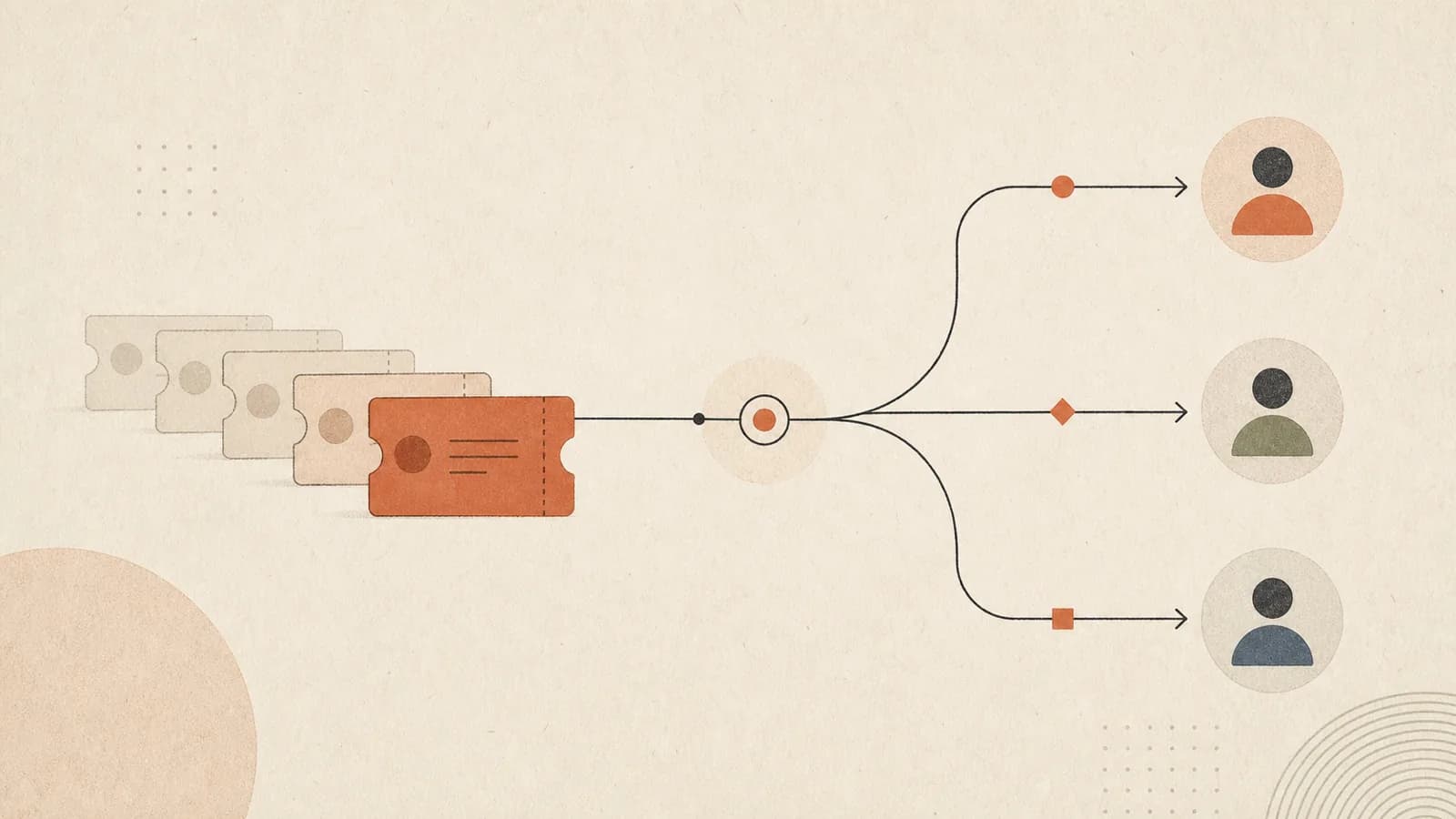
A pattern, codified by OpenAI's Symphony, that inverts the usual unit of agentic work: the issue tracker ticket becomes the unit of work, not the coding session or pull request. Open tickets are the queue; agents are pulled to tickets rather than humans assigning sessions to agents; tickets persist across multiple PRs, restarts, and continuation turns. The pattern decouples agentic execution from both sessions and PRs, making it possible for non-engineers to dispatch work and for a single ticket to span investigations that produce zero, one, or many PRs.
Details#
The Inversion#
Conventional agentic-coding workflows organize around either sessions (Claude Code's chat thread) or PRs (the merged unit). Both are means-to-ends abstractions. The actual organizing principle of software work is the deliverable: issue, ticket, milestone.
Symphony's reframing:
"Software workflows are largely organized around deliverables: issues, tasks, tickets, milestones. So we asked ourselves what would happen if we stopped supervising agents directly and instead let them pull work from our task tracker."
Once tickets are the unit:
- One ticket → many PRs is normal. A "migrate auth to OIDC" ticket might span 3 PRs across 2 repos.
- One ticket → zero PRs is normal. "Investigate why CI is flaky" or "draft an architectural plan" produce notes/proposals, not code changes.
- PRs become artifacts of tickets, not the work itself.
- Agents pull work; humans don't push sessions.
DAG-Style Dependencies#
Tickets carry blocker relationships. Symphony's Issue.blocked_by field is part of the candidate-selection rule:
"If the issue state is
Todo, do not dispatch when any blocker is non-terminal."
Combined with agents' ability to file new tickets, this creates a directed acyclic graph of work that unfolds in dependency order. Concrete example from the post:
"We marked the React upgrade as blocked on a migration to Vite. As expected, agents started upgrading React only after the migration to Vite was complete."
Importantly, the DAG is agent-extensible: during implementation or review, agents that notice adjacent improvements (perf issues, refactoring opportunities, better architectures) file new tickets rather than expanding the current scope. Many of those follow-ups are then picked up by other agents.
Who Files Tickets#
Once execution is decoupled from sessions, anyone can dispatch agentic work without touching a repo:
- Engineers file tickets the same way they file bugs.
- PMs and designers can file feature requests directly into the tracker, without checking out the repo or managing a Codex session. Their deliverable is a "review packet" with a video walkthrough of the working feature.
- The OpenAI post cites an engineer making three significant changes "from the Linear app on his phone from a cozy cabin on shoddy wifi."
The economic effect: the perceived cost of each change drops because human effort is no longer the gating resource. This shifts behavior — speculative tickets, exploratory refactors, and "try this idea" tasks become cheap. Discard cost is also near zero.
"Objectives, Not Transitions"#
A key lesson from Symphony's evolution. Their first version treated agents as rigid nodes in a state machine — Codex was only asked to implement the task in a ticket. This proved too limiting once models got smarter:
"Codex is perfectly capable of creating multiple PRs as well as reading review feedback and addressing it. So we gave it tools —
ghCLI, skills to read CI logs, etc. — and now we can ask Codex to do more, like closing old PRs or pulling reports on completed vs. abandoned work."
The shift: give agents objectives (the ticket title/description) and tools, not strict state-machine transitions. This is a re-statement at the orchestration layer of "enforce invariants, not implementations" — the orchestrator constrains the envelope (per-issue workspace, concurrency caps, terminal-state cleanup) but not the steps an agent takes inside that envelope.
The Workflow.md Prompt-as-Policy Pattern#
In ticket-driven orchestration, workflow policy lives in a versioned markdown file in the repo (Symphony's WORKFLOW.md). It captures the implicit "process humans followed but never documented":
"Work on an issue, check out a repo, put it in progress so the PM knows it's being worked on, add the PR, move it to the Review status, attach videos, etc. — is now captured in a simple
WORKFLOW.mdfile."
When the team decides agents should also attach self-reflection to finished work, they edit WORKFLOW.md; on next render, agents follow the new step. This is workflow as prompt-as-policy — the same pattern that motivates CLAUDE.md, AGENTS.md, and SOUL.md as agent-context files (see Claude Code Best Practices, Hermes Agent).
Effects Beyond Throughput#
Output gains are the most visible effect (Symphony's hedged 500% landed-PRs claim, see Symphony). The deeper effect is on team behavior:
- Cognitive cost of kicking off work drops to ~0, so teams file far more speculative/exploratory tickets.
- Engineers stop context-switching between many in-flight sessions and instead focus on one hard problem at a time.
- Last-mile reliability improves — Symphony watches CI, rebases, resolves conflicts, retries flaky checks, so by the time a ticket reaches
Mergingthe change can land without babysitting. - Documentation gardening becomes a ticket type, not a side-project that nobody owns.
- Routine vs. interesting work separates cleanly — agents handle the bulk of implementation; humans focus on ambiguous, high-judgment work.
Where the Pattern Doesn't Fit#
Honest tradeoffs from the source:
- Loss of mid-flight steering: assigning at the ticket level means no nudging during execution. Failures expose harness gaps and are patched system-wide rather than fixed in the moment.
- Ambiguous problems still need humans: tasks requiring strong judgment, deep expertise, or expert taste are still better handled in interactive sessions.
- Tracker dependency: the orchestrator is now coupled to the tracker's API and uptime. Symphony has no durable DB and relies on tracker + filesystem for restart recovery — when Linear is down, work pauses.
Connections#
- Symphony — the canonical implementation; entity page covering OpenAI's specific orchestrator
- Codex App Server Protocol — the runtime protocol Symphony uses for per-ticket sessions; continuation turns let one ticket span many turns on the same
thread_id - Agent Harness Engineering — ticket-driven orchestration is the natural extension of harness engineering: once the per-session harness works, the next bottleneck is which session runs next. "Objectives, not transitions" is the orchestration-layer restatement of "enforce invariants, not implementations"
- Claude Code Best Practices — Claude Code's
claude -pnon-interactive mode is the building block for ticket-driven orchestration on the Claude side; subagents and the Writer/Reviewer pattern can be wired into a tracker the same way Symphony wires Codex to Linear - Client-Side Agent Optimization — at this scale, AgentOpt-style combo selection becomes operationally important: choosing the right model per ticket type (planner vs. solver vs. reviewer) inside
WORKFLOW.md's prompt template is a per-pipeline budget decision - Hermes Agent — Hermes's cron jobs and home-channel delivery are a lighter analogue: scheduled deliverables that the agent dispatches itself, with results filed back to a chat rather than a ticket
- LLM-as-Compiler Knowledge Base — the wiki's
/compileand/lintare themselves ticket-like work units that could plug into a Symphony-style daemon - Model Spec Midtraining (MSM) — the spec-as-document pattern (SPEC.md → ticket → agent) generalized one layer deeper: the Model Spec becomes a direct training input, not just runtime guidance
- Agent Context Files —
WORKFLOW.mdis the orchestration-layer instance of the markdown-as-control-plane pattern; the ticket layer invokes the policy plane that context files define - Loop Engineering — a Linear board (or markdown file) is the loop's sixth primitive, memory — the durable work graph that lets a morning automation resume where yesterday's run stopped; ticket-driven orchestration is this state primitive made first-class
- Agentic Work Systematization — tickets are the work-graph side of externalizing agent context; skills/plugins are the procedure side — both turn ad-hoc delegation into repeatable, handed-off workflows
- Orchestration-Plan Simulation — the benchmarked form of this page's dependency graph, and the scope line between them. OrchBench takes a task DAG as a fixed input and evaluates only what a planner does with it (which agent runs which subtask, and what information crosses between agents), which is exactly the half Symphony leaves to the agents: Symphony's
blocked_bygraph is agent-extensible and grows during execution, while OrchBench freezes it so plan quality can be isolated. Its finding is the one this page's model makes easy to overlook — the dependency edge is not free. When one ticket's output is a prerequisite for another assigned elsewhere, something has to carry the result across, and in OrchBench's measurements the omitted or over-compressed handoff is where essentially all the quality goes, far more than agent count. A tracker that recordsblocked_bybut not what gets passed is recording half the plan
Derived#
- Agent Control Plane Patterns: Tickets, Loops, Specs, and Memory Files — positions tickets as the primary durable work graph, loops as execution, specs/context files as policy, and memory as bounded recall
Open Questions#
- What's the right granularity for ticket size when the unit is "what one agent does in one workspace"? The post implies "much larger units of work" become viable, but how does that interact with the
agent.max_turnslimit (default 20)? - How do you prevent a ticket-extension cascade when agents file follow-up tickets liberally? Is the only governance check human triage at the
Todo-state queue? - Does this pattern generalize to non-software work (research, ops, content)? The DAG dependency model and prompt-as-policy file should transfer; the per-issue workspace doesn't obviously.
- When an agent gets a ticket "completely wrong" (mentioned in the post), how is the lesson fed back into the system? Symphony's answer is "add guardrails and skills" — what's the institutional process for that?
- How does ticket-driven orchestration interact with sprint planning / OKRs / roadmap work that operates on aggregates of tickets? Does the abstraction collapse when tickets are scoped that small?
Sources#
Cited by 17
- Agent Control Plane Patterns: Tickets, Loops, Specs, and Memory Files×5
Work selection · Ticket Driven Agent Orchestration · Primary control plane for multi-task autonomy
- Agent Harness Engineering×2
Symphony's evolution sharpens the principle stated above. Their first version treated agents as…
- Loop Engineering×2
Then the sixth thing, memory: a markdown file, a Linear board — anything that lives outside the…
- Open Questions Dashboard×2
2026-04-28 (135d) Ticket Driven Agent Orchestration — How do you prevent a ticket-extension cascade…
- Orchestration-Plan Simulation×2
Task decomposition is a fixed input. The DAG is given. Deciding how to cut a task apart — arguably…
- Is Persistence the Line Between Prompting and Spec-Driven Development?×2
WORKFLOW.md (Symphony, Ticket Driven Agent Orchestration) · Repo-versioned prompt-as-policy — "work…
- Symphony×2
The deeper shift Symphony forces is captured in Ticket Driven Agent Orchestration: tickets become…
- Agent Context Files
Ticket Driven Agent Orchestration — the WORKFLOW.md prompt-as-policy pattern in full; context files…
- Agentic Work Systematization
Ticket Driven Agent Orchestration — board/ticket state is the other durable externalization;…
- Claude Code Best Practices
Ticket Driven Agent Orchestration — the orchestration pattern that becomes natural once…
- Client-Side Agent Optimization
Ticket Driven Agent Orchestration — at orchestration scale, choosing the right model per ticket…
- Codex App Server Protocol
Ticket Driven Agent Orchestration — continuation turns are what make multi-turn work-per-ticket…
- Hermes Agent
Ticket Driven Agent Orchestration — Hermes's cron jobs + home-channel delivery are a lighter…
- LLM-as-Compiler Knowledge Base
Ticket Driven Agent Orchestration — Symphony's WORKFLOW.md is structurally the same artifact…
- Agent Systems & Harness Engineering
Ticket Driven Agent Orchestration — The inversion that makes Symphony work: tickets as units of…
- Model Spec Midtraining (MSM)
The wiki already documents a spec-as-document pattern in product engineering: Symphony's SPEC.md,…
- Open Questions Backlog
Ticket Driven Agent Orchestration ×5 (oldest 135d) — What's the right granularity for ticket size…
Related articles
- Agent Harness Engineering
Patterns for scaffolding long-running LLM agents: environment design, progressive context disclosure, mechanical archit…
- Symphony
OpenAI's open-source agent orchestrator (March 2026): turns Linear into a control plane for Codex, per-issue workspace,…
- Agent Context Files
The cross-vendor markdown-as-control-plane pattern: repo-versioned plaintext (CLAUDE.md / AGENTS.md / SOUL.md / WORKFLO…
- Client-Side Agent Optimization
AgentOpt's framing of developer-controlled agent optimization (model-per-role, budget, routing) as distinct from server…
- Claude Code Best Practices
Anthropic's guide to effective Claude Code usage: context management, verification-driven development, explore→plan→cod…