Sources#
Summary#
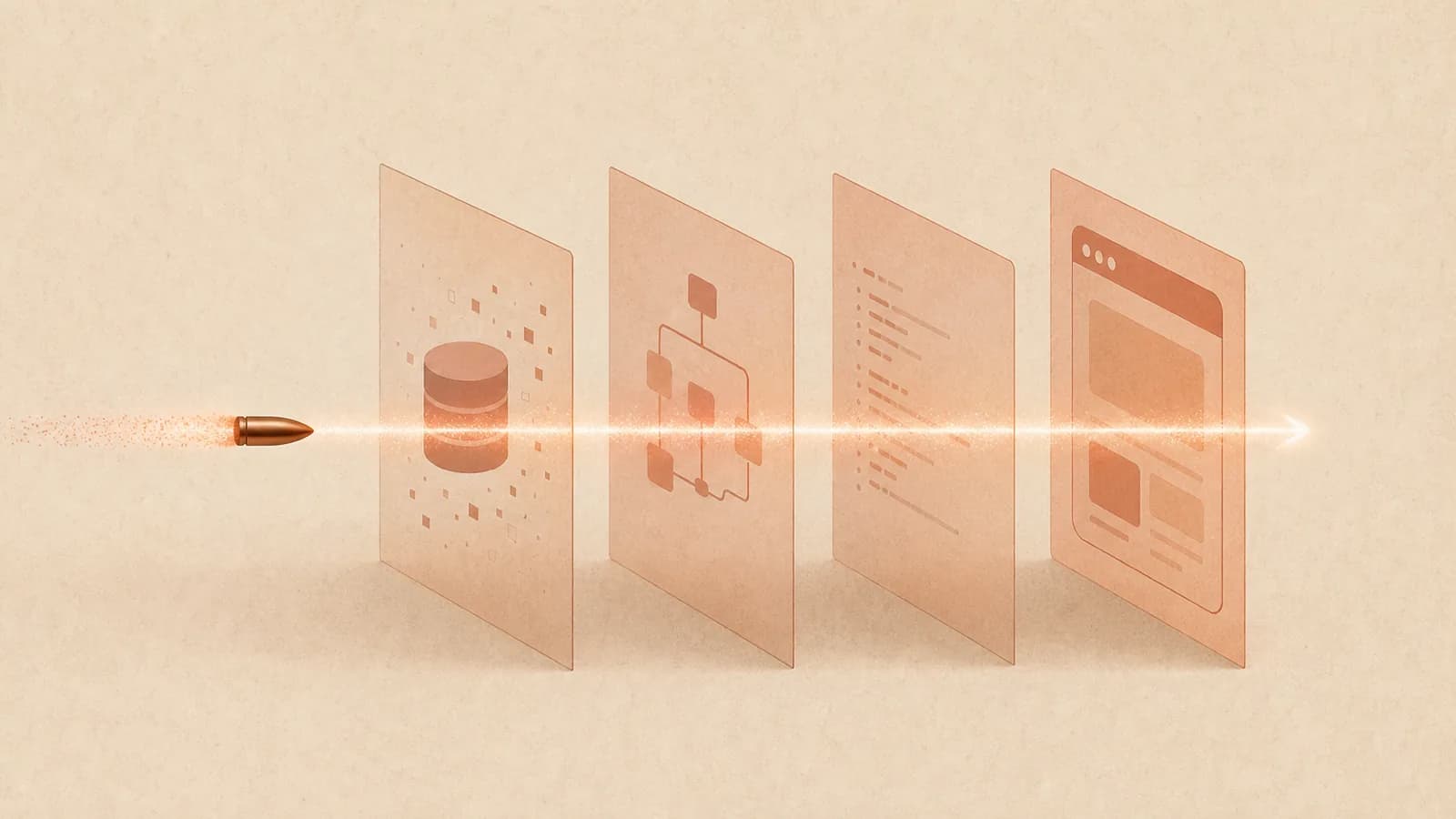
Borrowed from The Pragmatic Programmer and applied to agent task decomposition by Matt Pocock: when planning a feature, slice it vertically (a thin path through every layer — schema → service → API → UI) rather than horizontally (do all schema, then all service, then all UI). Vertical slices give end-to-end feedback after the first slice; horizontal slices defer feedback until phase three. Agents reliably default to horizontal — agent-friendly planning has to actively counter that bias.
The "tracer bullet" image#
Anti-aircraft gunners at night can't see where their bullets are going. Phosphor-coated tracer rounds glow in flight, every sixth round, so the gunner sees a line in the sky and corrects aim. Vertical slices are the same: each slice produces visible signal end-to-end so the developer (and the agent) can correct.
Why agents prefer horizontal — and shouldn't#
Agents trained on coding tasks model the work layer by layer:
- Phase 1: all schema migrations
- Phase 2: all services
- Phase 3: all UI
This is legible but produces no integrated feedback until phase 3. If anything is wrong with the original assumption (data shape, service boundary, UI flow), the cost is paid at the end. With agents this is even worse than with humans, because agents have no end-to-end mental model that catches mismatches in flight.
A vertical slice for the same feature looks like:
- Slice 1: schema for one event type + service to write one event + dashboard tile that shows one event count
- Slice 2: second event type, deeper logic, wider UI
- Slice 3: backfill, polish, edge cases
Each slice merges to main. Each slice gives the user something to QA. Each slice can be QA'd before the next slice depends on it.
Kanban over multi-phase plans#
Once tasks are vertically sliced, Pocock argues for a Kanban with blocking edges rather than a numbered phase list:
- Multi-phase plan ⇒ one agent works one task at a time, sequentially.
- Kanban with explicit blocking edges ⇒ multiple agents can grab non-blocked tickets in parallel.
The Kanban is materialized as markdown files in issues/ (or GitHub issues) with explicit blocked-by: frontmatter. The Ralph loop picks the next AFK-tagged unblocked ticket on each iteration. Pocock's Sandcastle library runs that selection in parallel: planner agent picks N parallel tickets, fan-out to N implementer agents in N git worktrees, fan-in to a merger agent.
Slice quality rules#
Pocock's prd-to-issues skill enforces vertical-slice rules. When the agent proposes a slice that's actually horizontal — e.g. "create the gamification service" alone — the rule fires:
"What I want to see in the first vertical slice especially is I want to see the schema changes or some schema changes. I want to see some new service being created and I want a minimal representation of that on the front end."
A "good" first slice = "Award points for lesson completion visible on dashboard" (touches schema, service, route, UI).
Why this isn't agile-with-extra-steps#
The shape of the practice is the same as agile/XP-era thin slicing. The reason it matters now is that agents specifically default to horizontal layering — possibly because most coding tutorials/tasks in their training data are organized that way. Without explicit pushing, you get layered output even from a strong model.
Connections#
-
Spec-Driven Development as the New Waterfall — the same increment-then-look remedy reached from agile rather than from Pragmatic Programmer, with the cost of change as the economic argument
-
Matt Pocock — primary articulator
-
Agent Loop Pattern — vertical slices fill the AFK loop's backlog
-
Design Concept Grilling — the slice list comes out of the PRD that comes out of the grilling session
-
Context Window Smart Zone — small slices fit in smart zone; horizontal phases don't
-
Deep Modules for Agents — vertical slices and deep modules reinforce each other: a slice cuts through the deep module's interface, exercising the test boundary you already wanted
-
Agent Harness Engineering — restated as "enforce invariants" at the planning layer: the invariant is "every slice produces visible feedback"
-
Claude Code Best Practices — the task-decomposition pattern that fills the Kanban backlog the loop primitive drains
-
Building Is Cheap, Arguing Is Expensive — a tracer bullet is the "build a thin real thing to learn" instinct; both prefer a built artifact over abstract argument
-
Narrow Wedge into a Legacy Market — Campfire's "best for one narrow profile" is a vertical slice as GTM: fully solve one customer, not a horizontal feature layer
Open Questions#
- How should slice granularity be tuned? Too thin = many merge conflicts; too thick = back to horizontal.
Resolved Questions#
- Can the planner agent be trusted to slice vertically once told to, or does it need a verifier that flags horizontal slices? Pocock's experience: it needs the verifier, at least through 4.7. Answered: Verifying Without a Compiler: Cowork's Harness vs Claude Code's, and Why the Slice Verifier Stays — it needs the verifier by design, not just empirically: slice shape is a mechanically checkable invariant (does the ticket touch schema + service + UI?), and checkable invariants belong in the deterministic checker regardless of model trust. "Slice vertically" in a prompt is a behavior request — unreliable against the training prior on the way up, compounding-prone once the behavior goes native — while the verifier is a constraint: it doesn't compound, costs ~nothing, and catches drift in either direction. Correct trajectory as models improve: prune the prompt line when ablation shows it's native; keep the checker, the way tests outlive the model learning to write correct code.
Derived#
- Verifying Without a Compiler: Cowork's Harness vs Claude Code's, and Why the Slice Verifier Stays — why the slice verifier is durable harness while the slice instruction is transient prompt
Sources#
Cited by 15
- Learning to Co-Work with AI: A Software Engineer's Field Guide×4
Slice vertically, not horizontally. Don't do "all schema → all services → all UI." Do "thin slice…
- Verifying Without a Compiler: Cowork's Harness vs Claude Code's, and Why the Slice Verifier Stays×3
The constraint form is the reliable one. "Slice vertically" in a prompt is a behavior request — the…
- Agent Loop Pattern×2
Amortize planning over many executions. One careful planning session (e.g. via Design Concept…
- Building Is Cheap, Arguing Is Expensive×2
This norm is in productive tension with the wiki's planning-first concepts. Design Concept Grilling…
- Claude Code Best Practices×2
A more aggressive variant: Design Concept Grilling (Matt Pocock's grill-me skill) replaces "ask the…
- Context Window Smart Zone×2
Fragment work into many sessions. Loops (see Agent Loop Pattern) and vertical slices (see Vertical…
- Design Concept Grilling×2
Kanban (journey doc) — vertical slices into independently grabbable tickets (see Vertical Slice…
- Matt Pocock×2
Tracer bullets over multi-phase plans. Vertical slices that touch every layer beat horizontal…
- Playbook Boundary Conditions: the Devil's-Advocate Substrate and the Prototype's Edge×2
Backend/infra feature shape · The tracer-bullet vertical slice — schema → service → UI in one thin…
- Spec-Driven Development as the New Waterfall×2
Vertical Slice Tracer Bullets is the closest existing page to Martin's remedy — a thin slice, then…
- Agent Harness Engineering
Vertical Slice Tracer Bullets — planning-layer restatement of "enforce invariants, not…
- Deep Modules for Agents
Vertical Slice Tracer Bullets — slices cut through deep modules at the interface, exercising the…
- AI Coding Practice
Vertical Slice Tracer Bullets — Pragmatic-Programmer tracer-bullet pattern applied to agent task…
- Narrow Wedge into a Legacy Market
Vertical Slice Tracer Bullets — a narrow feature set that fully solves one profile is a vertical…
- Open Questions Backlog
Vertical Slice Tracer Bullets (127d) — How should slice granularity be tuned?
Related articles
- Design Concept Grilling
Matt Pocock's `grill-me` skill; reach Brooks "design concept" before any plan; counter to specs-to-code; PRD as destina…
- Deep Modules for Agents
Ousterhout deep-vs-shallow modules applied to agent-friendly codebases; push-vs-pull instruction delivery; reviewer in…
- Agent Loop Pattern
`/loop` (cron-scheduled) and Ralph Wiggum (backlog-draining) loops as next-generation agent primitive; AFK execution, p…
- Agent Harness Engineering
Patterns for scaffolding long-running LLM agents: environment design, progressive context disclosure, mechanical archit…
- Agentic Technical Debt
Debt that *compounds* (not just accumulates) because each agentic-coding session re-derives architectural decisions wit…