Sources#
- Full Walkthrough: Workflow for AI Coding — Matt Pocock
- Uncle Bob on Software Fundamentals in the Age of AI
Summary#
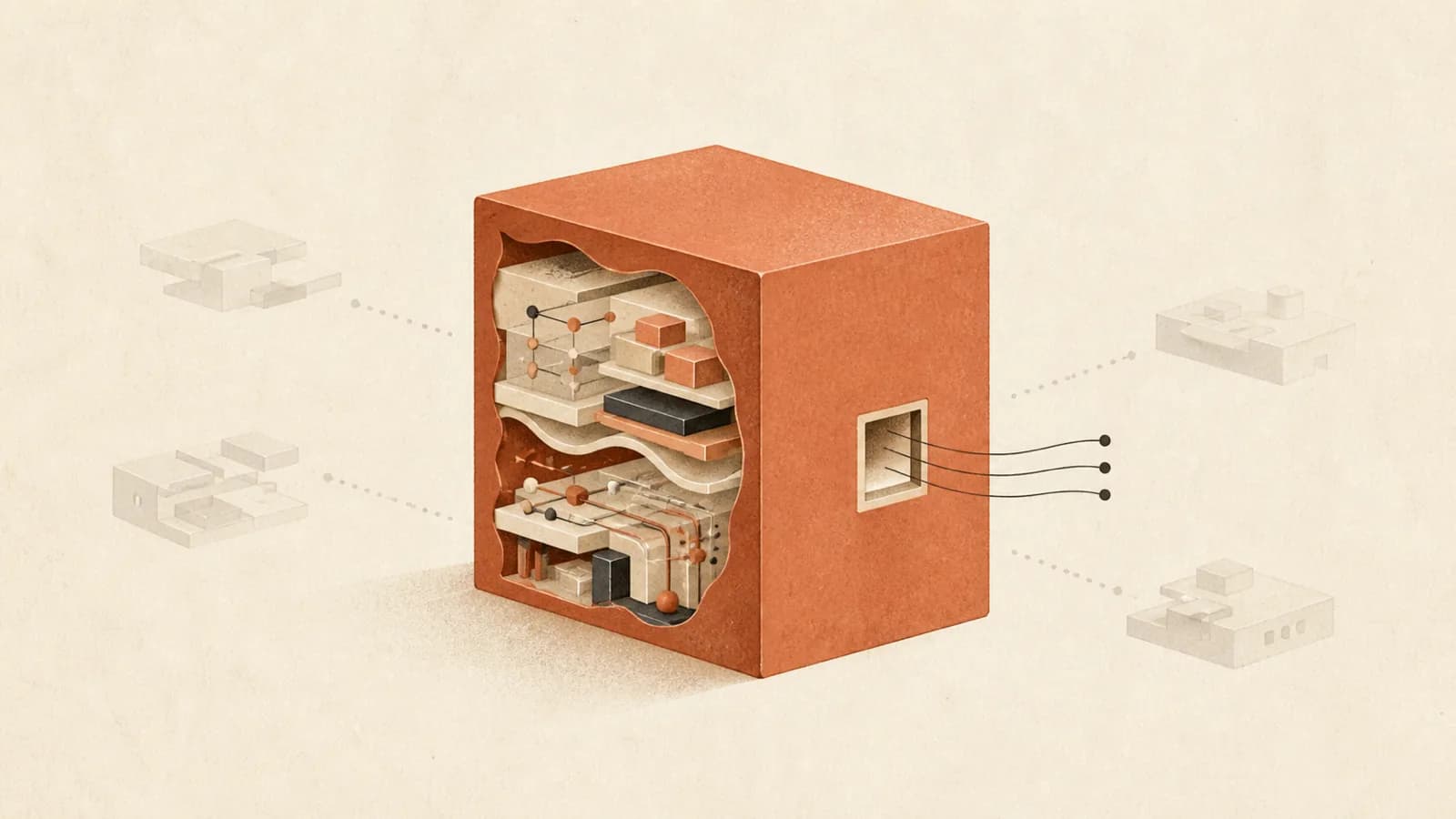
John Ousterhout's A Philosophy of Software Design distinguishes deep modules (small interface, large behavior) from shallow modules (small interface, little behavior, but many of them). Matt Pocock applies the distinction to agent-friendly codebases: agents thrive in deep-module codebases because the test boundary is clear, the dependency graph is shallow, and the developer can delegate implementation while keeping the interface in mind. Shallow-module sprawl is what AI produces by default if you don't push back, and it produces unreviewable, untestable codebases.
Deep vs shallow#
- Shallow module: many small files, each exposing many small functions, dense dependency graph between them. Test boundaries are unclear — do you mock every neighbor? Test units in isolation and miss integration bugs? AI can't see the whole picture, can't decide where the abstractions are.
- Deep module: one larger module with a small public interface and lots of internal logic. One natural test boundary: the public interface. AI can see what the module does without traversing dependencies. Implementation is delegable because the interface is the contract.
Why agents specifically benefit#
- Fewer dependency hops to traverse. Smart-zone budget (see Context Window Smart Zone) is conserved.
- Test boundaries are obvious. A reviewer agent can verify behavior at the interface without micro-managing internals.
- Implementation is delegable. Pocock's "gray box" pattern — design the interface yourself, hand off implementation to the agent. You retain a model of what without burning attention on how.
- The module map is finite. A PRD that says "modify gamification service, dashboard route, lesson route" is concrete; the same PRD against a shallow codebase would say "modify 47 files."
The risk: agents drift toward shallow#
Pocock's observation:
"If you don't watch AI carefully, it's going to produce a code base that looks like [shallow]. So you need to be really, really careful when you're directing it."
Reasons agents drift shallow:
- Each task is small; the agent makes the smallest change that works
- Without a global module map, the agent doesn't know which existing module to extend, so it makes a new one
- "Single-responsibility principle" misapplied — the agent wraps every helper in its own file
The fix is twofold:
- Keep the module map in the PRD (see Design Concept Grilling) so the agent knows what to extend.
- Periodically run a refactor pass that consolidates shallow modules into deep ones. Pocock has a skill for this:
improve-code-base-architecture— scans the codebase for "architectural improvement candidates" (clusters of related modules that could be deepened), with arguments and dependency category for each.
Push vs pull instructions#
A subtle but high-leverage architectural choice: how to deliver coding standards and architectural rules to agents.
| Mode | Mechanism | When |
|---|---|---|
| Push | Always-in-context (CLAUDE.md, system prompt) | Reviewer agents — they need to know the standards to compare against the code |
| Pull | On-demand via skill (agent fetches when relevant) | Implementer agents — pulling avoids burning smart-zone budget on rules that don't apply |
This is also why a clean reviewer is smarter than a same-context reviewer: the implementer can pull rules as needed; the reviewer benefits from having them pushed plus having a clean smart-zone window to actually evaluate the code.
Reviewer in fresh context#
If implementation used 80K tokens of smart zone, a same-context reviewer is reading the diff in the dumb zone. Clearing the context and running review fresh restores smart-zone reasoning. Pocock pairs this with model selection: Sonnet for implementation, Opus for review — "I need the smarts then."
The Sandcastle three-agent pattern#
Pocock's parallelization library bakes deep-module discipline into its architecture:
- Planner — picks N parallel issues from the backlog
- N implementers — one per issue, each in its own git worktree + Docker sandbox; coding standards available via pull skills
- Reviewer — runs in fresh context per implementer's diff; coding standards pushed into its system prompt
- Merger — reconciles all approved branches, fixes type / test conflicts
Each agent runs in its own smart zone. Each module-level change is reviewed at the interface, not the implementation.
Why "large model = no design needed" is wrong#
The seductive argument: "models are smart enough now to navigate any codebase, design doesn't matter." Pocock's counter:
"Bad code bases make bad agents. If you have a garbage code base, you're going to get garbage out of the agent that's working in that code base."
The smart-zone constraint (see Context Window Smart Zone) is structural, not just a function of model size. Architecture choices that make the agent's job harder cost smart-zone budget that better architecture would have saved.
Ousterhout's other party, and the architecture gate (Martin, 2026-08)#
Robert C. Martin — Ousterhout's opponent in the Clean Code second-edition appendix debate, and therefore the least likely endorser — agrees with this page's core claim without qualification (Uncle Bob on Software Fundamentals in the Age of AI, 2026-08-19, practitioner-opinion). Asked whether deep modules suit agents because they can read the interface without understanding the implementation:
"Absolutely. They pay attention to the structure. It can allow them to not read the code beneath them, which is both a danger and an advantage — as long as the code is consistent, you're okay. They also pay attention to the tests. They read tests to understand what the system does."
Two additions worth carrying.
A trajectory argument for module boundaries. Martin gives the same mechanism this page uses for context ("agents work better when the module fits in the window") a different basis — topical coherence rather than size:
"They work far better if they can focus on a module and if that module has a trajectory, so that the model does not get confused by the topics inside that module… If you load up a module with every bit of stuff under the sun, the poor agent is going to wonder, what the heck am I doing in here?"
The reference is to the interview's coffee/soap-opera illustration: unrelated content entering a context window contaminates everything after it, so a module that mixes concerns is a contamination source rather than merely a large one. That predicts something size alone does not — a small module with two unrelated responsibilities should hurt agents more than a large single-purpose one.
Architecture as a deterministic gate, partly built. Martin is the corpus's furthest-along attempt to move module structure out of prose review and into a checker:
- An architecture viewer his agents built him: a UML view of modular structure and dependency direction, clickable down through sub-modules into the code, so he can inspect at any level without reading files.
- A dependency-rule specification file — which modules may depend on which, and which way the dependencies flow — "that the agents cannot violate. There's another little checker that runs at the end and if they violate it, they've got to fix it somehow. Usually by inverting a dependency or inserting an interface or splitting a module in half."
He reached these because interrogating agents about the structure they had produced was reliably alarming: "I would get scared to death because the answers were horribly frightening." And he is explicit that the remaining step is the one he cannot automate — deciding the partition in the first place: "I'm working now to see if I can automate that and I'm having not a lot of luck so far." That places architecture on the far side of the boundary from the quality gates in Reviving Impractical Quality Tools: complexity and coverage are checkable, dependency direction is checkable once you have declared it, and what the modules should be is not.
Connections#
-
Impose Values, Not Disciplines — a value that transfers to agents unchanged, by both Ousterhout's and Martin's account, in contrast to the human-ergonomic rituals that do not
-
Spec-Driven Development as the New Waterfall — the architectural review step between increments is what neither Martin nor anyone else has automated away
-
Review as the Control Point — the residual human step Martin keeps even after discharging line-level review into gates
-
Robert C. Martin (Uncle Bob) — Ousterhout's appendix opponent, endorsing deep modules for agents and adding the topical-trajectory argument
-
Reviving Impractical Quality Tools — the checkable quality gates; his dependency-rule checker is the architectural member of that family, and the partition decision is the part that resists it
-
Interaction / Background Model Split — the async background model is a deep module hiding reasoning behind a thin interface
-
Model Introspection Feedback — introspection probes module boundaries to find where the harness is shallow
-
Matt Pocock — primary articulator
-
Context Window Smart Zone — deep modules conserve smart-zone budget
-
Vertical Slice Tracer Bullets — slices cut through deep modules at the interface, exercising the natural test boundary
-
Design Concept Grilling — module map in the PRD operationalizes deep-module discipline at planning time
-
Agent Loop Pattern — review-in-fresh-context fits the loop's clear-then-restart rhythm
-
Agent Harness Engineering — "enforce invariants, not implementations" is the same principle at the orchestration layer
-
Claude Code Best Practices — module map in CLAUDE.md sits in the same family
-
Agentic Technical Debt — deep modules + persistent CLAUDE.md context together are the architectural defense against the compounding-debt failure mode named in the founder's playbook
-
Evals as Product Spec — Pocock's integration tests at the deep-module boundary are the engineering instance of Cat Wu's "ten great evals"; both are durable verification artifacts at the interface
-
Verification as the New Bottleneck — reviewer-in-fresh-context at the module interface is a concrete answer to Fiona Fung's "who reviews" once verification is the bottleneck
-
Repository Exploration Subagent — FastContext applies the deep-module / fresh-context discipline to search: the explorer is a deep module (NL query in, file-line citations out) whose compact return keeps the solver's window clean, just as a fresh-context reviewer does
-
The Code-Quality Payoff Is Token-Indexed — the economic case for exactly this discipline, and its expiry condition: DHH argues agent-legible architecture is worth building only while tokens are scarce, since its historical justification (cheap human modification) no longer applies
Derived#
- Single General Agent vs. Multi-Agent Coding Architecture — the Sandcastle Planner/Implementers/Reviewer/Merger split and reviewer-in-fresh-context are cited as the "context isolation" specialization that survives model improvement (structural smart-zone constraint), vs. hand-engineered task structure that The Bitter Lesson dissolves
- Writer/Reviewer vs Agent-to-Agent Review — the fresh-context argument audited against the measured alternatives, and split in two: freshness buys smart-zone reasoning (this page's claim,
practitioner-opinion, with its only number borrowed from an adjacent task — safety-monitor recall falling 92% → 48% under long benign context), while the own-code bias it is usually credited with removing turns out to be a model-family property that clearing context leaves intact
Open Questions#
- How big is "deep enough"? Pocock's example modules are several hundred LOC; Ousterhout's textbook examples are larger. There's a sweet spot; not articulated.
- For ports/adapters codebases, does the deep-module advice transfer cleanly? The "small interface" is the port; the "large behavior" is the adapter. Probably yes, but not exercised in source.
- Refactor cost vs benefit: when is "improve-code-base-architecture" worth running on a working repo?
Sources#
- Full Walkthrough: Workflow for AI Coding — Matt Pocock
- Uncle Bob on Software Fundamentals in the Age of AI — Robert C. Martin with Matt Pocock, 2026-08-19 (
practitioner-opinion; auto-caption transcript): endorsement from Ousterhout's appendix opponent, the topical-trajectory basis for module boundaries, and the dependency-rule checker plus UML architecture viewer he had his agents build
Cited by 26
- Learning to Co-Work with AI: A Software Engineer's Field Guide×6
What it is: codebase shape that lets agents work effectively — deep modules, clear test boundaries,…
- Single General Agent vs. Multi-Agent Coding Architecture×3
Vibe Coding Vs Agentic Engineering (Ambrosino) places autonomous single-agent development past…
- Verification as the New Bottleneck×3
Before shipping Claude Code's own code-review feature, "how do you keep up with code reviews?" was…
- Writer/Reviewer vs Agent-to-Agent Review×3
The argument for freshness is a context-budget argument, and it is practitioner-opinion. Deep…
- Claude Code Best Practices×2
A more aggressive variant: Design Concept Grilling (Matt Pocock's grill-me skill) replaces "ask the…
- The Code-Quality Payoff Is Token-Indexed×2
Deep Modules For Agents — the positive program: architectural coherence as an agent-legibility…
- Context Window Smart Zone×2
Reviewer should run in fresh context. If the implementer used 80K tokens in the smart zone, asking…
- Design Concept Grilling×2
The PRD includes "modules to be modified" — concrete identification of which existing modules…
- Evals as Product Spec×2
Matt Pocock doesn't use the word "evals" — his pedagogical framing is "verification" and "feedback…
- Impose Values, Not Disciplines×2
Code review by a second person · An adversarial reader who did not write it · No — the value is the…
- Interaction / Background Model Split×2
Deep Modules For Agents / Agent Harness Engineering — multi-agent splits for context isolation…
- Matt Pocock×2
Deep modules win. Ousterhout's deep-module pattern makes codebases agent-friendly: small interface,…
- Model Introspection Feedback×2
"Delegated to sub-agent, didn't check its work" · Reviewer agent in fresh context (see Deep Modules…
- Reviving Impractical Quality Tools×2
Techniques in the corpus that fit the shape and have not been re-audited under agent labor:…
- Robert C. Martin (Uncle Bob)×2
Architecture is the part he cannot automate yet. He interrogates agents about module structure and…
- Spec-Driven Development as the New Waterfall×2
The agile answer leaves a manual step he cannot remove: "let them do a story or two, and then we'll…
- Agent Harness Engineering
Deep Modules For Agents — codebase-shape complement: agents in deep-module codebases conserve…
- Agent Loop Pattern
Deep Modules For Agents — modules with strong test boundaries make loops viable
- Agentic Technical Debt
Deep Modules For Agents — Ousterhout-style deep modules + persistent-context discipline are the…
- Claude Code
Skills — markdown files in repo that Claude can pull on demand; see push/pull in Deep Modules For…
- Agent Systems & Harness Engineering
Deep Modules For Agents — Ousterhout deep-vs-shallow modules applied to agent-friendly codebases;…
- Open Questions Backlog
Deep Modules For Agents ×3 (oldest 127d) — How big is "deep enough"?
- Repository Exploration Subagent
Deep Modules For Agents — an exploration subagent is a deep module: a thin interface (NL query →…
- Review as the Control Point
Where it strains is comprehension debt, the feedback loop this page treats as the under-attended…
- The Bitter Lesson
Deep Modules For Agents — the module boundary is the part that survives; hand-engineered task…
- Vertical Slice Tracer Bullets
Deep Modules For Agents — vertical slices and deep modules reinforce each other: a slice cuts…
Related articles
- Harness Shrinkage as Models Improve
Prompt scaffolding shrinks each model release; Cat Wu's pruning discipline; Boris Cherny "100 lines of code a year from…
- Context Window Smart Zone
Smart zone vs dumb zone (Dex Horthy / Matt Pocock): quadratic attention scaling, ~100K marker independent of advertised…
- Agent Harness Engineering
Patterns for scaffolding long-running LLM agents: environment design, progressive context disclosure, mechanical archit…
- Matt Pocock
Independent AI-coding educator; built Sandcastle library; smart-zone/grill-me/tracer-bullets pedagogical framing; "bad…
- Agentic Technical Debt
Debt that *compounds* (not just accumulates) because each agentic-coding session re-derives architectural decisions wit…