Sources#
- Andrew Ng: The Biggest Opportunities in AI Aren't Where You Think
- Anthropic's Boris Cherny: Why Coding Is Solved, and What Comes Next
- Designing with Claude: From prompt to production
- How Anthropic's product team moves faster than anyone else | Cat Wu (Head of Product, Claude Code)
- State of AI 2026: The Builder's Economy
- Thread by @AndrewYNg
- Why Netflix is betting on systems thinkers—not specialists—in the AI era | Elizabeth Stone (CPTO)
Summary#
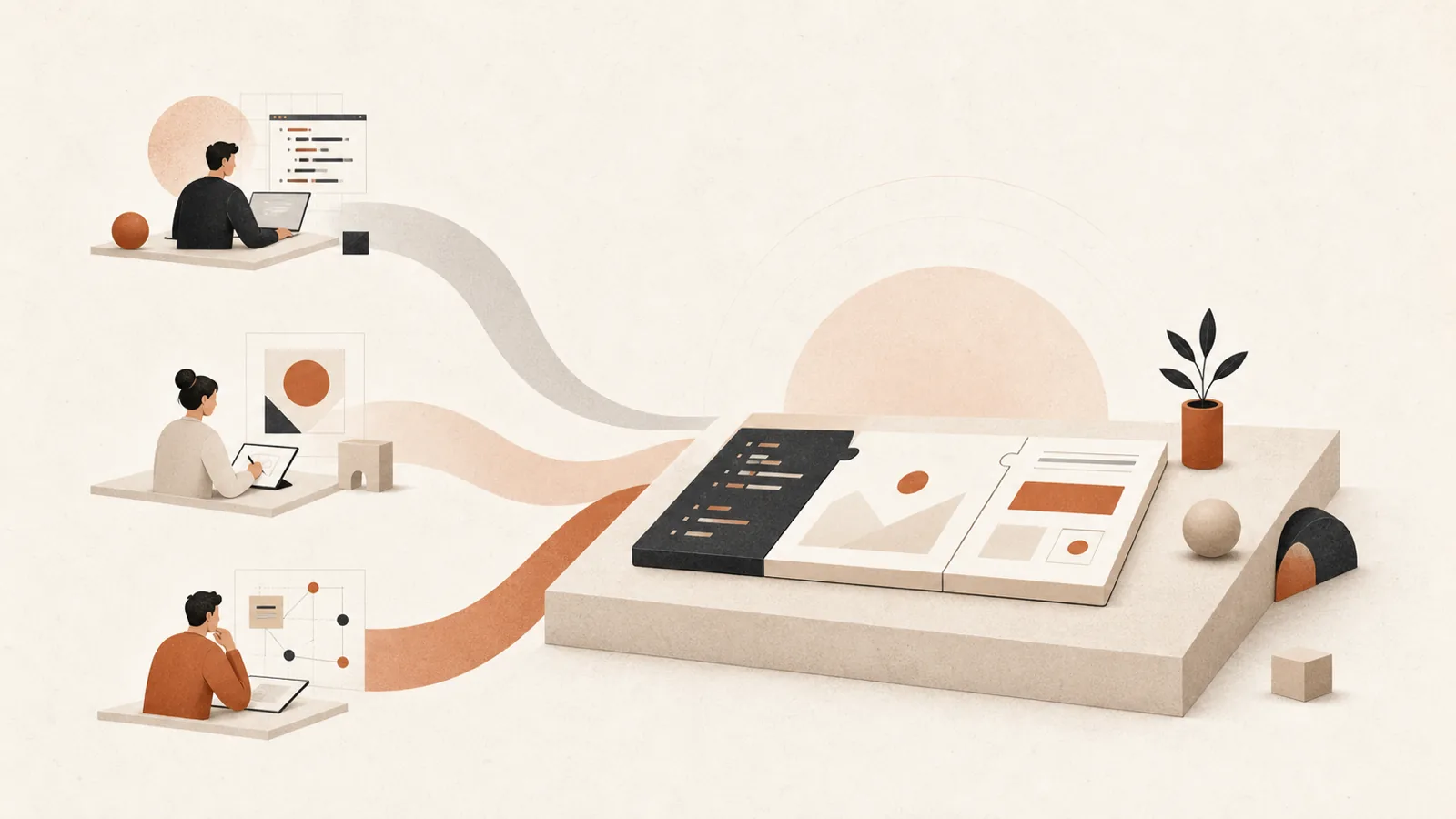
Both Boris Cherny (Sequoia AI Ascent 2026) and Cat Wu (Lenny's Podcast, April 2026) report the same trend from inside Anthropic: roles are merging. Engineers do PM work, PMs ship code, designers ship code, every functional role on the Claude Code team writes code. The convergent skill that matters across the merged role is product taste — deciding what to build, given that building is now cheap. This challenges the conventional model of cross-functional teams (one PM, one designer, several engineers, separate eval/QA) and points toward smaller groups of high-context generalists who individually own end-to-end delivery.
What's actually happening at Anthropic#
From Cat Wu:
- Everyone on the Claude Code team codes — engineering manager, product manager, designers, data scientist, finance, user researcher.
- Designers were formerly front-end engineers.
- "There are many engineers on our team who are fully able to end-to-end go from see user feedback on Twitter through to ship a product at the end of the week with almost no product involvement."
- Hiring bias: "We're pretty focused on hiring engineers with great product taste."
- Boris ↔ Cat split is "80% mind-meld, 20% domain-driven."
From Boris Cherny:
- "Generalists across disciplines" — engineers who are also great at design, or product + data science.
- "Everyone on our team codes."
- The "product engineer" archetype (iOS + web + server) is the baseline generalist; the new pattern is cross-disciplinary generalist.
From Dan Carey (Anthropic Labs, building Claude Design):
- The team was three people for most of development; "everyone on the team does everything — the engineers talk to users, PMs write code, designers do data analysis."
- "The lines between the roles on this team have essentially dissolved." You keep your specialization and unique perspective, but at any moment one person can talk to 10 users, find the underlying problem, design the fix, ship it, and keep iterating — "most things on the team are totally solo."
- "Claude is a pretty good team member" — the third teammate that lets a 3-person team behave like a larger one.
Outside Anthropic: the same convergence, and its failure mode#
Andrew Ng reports the trend from outside the frontier labs entirely (June 2026, practitioner-opinion) — the third independent vantage:
"With coding agents speeding up software development, more engineers are starting to play a partial product management role… the hardest part is shaping the product vision and striking a balance between building (bridging the gap between vision and spec) and getting user feedback to evolve the vision. It is important to do both!"
Ng adds what the Anthropic accounts don't: a named failure mode. Engineers newly holding the product role over-invest in the half they already know how to run. Building is fast, legible, and fun; the external feedback loop is slow, unpleasant, and unautomatable — so it gets skipped, and the vision stops updating. He is symmetric about the direction of travel: "engineers are playing an expanded role (just as product managers and designers now do more engineering)."
Ng also declines the word this page leans on. What Cat Wu calls taste, he calls a context advantage — not a faculty the generalist cultivates but knowledge they happen to hold. If he is right, "hire for taste" is really "hire for proximity to the user," and it is perishable.
August 2026: the convergence extended past product and engineering, and given a hiring test. In a general-audience interview (Andrew Ng: The Biggest Opportunities in AI Aren't Where You Think, Silicon Valley Girl, 2026-08-28, practitioner-opinion) Ng names the bottleneck Cat Wu describes — "the cost of building has plummeted and so the challenge is shifting to deciding what to build which… I've been calling the product management bottleneck" — and answers it with proximity rather than taste: "founders engineers product managers that can talk to customers get a sense for the taste of judgment on what to build and then build with AI and iterate quickly." The convergence he reports runs the other way from this page's: not engineers absorbing product but every function absorbing engineering. "All of my marketers know how to code. So, as part of how I interview marketers, we ask them what they've built" — one built a desktop app that crawls related work while he drafts an article; a CFO wrote scripts that open documents, check consistency and flag what needs attention; the recruiting team has "recruiting engineers… professional engineers that sit in a recruiting team." His generalization is a set of job titles — "recruiting engineers, marketing engineers, HR engineers" — and a finding from his team's AI-engineering skills map: "a lot more job descriptions seem to be saying they want people that demonstrate a very high sense of agency," against managers who tell people to "stay in their swim lane." That is Cat Wu's "just do things" as a job-description keyword. Hold the usual discount: it is one employer describing the team he selected ("my team's probably… somewhat ahead of the curve," his words), and "what have you built" is a hiring filter, not a measurement of what marketers who pass it produce. The population-scale version — whether non-engineers building is a practice or a selection effect — is open on Printing Press Software Democratization.
Surveyed beyond the frontier labs (ICONIQ, Q2 2026)#
The Anthropic/OpenAI accounts are frontier-lab self-report; ICONIQ's State of AI 2026 survey (~305 AI-building software companies, empirical) shows the convergence is broader. AI-heavy companies are more cross-functional (42% at 50%+ AI-revenue vs 35% below) and flatter (72% vs 56% run on 1–4 management layers at $100M+ scale) — the structural precondition for merged roles. The convergence appears in the network anecdotes too: one operator "collapsed PM and designer into single-person product ownership," and RevOps teams are "replacing non-AI-native RevOps hires with AI-native ones." Whether this validates Cat Wu's small-teams-of-generalists model or degrades into the discipline-loss Ambrosino warns about is exactly the open tension — ICONIQ measures that the collapse is happening at population scale, not whether it preserves the specialties.
The enterprise-scale vantage: fluidity with guardrails (Netflix)#
Elizabeth Stone (Netflix CPTO, July 2026, practitioner-opinion) confirms the trend from the largest non-lab org in the wiki — and is the most explicit about its boundary conditions. She hears the role-confusion frustration inside Netflix ("what is my job anymore?") and reads it as "a storming phase before the forming phase." PMs, designers, and data scientists now "get farther in the product development life cycle before engineering really needs to be front of the line." But the fluidity is sanctioned only when the business problem is clear and the engineering partner is aware — "it's not throwing a bunch of spaghetti at the wall" — and she draws the line the lab accounts don't: "Do I believe that means anyone should be shipping code to production? Probably not."
Her craft claim is the counterweight to full convergence, aligned with Ambrosino: comparative advantages persist — the data scientist knows whether the data can be trusted, the PM whether the what is framed right, the engineer the how (scale, quality, deployment consequences). "I still see a craft excellence that's really important… I still find great engineering to be scarce, great data science to be scarce, great creativity to be scarce." Roles speak more languages; the craft nucleus stays. Organizationally her enablers are infrastructure, not coordination: source-of-truth data, production guardrails, and reiterated human accountability ("it can be that an agent wrote the code… it doesn't make people not have the responsibility") — see Systems Thinking Over Specialization.
The taste argument#
"As code becomes much cheaper to write, the thing that becomes more valuable is deciding what to write."
— Cat Wu
Code generation cost is dropping. The bottleneck shifts upstream:
- Picking which feature to ship from 10K GitHub issues
- Designing the UX so the model's strengths are exposed and weaknesses patched
- Knowing when to push something out as research preview vs full product
- Distinguishing the 90 features people say they want from the 10 they'll actually use
This is product taste, and it's not bound to a job title — engineers can have it, designers can have it, PMs can have it. Whoever has it ships well; whoever doesn't ships drift.
Why now (Lenny's contrasting take)#
Lenny pushes back during Cat's interview, citing Anthropic Head of Growth Amol Avasare's prior episode: Amol says he needs more PMs because engineers are shipping so fast that designers and PMs can't keep up — every day there's a new feature.
Cat agrees this can be the case, but on Claude Code prefers the engineer-with-taste path: hire fewer of those, scale leverage, fewer coordination handoffs.
The two answers aren't contradictory — they describe different team shapes:
- Cat's model: small teams of generalists with high autonomy (Claude Code, ~couple dozen people)
- Amol's model: larger orgs where engineers move fast and need PM/design support to keep parity (Growth, GTM, Enterprise)
The asymmetry: human EQ remains#
Cat names what isn't merging: tacit, common-sense, EQ-heavy work — knowing the right venue to communicate with stakeholders, sensing when a launch is ready, knowing what counts as a fair trade-off. The model is improving here but isn't there yet, and humans still provide the connective tissue across a launch.
"Just do things"#
Cat's life motto:
"Jobs are fake. If you understand the constraints, you can figure out what you can do and then just like try to do it quickly, learn from the mistakes and apologize or fix them if you did something wrong."
This is the cultural substrate that makes role merging work. If roles are bounded by JD, no one acts cross-functionally. If "do what needs doing" is the norm, the merging happens organically.
Mission alignment is what makes "just do things" not chaotic — Cat: "If there's two competing priorities, we'll talk about which one is more important for Anthropic's mission. And it makes it a lot easier to decide which of the two we prioritize. And then everyone will stand behind the one that we decide."
Implications#
- Hire for taste, regardless of role. Cat's stated bar: anyone with strong product taste they can demonstrate.
- Cross-train aggressively. If your designers don't ship code, that's an organizational choice, not a constraint.
- Smaller teams. A 5-person team where every person owns end-to-end ships faster than a 15-person team with handoffs.
- PRDs become lighter. Cat: short bullet PRDs for ambiguous features; metrics readouts and team principles do most of the alignment work; full PRDs only for heavy-infra projects.
- Career ladders fragment. Cat: "We're sacrificing product consistency" as a tradeoff for shipping speed; career-ladder consistency is a quieter casualty.
Connections#
- Task Crossover — the convergence measured at population scale and outside tech: 43.5% of occupation-specific ChatGPT work use is another occupation's work, and crossover is highest in the smallest workspaces — role merging tracks organizational thinness, not just AI capability
- Implementation Abundance Inverts Product Work — the OpenAI-side, process-level statement of the same "deciding what to build is the bottleneck" shift
- Role Averaging, Not Role Elimination — Ambrosino's counter-caution: welcome the convergence, but don't eliminate roles as specialties with knowable best practices
- Outsource Your Thinking, Not Your Understanding — the converged generalist must keep understanding while delegating execution
- Seven Powers Applied to AI — process power erodes as roles converge into generalists
- Cat Wu — primary articulator
- Boris Cherny — converging report from same team
- AI Native Product Cadence — the cadence that makes role merging viable
- Claude Code Best Practices — engineer-with-taste is the user persona Claude Code targets
- Harness Shrinkage as Models Improve — as harness shrinks, the surface area of a "PM" role shrinks; the surface area of a "person who ships product" expands
- Printing Press Software Democratization — same direction, different timescale: software literacy expands, role distinctions blur
- Agent Loop Pattern — at the limit, individual contributors run dozens of agents and ship like teams used to
- Human-AI Accountability Redesign — workforce-wide mirror of this convergence: as agents take execution, human roles concentrate on supervision/judgment/oversight quality
- AI Employee Framing — counter-evidence for the cross-functional generalist: in HR/finance contexts, framing AI as colleague (rather than tool) erodes individual accountability rather than expanding it
- Compute Allocator — "deciding what to write" as the bottleneck skill, restated at the level of individual model invocations (Thariq Shihipar)
- Living Design System — tooling that lets non-engineers self-serve high-fidelity assets is the artifact side of roles blurring across the org
- Founder as Agent Orchestrator — within-company role merging extrapolated to the founder/company-of-one scale; same direction, smaller unit
- AI-Native Startup Lifecycle — the founder/startup version of this convergence: stage-by-stage compression of function-specific gates
- Evals as Product Spec — the canonical hybrid-role activity: PMs writing evals, engineers writing evals, both converging on "ten great evals" as a shared definition-of-done artifact
- Managers as ICs — Fiona Fung extends "everyone codes" up the org chart: every Claude Code manager starts as an IC
- Dogfooding as Product Discipline — "creative builder with product sense" is the dogfooding-fed hiring profile this convergence produces
- Dan Carey / Anthropic Labs — the 3-person Claude Design team as a second case study: "everyone does everything," roles dissolved
- Compounding Loop Optimization — the small, role-dissolved team is what makes "build your own tooling, run the loop solo" viable
- Returns to Expertise in Agentic Coding — "deciding what to build, given building is cheap" as the bottleneck skill, measured at population scale: domain/product understanding (not coding) predicts who succeeds with an agent, and managers (delegation taste) post the highest verified success
- Conversation-to-Delegation Shift — OpenAI's Codex study sees the same convergence in usage: intensive users "manage a portfolio of agentic work," shifting their own effort toward delegation, supervision, and integration
- Parallel Agent Orchestration — the role convergence made literal: running a fleet of concurrent agents is the IC-becomes-orchestrator shift, with adoption numbers
- Organizational Complements to AI — the job-redesign complement: realizing AI's value requires roles that direct/monitor/integrate agent output rather than execute tasks directly
- The Three Loops of AI-Native Building — Andrew Ng's third-vantage report, plus the failure mode: engineers-turned-PMs over-run the inner loop they enjoy and skip the outer one that updates the vision
- Context Advantage, Not Taste — Ng's reframing of the convergent skill: not taste but proximity to the user, which makes "hire for taste" a perishable strategy
- AI-Native Organization — the whole-company version: ICONIQ's cross-functional/flatter-org data and the PM+designer-into-single-person-ownership anecdote are this convergence measured across ~305 AI-builders (see that page's restructuring section)
- Systems Thinking Over Specialization — Stone's org-level answer to the convergence: staff the paved paths and design systems that let fluid roles ship coherently, and hire the systems thinkers who build them
- Excellence as an Operating System — the Netflix cultural substrate for fluidity, parallel to "just do things": trust + accountability instead of role boundaries
- Elizabeth Stone — the enterprise-scale vantage: fluidity sanctioned, production-shipping line held, craft scarce
- The Committed-Artifact Chain — the convergence written into an SDLC's job descriptions. In Anthropic's Applied AI playbook (
vendor-claim, 2026-08-21) the product owner reviews a requirements-and-design spec they did not write, resolves each flagged policy concern with its named owner before engineering sees it, and decides whether the change proceeds to build — a reviewing-engineer's workflow assigned to a product role, with "no engineering skill required" as the stated prerequisite. The other half of the convergence appears in the same document: the engineer's Build stage is plan-writing and interrogation before any code is generated.
Open Questions#
- Does this scale beyond ~50-person Claude Code-style teams? Boris hedges: "I think this is going to be a question for years."
- What happens to formal PM career ladders in companies where engineers do PM work? Open at Anthropic per Cat.
- Cross-disciplinary generalist is a hiring bar — where does the supply come from? Career changers, or new-grad bias toward AI-native education?
Derived#
- Learning to Co-Work with AI: A Software Engineer's Field Guide — engineer-PM convergence framed as a personal career-skills directive (product taste as bottleneck skill cluster)
- Opinions on Using AI Tools & the Future of the Software Engineering Role — role convergence as a core pillar of the future-of-the-SWE-role synthesis
Sources#
- How Anthropic's product team moves faster than anyone else | Cat Wu (Head of Product, Claude Code)
- Anthropic's Boris Cherny: Why Coding Is Solved, and What Comes Next
- Thread by @AndrewYNg — Andrew Ng, The Batch (2026-06-30),
practitioner-opinion: engineers into partial PM roles, and the balance failure - State of AI 2026: The Builder's Economy — ICONIQ Growth, State of AI 2026: The Builder's Economy (2026-07-08,
empirical): §"Talent & Organization" cross-functional/flatter-org cuts and the PM+designer-into-single-person-product-ownership anecdote — the convergence at population scale beyond the frontier labs - Why Netflix is betting on systems thinkers—not specialists—in the AI era | Elizabeth Stone (CPTO) — Lenny's Podcast (2026-07-19,
practitioner-opinion): the Netflix-scale confirmation with guardrails — storming-before-forming, farther-before-engineering, the production-shipping line, craft scarcity - Andrew Ng: The Biggest Opportunities in AI Aren't Where You Think — Andrew Ng interviewed by Marina Mogilko, Silicon Valley Girl (2026-08-28,
practitioner-opinion): "the product management bottleneck," the what-have-you-built interview bar for marketers, the marketer/CFO/recruiting-engineer examples, and the sense-of-agency job-description finding from his skills map (no figures given)
Cited by 44
- AI-Native Product Org Bottlenecks×5
Engineer Pm Convergence names what appears after handoffs shrink: code is cheaper, so "deciding…
- Learning to Co-Work with AI: A Software Engineer's Field Guide×5
Cross-disciplinary range matters more than vertical depth. Cat reports every functional role on the…
- AI Native Product Cadence×4
Cat Wu's account of how Anthropic ships at a pace that surprises observers. Cycle time per product…
- Opinions on Using AI Tools & the Future of the Software Engineering Role×4
Cat Wu: "As code becomes much cheaper to write, the thing that becomes more valuable is deciding…
- Andrew Ng×3
Engineers into product. "More engineers are starting to play a partial product management role… the…
- Boris Cherny×3
Generalists across disciplines. Every member of the Claude Code team writes code — including the…
- Human-AI Accountability Redesign×3
Engineer Pm Convergence — the persistent human skills (taste, ambiguity tolerance) align with what…
- Open Questions Backlog×3
Engineer Pm Convergence: What happens to formal PM career ladders in companies where engineers do…
- Role Averaging, Not Role Elimination×3
Does "your role is the average of what you spend time on" survive performance review and career…
- AI Employee Framing×2
This connects to engineer-PM convergence and Ai Native Product Cadence: visible managerial AI use…
- Anthropic×2
AI safety company; vendor of the Claude model family. Stated mission: "safe AGI for all of…
- Anthropic Labs×2
Scale tiny, deliberately. A promising spark scales "all the way to three people" — kept small to…
- Cat Wu×2
Head of Product for Claude Code and Cowork at Anthropic. Engineer for many years before a brief VC…
- Compute Allocator×2
Engineer Pm Convergence — "deciding what to write" as the bottleneck skill; allocation is taste at…
- Dogfooding as Product Discipline×2
Once coding is cheap (Verification As The New Bottleneck), the constraint shifts to knowing what's…
- Elizabeth Stone×2
Role fluidity with guardrails: pro-experimentation ("storming phase before the forming phase") but…
- Evals as Product Spec×2
Predicts a near-term role redefinition: PMs who can write evals will out-ship PMs who can't.…
- Implementation Abundance Inverts Product Work×2
Engineer Pm Convergence — "as code becomes cheaper, deciding what to write becomes more valuable"…
- Managers as ICs×2
This is the management-layer instance of Engineer Pm Convergence: Boris Cherny notes every member…
- Outsource Your Thinking, Not Your Understanding×2
Engineer Pm Convergence — product taste as the durable human skill is understanding in the product…
- Printing Press Software Democratization×2
Literacy didn't replace lords. Mass literacy didn't disempower the literate elite — it changed…
- Task Crossover×2
Crossover is the population-scale, telemetry-side measurement of a shift the wiki has documented…
- The Three Loops of AI-Native Building×2
This is Engineer Pm Convergence from a third independent vantage (after Cat Wu and Boris Cherny),…
- Agent Loop Pattern
Engineer Pm Convergence — generalist PM-engineers fan work out across loops
- AI-Native Organization
The org runs flatter and more cross-functional: cross-functional structure is more common at…
- AI-Native Startup Lifecycle
Engineer Pm Convergence — within-company analogue of the founder-role shift
- Claude Code
Engineer Pm Convergence — the team that builds it embodies the trend
- Claude Code Best Practices
Engineer Pm Convergence — the engineer-with-product-taste persona this guide implicitly targets
- The Committed-Artifact Chain
Engineer Pm Convergence — the role consequence: the product owner reviews a spec they did not write…
- Compounding Loop Optimization
Removing planning drag (prototypes over PRDs, Prototype Over Prd) and coordination drag (tiny…
- Context Advantage, Not Taste
Engineer Pm Convergence — the practical consequence: if the convergent skill is proximity to the…
- Conversation-to-Delegation Shift
Engineer Pm Convergence — the intensive user "manages a portfolio of agentic work," shifting toward…
- Cowork
Engineer Pm Convergence — Cowork plus Claude Code is what makes "everyone codes" + "everyone runs…
- Excellence as an Operating System
Engineer Pm Convergence — "just do things" is the same cultural substrate; role fluidity requires…
- Founder as Agent Orchestrator
Engineer Pm Convergence — within-company analogue (Cat Wu on Anthropic's roles merging);…
- Living Design System
Engineer Pm Convergence — an artifact that lets non-engineers self-serve high-fidelity assets is…
- Product & Organization
Engineer Pm Convergence — Generalists across disciplines; product taste as bottleneck skill;…
- Orchestration vs Employee Framing: Reconciling the Founder's Playbook with HBR's Accountability Evidence
Engineer Pm Convergence — analogous within-Anthropic role shift
- Organizational Complements to AI
Engineer Pm Convergence — the role-redesign complement: jobs shift toward directing, monitoring,…
- Parallel Agent Orchestration
Engineer Pm Convergence — the parallel-orchestration workflow is the IC-toward-manager/PM…
- Returns to Expertise in Agentic Coding
Engineer Pm Convergence — domain/product understanding as the bottleneck skill, seen in the success…
- Seven Powers Applied to AI
Engineer Pm Convergence — internal mirror: process-heavy organizational structures lose value the…
- Systems Thinking Over Specialization
Engineer Pm Convergence — the role-fluidity trend this page bounds: Stone confirms…
- Thariq Shihipar
Engineer Pm Convergence — his compute-allocator framing is "deciding what to write" exercised at…
Related articles
- Claude Code
Anthropic's agentic coding product; created by Boris Cherny late 2024; TypeScript/React on Bun (itself Claude-rewritten…
- Harness Shrinkage as Models Improve
Prompt scaffolding shrinks each model release; Cat Wu's pruning discipline; Boris Cherny "100 lines of code a year from…
- AI Native Product Cadence
Cat Wu's 6mo→1mo→1day cadence at Anthropic: research-preview branding, mission-as-tiebreaker, evergreen launch room, li…
- Printing Press Software Democratization
Boris Cherny's analogy: 1400s literacy expansion → AI software-writing expansion; domain knowledge displaces coding ski…
- Anthropic
AI safety company / vendor of Claude; mission-as-tiebreaker culture; ~30–40 PMs across teams; Mike Krieger leads Labs r…