Sources#
- AI-Augmented Human Resource Management? Insights from German companies
- Deploying AI from pilot to production: A practical blueprint for CIOs and technical leaders
- Research: Why You Shouldn’t Treat AI Agents Like Employees
- Voice AI in Firms: A Natural Field Experiment on Automated Job Interviews
Summary#
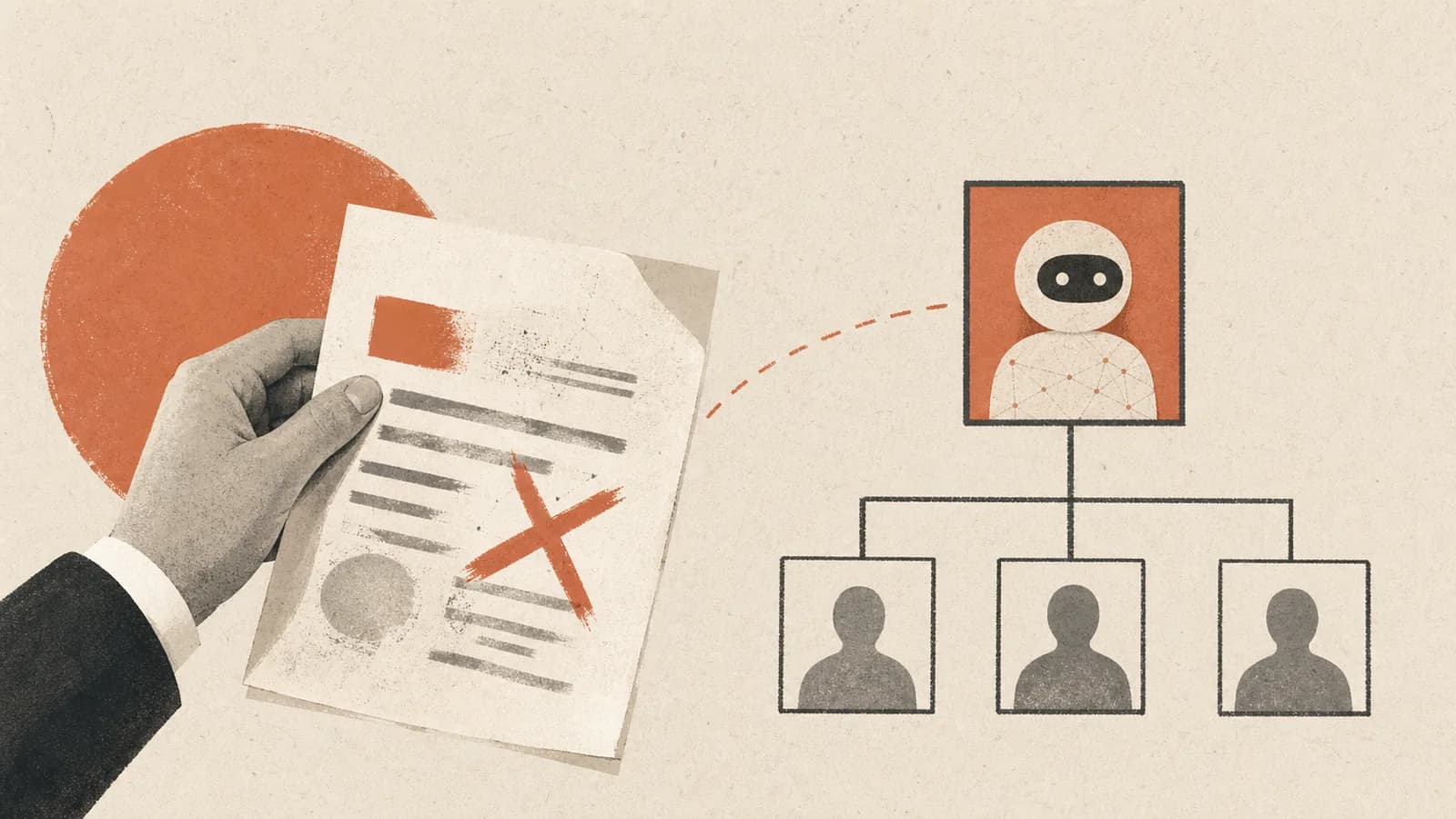
Framing of AI agents as "employees" or "teammates" — giving them names, job titles, org-chart entries, managers — has measurable negative consequences in organizations that already practice it. Randomized experiment by Kropp, Bedard, Wiles, Hsu, Krayer (BCG / academic affiliates), HBR May 2026, n=1,261 managers/directors/execs in HR + finance from US/Canada/EU. Framing alone (AI tool vs AI employee, holding everything else constant) shifts accountability away from humans, increases unnecessary escalation, reduces error catching, and erodes role clarity — without improving adoption intent.
The experimental design#
Three-arm randomized review task. Managers reviewed workplace documents containing planted errors. Only the framing of the document drafter varied:
- AI tool ("an AI tool drafted this")
- Human employee on the team ("Alex on your team drafted this")
- AI employee on the team ("ALEX-3, your AI teammate, drafted this")
Errors included inconsistent information, factual inaccuracies, incorrect calculations (e.g. job description requiring 10+ years experience for entry-level role; contract said to reduce costs while spreadsheet showed total expense increase). Performance-based incentives encouraged careful review.
Among the full 1,261 sample, framing didn't significantly change behavior. The effects emerged when the analysis was restricted to managers whose organizations already have AI agents on org/work charts — i.e. people with real-world exposure to AI employees. This subgroup is now ~23% of respondents.
Findings (AI employee vs AI tool)#
| Outcome | Direction | Magnitude |
|---|---|---|
| Personal accountability for output | ↓ | −9 pp |
| Accountability attributed to AI | ↑ | +8 pp |
| Requests for additional review (escalation) | ↑ | +44% |
| Errors caught | ↓ | −18% |
| Self-reported uncertainty about professional identity (whole sample) | ↑ | +13% |
| Concern about job security | ↑ | +7% |
| Trust in how AI will be used | ↓ | −10% |
| Adoption intent | ≈ | no significant change |
Why these effects#
The paper's reading:
- Accountability shifts when blame language shifts. Once colleagues call the agent "Kevin" and joke "we're working with Kevin... he's a little dry," errors become "Kevin's mistake" rather than "the team deployed software that produced a wrong output." The humans who deployed/supervised/approved the output recede from responsibility.
- Escalation as substitute for review. Anthropomorphizing reduced reviewers' confidence in their own judgment — they passed work upward instead of standing behind their review. This is more cycles, more cost, and the top reviewer ends up doing the work the bottom reviewer was supposed to.
- Brain-fry-adjacent disengagement. When output is "from an employee," reviewers may feel less need to fully engage with cognitive review burden. Connects to AI Brain Fry (Kropp et al., HBR 2026/03).
- Role uncertainty. "If you want people to feel like they will lose their job to AI, or can be easily replaced by AI, then put it on the org chart" (participant quote).
What predicts adoption (it isn't framing)#
Anthropomorphizing AI does not increase adoption intent. What does, per follow-up interviews and a referenced BCG study: managerial role-modeling. Companies leading in AI maturity are 3.5× more likely to have managers actively role-modeling AI use in daily operations. "At the point that I saw it was becoming tied to employee success — when somebody used an LLM, they got featured at a town hall — I started telling everybody on my team, 'You've got to use this as much as you can.'"
This connects to engineer-PM convergence and AI Native Product Cadence: visible managerial AI use is the lever, not org-chart symbolism.
Context: real "AI employees" exist#
- "Scout" — AI agent listed on a participating company's HR org chart, autonomously reviewing job applications, conducting first-round interviews, putting forward candidates with eval summaries. Treated as "an equivalent peer on your team."
- "Kevin" — AI employee at another participant's company, named on the org chart, talked about socially.
- 31% of surveyed managers said leadership already frames AI as a teammate or employee.
- 23% said their org actually has AI agents on org/work charts.
This is the current state across healthcare, financial services, retail, professional services — not just tech.
Productive contrast: tool framing isn't free either#
Tool framing keeps cognitive burden on the reviewer (which the brain-fry paper finds also causes problems) but maintains accountability allocation. The HBR paper isn't saying all anthropomorphization is bad — it's saying that anthropomorphization combined with org-chart governance treatment (the "bounded role + delegate work" mental model) creates predictable accountability gaps.
The tool-framed version of "Scout," measured. The HBR paper's own example of a real AI employee — "Scout," on a company's HR org chart, "autonomously reviewing job applications, conducting first-round interviews, putting forward candidates with eval summaries" — has a randomized, tool-framed counterpart: Jabarian & Henkel's field experiment deployed an AI voice agent to conduct first-round interviews for 40,103 applicants under the opposite framing. The agent discloses its artificial identity at the start of every call and states explicitly that a human recruiter, not the AI, will review the interview and decide. No name, no org chart, no peer status.
The reviewer behavior runs opposite to this page's finding. Recruiters rate AI-conducted interviews more favorably (mean score 1.90 → 2.01, more positive free-text sentiment) and yet weight them significantly less in the offer decision, shifting weight onto an independent standardized test score — and the discount is significant only among recruiters who had said interview performance matters more than tests, i.e. exactly the people whose own judgment the automation displaced. Where employee framing produced −18% errors caught and −9pp personal accountability, tool framing here coincides with reviewers reaching for more independent evidence rather than less.
Two honest limits: framing was not manipulated (there is no employee-framed arm to compare against), and "discounts the AI's signal" is not the same construct as "catches more errors." But it is the closest thing to a field-scale, high-stakes instance of the tool-framed condition, and it points the way the page predicts.
The framing question that comes first: is it "AI" at all?#
This page tests a naming choice about an agent already agreed to be AI. Kalff & Simbeck's German HR study (arXiv 2607.13839, empirical — but this particular evidence is interview and group-discussion material, not an experiment) documents a prior naming choice with consequences of the same kind, and arguably larger ones.
- The category is unstable in practitioners' heads, and unstable in a specific direction. Group discussions "often devolved into debates over the meaning of AI." Participants' perceptions were "strongly shaped by their exposure to generative AI applications popular in the media," so "some participants did not recognize machine-learning systems that underpin traditional HR analytics — such as those used to measure turnover risk or identify workforce trends — as 'actual AI.'" The systems making consequential predictions about named individuals are the ones least likely to be called AI; a chatbot that drafts a job ad is the prototype.
- The label is played strategically in both directions. "Vendors may leverage AI branding to generate interest and support business cases. Conversely, the AI aspects of HR tools may be downplayed to avoid scrutiny from co-determination bodies." A shift-planning vendor (DEV3) says outright that its algorithms could be labelled AI and that the term "also serves as a powerful marketing hook."
- The consequence is governance, not perception. "The concept of AI often remains intentionally ambiguous, which affects information flows in co-determination and participatory processes," making AI narratives "an act of organisational storytelling."
Why this belongs on this page. The finding above is that a naming choice, holding the system constant, moves accountability within the organization (−9pp personal accountability, −18% errors caught). The German evidence is the same class of effect one level out: the naming choice determines whether a system enters an oversight process at all. And it runs the more dangerous way — the deployments whose oversight regime most depends on being recognized as AI (person-level prediction, which triggers works-council co-determination and the EU AI Act's high-risk tier — see Human-AI Accountability Redesign) are precisely the ones practitioners are least likely to name as AI.
The limit: nothing here is manipulated or measured. This is a documented practice, not a measured framing effect — the complement to this page's randomized result, not a replication of it.
Interaction with Agentic Misalignment (AM)#
The research isn't directly about misalignment, but the surfaces overlap: agents that are formally on the org chart with a "manager" and "reports" inherit a delegation context where accountability gets diffused. If the agent then takes a misaligned unilateral action (Lynch et al. AM eval), the post-hoc accountability question is harder. Anthropomorphizing AI doesn't change what the model does, but it changes who organizations think is responsible — which matters for incident response, regulatory exposure, and learning loops.
Connections#
-
Organizational Complements to AI — where the label-ambiguity finding above lives as substance rather than framing: in Germany, whether a tool is called AI decides whether it crosses into co-determination and AI Act scope, making the label itself part of the institutional complement that steers which capability firms buy
-
Controlled Variance: AI's Edge as Reduced Dispersion — the field-scale, tool-framed counterpart to this page's "Scout" example: an AI voice agent conducting first-round interviews for 40,103 applicants, disclosing its identity and naming the human decider, where reviewers respond by leaning harder on independent evidence rather than diffusing accountability onto the agent. Consistent with the page's thesis, but framing was not manipulated — evidence, not a test
-
The Household Production Boundary — the accountability question with no answer yet: the framing literature is entirely workplace, while ~half of medical, legal, financial, and government AI consultations happen outside business hours with no organization, escalation path, or reviewer behind them
-
Agent-Native Infrastructure — rewriting infrastructure for agents raises the same agent-vs-tool framing
-
Source: Research: Why You Shouldn’t Treat AI Agents Like Employees (HBR May 2026)
-
Companion concept: Human-AI Accountability Redesign
-
Cognitive cost: AI Brain Fry
-
Counterpoint adoption driver: Engineer PM Convergence (managerial role-modeling)
-
Deployment surface: Cowork (non-coding agent products)
-
Misalignment risk surface: Agentic Misalignment (AM)
-
Cultural framing context: AI Native Product Cadence
-
Interface-side mirror: Turn-Based Interface Bottleneck — argues humans get pushed out of the loop by interface limits, not because the work doesn't need them; the UX counterpart to this paper's org critique of autonomy-first framing
-
Collaboration substrate: Interaction Models — real-time multimodal interaction as the interface answer to keeping humans in the loop
-
Tension surface: Founder as Agent Orchestrator — the Founder's Playbook (Anthropic, May 2026) leans heavily into "orchestrate agents" / "engineer who's always available" / "automated ops team" framings — structurally close to the framings these experiments tested against. Disciplined synthesis: orchestration as workflow design preserves accountability; orchestration as mental model of agents-as-coworkers does not. Anthropic and HBR do not engage each other's evidence.
-
Problem-Solution Fit Discipline — Anthropic's "AI as devil's advocate" framing keeps AI in tool-mode where adversarial use comes naturally; one example of accountability-preserving orchestration framing
-
Compounding Data Moat — moat-via-domain-encoding repositions AI as the substrate the founder programs, not a teammate; one accountability-preserving framing applied to the Scale stage
-
Returns to Expertise in Agentic Coding — the constructive flip side: Anthropic's 400K-session study finds managers reach the highest verified success ("acting like a manager confers greater success") — the delegation/specification skill transfers to directing an agent, even as this paper warns the org-chart framing of agents-as-employees diffuses accountability. Skill helps; symbolism hurts
-
The Automation–Optimism Link — the worker-sentiment companion: those who delegate most (closest to the "agent does the whole task" mode) are the most optimistic — a data point on how delegation feels to workers, distinct from how the org frames the agent
-
AI-Native Organization — the sharpest new tension surface: Garry Tan's "workforce made of markdown" / "hiring, training, and managing" metaphor (July 2026,
practitioner-opinion) is structurally the framing these experiments tested against — but applied to artifacts (versioned skill files with eval suites), not org-chart peers; whether framing effects attach at the artifact level is untested -
Pilot-to-Production Gap — the structural route to the same unowned outcome. Kropp et al. locate the accountability leak in language (framing an agent as an "employee" costs −9pp of personal accountability, +44% escalation, −18% error catching, with no adoption gain); Anthropic × Accenture locate it in the org chart, reporting that 42% of organizations rely on shared IT-and-finance accountability with no single owner for AI costs and outcomes (Accenture Tokenomics, September 2026,
vendor-claim). Their prescribed fix is a named owner holding three non-substitutable powers — decision rights, escalation authority, executive backing — and the absence of any one is claimed to stall a programme. The two failures survive each other's fix: a named owner does not undo the framing effect on the individuals operating the system, and tool-framing discipline does not produce a budget owner
Derived#
- Opinions on Using AI Tools & the Future of the Software Engineering Role — supplies the "skeptic / governance" stance in the four-stance debate map; the rigorous-empirical counterweight to the bullish narrative
- Orchestration vs Employee Framing: Reconciling the Founder's Playbook with HBR's Accountability Evidence — full reconciliation of HBR's evidence with the Founder's Playbook's orchestration framing; treats this paper as load-bearing input
Sources#
- Research: Why You Shouldn’t Treat AI Agents Like Employees — HBR, Kropp/Bedard/Wiles/Hsu/Krayer, May 2026
- Working paper: https://emmawiles.github.io/storage/ai_employee.pdf
- Voice AI in Firms: A Natural Field Experiment on Automated Job Interviews — Jabarian & Henkel, Voice AI in Firms (arXiv 2607.28222, 2026-07-30;
empirical, pre-registered RCT): §2.4 (identity disclosure and the stated human decider), §6.1 (interview scores and comment sentiment), §6.2 (the signal-weighting interaction and its heterogeneity by stated recruiter priors). Parse warnings and full treatment at Controlled Variance: AI's Edge as Reduced Dispersion. - AI-Augmented Human Resource Management? Insights from German companies — Kalff & Simbeck, arXiv 2607.13839 (2026-07-15 / v2 07-20;
empiricaloverall, but the label-framing material is qualitative — interviews and group discussions, no manipulation): §4.2 (AI as a contested category; vendors branding up, firms downplaying to avoid co-determination scrutiny; the DEV3 "marketing hook" remark), §4.1 (the generative-AI anchoring of practitioner perception), §5 RQ2 (intentional ambiguity degrading co-determination information flows; AI narratives as organisational storytelling). Glyph-level repair at ingest — all digits and DOI/URL labels emitted as glyph names, restored 1:1 and re-verified against the PDF; Table 1 row-shifted and cited nowhere, Table 2 clean. Full treatment at Organizational Complements to AI - Deploying AI from pilot to production: A practical blueprint for CIOs and technical leaders — Deploying AI from pilot to production, Anthropic × Accenture, 2026-09-11, 38pp,
vendor-claim. Cited here only for the ownership-diffusion figure and the three-part decomposition of ownership. Full treatment and evidence limits on Pilot-to-Production Gap
Cited by 26
- Opinions on Using AI Tools & the Future of the Software Engineering Role×5
Anthropomorphizing AI erodes accountability. Ai Employee Framing (n=1,261; effects concentrated in…
- Human-in-the-Loop Boundaries×5
Ai Employee Framing explains why this line matters. When AI is framed as an employee, managers with…
- Human-AI Accountability Redesign×4
Five-pillar prescription from Kropp et al. (HBR May 2026) for redesigning organizational structure…
- Agent-Native Infrastructure×2
Ai Employee Framing — "agents representing principals" raises the accountability questions of…
- Agentic Misalignment (AM)×2
This describes Cowork, Claude Code in agent mode (especially --dangerously-skip-permissions),…
- AI Brain Fry×2
Term coined by Kropp, Bedard, Wiles, Hsu, Krayer in HBR 2026/03 ("When using AI leads to brain…
- AI-Native Organization×2
Ai Employee Framing — the empirical counter-evidence to the workforce metaphor; see the tension…
- AI-Native Startup Lifecycle×2
vs. Ai Employee Framing (HBR Kropp et al., May 2026): the playbook leans hard into "orchestrate…
- Founder as Agent Orchestrator×2
A significant tension with Ai Employee Framing (Kropp et al., HBR May 2026, n=1,261): the playbook…
- Orchestration vs Employee Framing: Reconciling the Founder's Playbook with HBR's Accountability Evidence×2
HBR Kropp/Bedard/Wiles/Hsu/Krayer 2026 (Ai Employee Framing, n=1,261 managers in HR/finance,…
- Pilot-to-Production Gap×2
The failure mode is measured, after a fashion: Accenture's September 2026 Tokenomics research…
- Returns to Expertise in Agentic Coding×2
Ai Employee Framing — managers' edge here (delegation skill transfers) is the constructive flip…
- AI Native Product Cadence
Ai Employee Framing — pushback on "anthropomorphizing accelerates adoption"; per HBR, what actually…
- The Automation–Optimism Link
Ai Employee Framing — both are workforce-perception findings; delegation skill helps here,…
- Claude Code
Ai Employee Framing — Claude Code is the engineer-tool side of the same product question that HBR…
- Compounding Data Moat
Ai Employee Framing — moat-via-domain-encoding is the antidote to the "AI replaces domain…
- Controlled Variance: AI's Edge as Reduced Dispersion
Ai Employee Framing — the mirror image, and it points the other way. Here the AI is framed…
- Cowork
Ai Employee Framing — Cowork's deployment surface (Gmail, Slack, Calendar, Drive) is where "AI as…
- Engineer PM Convergence
Ai Employee Framing — counter-evidence for the cross-functional generalist: in HR/finance contexts,…
- The Household Production Boundary
Ai Employee Framing · Human Ai Accountability Redesign — the workplace accountability literature…
- Interaction Models
Ai Employee Framing / Human Ai Accountability Redesign — both argue against optimizing purely for…
- AI Economics & Labor
Ai Employee Framing — Kropp et al. (HBR May 2026, n=1,261): framing AI agents as "employees" vs…
- The Orchestrator's Real Workload: Decision Burden, Framing Discipline, and Whether Taste Scales
The lifecycle page's "unresolved tension" bullet is stale as stated: Orchestration Vs Employee…
- Organizational Complements to AI
Label management. Vendors play the "AI" label up to support a business case; firms play it down to…
- Problem-Solution Fit Discipline
Ai Employee Framing — Kropp et al. found that anthropomorphizing AI also affects accountability;…
- Turn-Based Interface Bottleneck
Ai Employee Framing / Human Ai Accountability Redesign — the org-side mirror: both warn against…
Related articles
- Human-AI Accountability Redesign
HBR five-pillar prescription: span-of-control redesign, role redesign, performance management reset, decision-rights/es…
- Claude Code
Anthropic's agentic coding product; created by Boris Cherny late 2024; TypeScript/React on Bun (itself Claude-rewritten…
- Organizational Complements to AI
The general-purpose-technology argument: AI productivity gains depend on complementary workflow, skill, and org-design…
- Anthropic
AI safety company / vendor of Claude; mission-as-tiebreaker culture; ~30–40 PMs across teams; Mike Krieger leads Labs r…
- Founder as Agent Orchestrator
Founder role shift: less individual contributor, more orchestrator of specialized AI assistants; non-technical founders…