Sources#
- How we built a realtime system for responsive voice AI in six months
- Interaction Models: A Scalable Approach to Human-AI Collaboration
Summary#
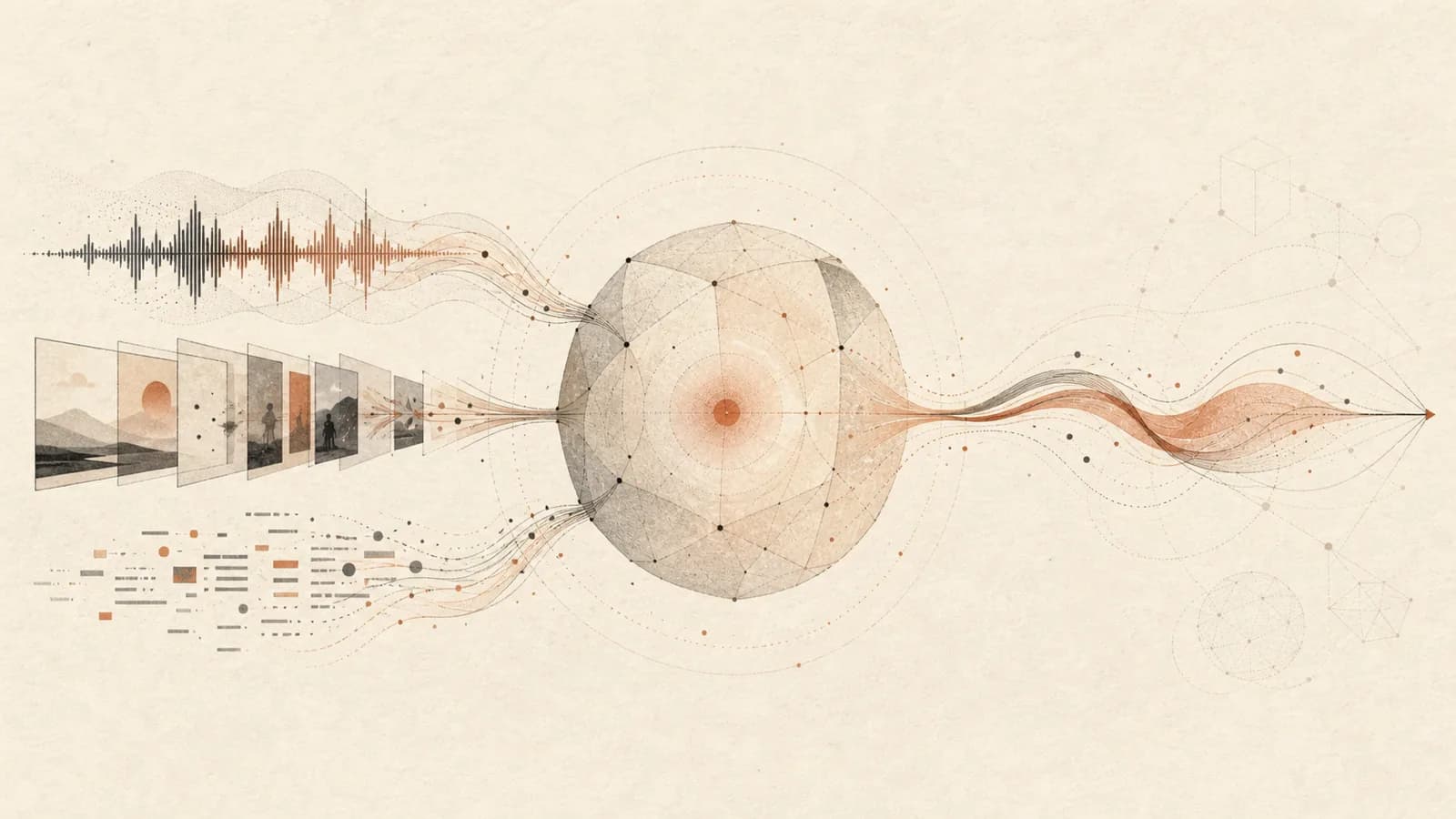
An interaction model is a model that handles interaction natively — continuously taking in audio, video, and text and thinking, responding, and acting in real time — rather than emulating real-time behavior through external scaffolding (VAD, turn-detection, dialog-management harnesses). Announced by Thinking Machines Lab as a research preview in May 2026, with a first model named TML-Interaction-Small.
The central bet: interactivity should scale alongside intelligence. If interaction is part of the model, scaling the model makes it both smarter and a better collaborator. If interaction lives in a hand-crafted harness, The Bitter Lesson says that harness gets outpaced by general capability growth.
The thesis in one line#
"For interactivity to scale with intelligence, it must be part of the model itself."
This is the harness-shrinkage argument (see Harness Shrinkage as Models Improve) applied to the interaction layer: VAD, turn-boundary prediction, dialog state machines — all "meaningfully less intelligent than the model itself" — should dissolve into model behavior. Once they do, capabilities that those harnesses couldn't support (proactive interjection, speak-while-listening, reaction to visual cues) become special cases of what the model does, and improve with scale.
What it unlocks (capabilities, not harness features)#
- Seamless dialog management — model implicitly tracks whether the speaker is thinking, yielding, self-correcting, or inviting a response. No separate dialog-management component.
- Verbal and visual interjections — model jumps in when context warrants ("interrupt when I say something wrong", "tell me when I've written a bug"), not only at end-of-turn.
- Simultaneous speech — user and model speak concurrently (live translation).
- Time-awareness — direct sense of elapsed time ("how long did it take me to run a mile?").
- Simultaneous tool calls / search / generative UI — while listening and speaking, the model concurrently searches, browses, generates UI, weaves results back in.
See Full-Duplex Interaction and Interactivity Benchmarks for how these are demonstrated and measured.
Why turn-based interfaces are the bottleneck#
Today's models "experience reality in a single thread": they wait, blind, until the user finishes typing/speaking; then they generate, blind, until done or interrupted. This is a narrow channel for collaboration — it limits how much of a person's knowledge, intent, and judgement reaches the model, and how much of the model's work is legible. Analogy from the post: resolving a crucial disagreement over email instead of in person. Full treatment in Turn-Based Interface Bottleneck.
Architecture (three load-bearing ideas)#
- Time-Aligned Micro-Turns — input and output are continuous streams, processed/generated in 200ms chunks; no artificial turn boundaries. Silence, overlap, and interruption stay in context.
- Interaction / Background Model Split — a time-aware interaction model maintains real-time presence; an asynchronous background model handles sustained reasoning, tool use, longer-horizon work. The interaction model delegates with a rich context package (the full conversation, not a standalone query) and interleaves results back at a moment appropriate to what the user is doing. Net effect: "planning, tool-use, and agentic workflows of reasoning models at the response latency of non-thinking ones."
- Encoder-Free Early Fusion — minimal pre-processing instead of large standalone encoders/decoders: audio in as dMel + light embedding; images as 40×40 patches via hMLP; audio out via a flow head. All components co-trained from scratch with the transformer.
Plus engineering: streaming sessions for low-overhead frequent small prefills/decodes (upstreamed to SGLang); latency-tuned MoE kernels (gather+gemv instead of grouped gemm); bitwise trainer-sampler alignment via batch-invariant kernels (<5% overhead) for stability and debuggability.
Convergence: OpenAI ships the audio slice (July 2026)#
OpenAI's GPT-Live arrives at the same architectural conclusions from the opposite direction — production latency engineering rather than a scaling-research bet — and ships them at ChatGPT scale. The mapping against the three pillars: full-duplex model in control of the conversation, no turn detector (audio-only; the cross-modal generalization stays TML's); background delegation to frontier models (Interaction / Background Model Split, with GPT-5.5 in the background slot); micro-turn internals undisclosed — OpenAI's account is instead the serving side (Live-Path Minimalism): stateful streaming inference, seamless instance handoff, compaction off the live path. Two labs, two months apart, one framing the thesis ("for interactivity to scale with intelligence, it must be part of the model") and one shipping its strongest testable consequence (the turn detector dissolved — see Turn-Based Interface Bottleneck).
Safety angle#
Real-time interaction stresses safety differently than turn-based exchange. TML's work focused on two axes:
- Modality-appropriate refusals — TTS-generated refusal / over-refusal training data so spoken refusals are colloquial but no less firm.
- Long-horizon robustness — automated red-teaming harness generating multi-turn refusal data, maintaining behavioral parity with the text model's refusals.
Limitations (per the post)#
- Long sessions — continuous A/V accumulates context fast; streaming-session design handles short/medium well, very long sessions need careful context management (parallels Context Window Smart Zone).
- Compute & connectivity — low-latency A/V streaming needs reliable connection; degrades badly without one.
- Scale —
TML-Interaction-Smallis 276B MoE / 12B active; larger pretrained models too slow to serve in this regime today; larger models promised "later this year". - Background agents — agentic intelligence acknowledged as essential but under-explored relative to the real-time work.
Connections#
- Build for the Next Model — matching the interaction shape to current capability (Codex-web "too AGI-pilled" vs. Claude Code's question-asking local form) is build-for-the-next-model at the interaction layer
- Software 3.0 — Karpathy frames interaction models as a step toward the 3.0 neural-computer
- The Bitter Lesson — the principle the whole approach rests on: scaled general methods beat hand-engineered structure
- Harness Shrinkage as Models Improve — same move, applied to the interaction harness (VAD/turn-detection dissolve into the model)
- Turn-Based Interface Bottleneck — the problem being solved
- Time-Aligned Micro-Turns, Interaction / Background Model Split, Encoder-Free Early Fusion — the three architectural pillars
- Full-Duplex Interaction — the interaction modes this enables
- Interactivity Benchmarks — how intelligence + interactivity are measured jointly
- Thinking Machines Lab, TML-Interaction-Small — who built it, what the model is
- Context Window Smart Zone — the long-session limitation echoes the smart-zone problem
- AI Employee Framing / Human-AI Accountability Redesign — both argue against optimizing purely for autonomy; interaction models are the interface-side answer to keeping humans in the loop
- Design Concept Grilling — collaborative, real-time iteration over spec-and-walk-away; an interaction model is the substrate that would make grilling-style collaboration feel native
- Agent Harness Engineering — the harness-vs-model division-of-labor question, here resolved firmly toward the model for the interaction layer
- Claude Opus 4.7 —
xhigheffort tier appears as a baseline config (GPT-realtime-2.0 minimal/xhigh) - HTML as the New Markdown — a sibling answer to "better human–AI collaboration" by the opposite mechanism: TML dissolves the real-time interface into the model, where Thariq Shihipar enriches the asynchronous artifact; both keep the human in the loop
- Configurable Human Participation — the task-benchmark companion to this architecture answer: HAS-Bench factors human input into clarification/feedback/control channels with explicit timing, and finds participation must be designed (which channel, when, by whom) rather than defaulted — the outcomes-measured version of "keep the human in the loop"
- GPT-Live — OpenAI's production convergence on the audio slice of the thesis
- Live-Path Minimalism — the serving architecture an interaction model demands, from the lab that shipped one
Open Questions#
- Does the interaction/background split generalize, or is it a transitional artifact until a single model is both fast and deep enough? Partially answered (2026-08-04): it generalizes across labs — GPT-Live ships the same split in production (full-duplex voice model delegating to GPT-5.5), independently derived from latency engineering. Whether the split is permanent or transitional remains open; two implementations are evidence of convergence, not permanence.
- "Interactivity scales with intelligence" is asserted; the larger-model release later in 2026 is the test.
- Research grant announced for interactivity benchmarks — what becomes the FD-bench equivalent for video proactivity?
Sources#
Cited by 27
- The Future of Agent Interfaces×5
Human collaboration · Interaction Models / Full Duplex Interaction · Human senses, speech, screen,…
- Opinions on Using AI Tools & the Future of the Software Engineering Role×3
Interface, not just code. Interaction Models / Turn Based Interface Bottleneck: today's turn-taking…
- Open Questions Backlog×3
Interaction Models: "Interactivity scales with intelligence" is asserted; the larger-model release…
- Thinking Machines Lab×3
Interaction Models (May 2026 research preview) — models that natively take in audio/video/text and…
- Build for the Next Model×2
The over-shoot he warns about — "too AGI-pilled for the moment." Ambrosino names the failure mode…
- Encoder-Free Early Fusion×2
A multimodal-design choice in Interaction Models: instead of routing audio and video through large,…
- Full-Duplex Interaction×2
"Full-duplex" = the model perceives and responds at the same time, in a constant two-way exchange —…
- HTML as the New Markdown×2
At first glance this contradicts the wiki's running Harness Shrinkage As Models Improve thesis (Cat…
- Interaction / Background Model Split×2
Interaction Models are architected as two cooperating models:
- The Bitter Lesson×2
Interaction Models — TML cites "the bitter lesson" directly: hand-crafted interactivity systems…
- Time-Aligned Micro-Turns×2
The core architectural move in Interaction Models: instead of consuming a complete user turn and…
- TML-Interaction-Small×2
Thinking Machines Lab's first interaction model — released as a research preview, May 2026. Pitched…
- Turn-Based Interface Bottleneck×2
Thinking Machines Lab's framing of why current AI interfaces limit collaboration: the turn-based…
- Agent Harness Engineering
Interaction Models — resolves the harness-vs-model question firmly toward the model for the…
- AI Employee Framing
Collaboration substrate: Interaction Models — real-time multimodal interaction as the interface…
- Anthropic
Thinking Machines Lab — peer lab; convergent harness-dissolves-into-model thesis (Interaction…
- Configurable Human Participation
Interaction Models — the channel-and-timing taxonomy (clarify-before-commit, feedback-after, mixed…
- Context Window Smart Zone
Interaction Models — continuous audio/video at 200ms granularity accumulates context fast; TML…
- Design Concept Grilling
Interaction Models — grilling is collaborative real-time iteration; turn-based interfaces are…
- Harness Shrinkage as Models Improve
Interaction Models — the same move on the interaction axis: VAD / turn-detection /…
- Human-AI Accountability Redesign
Interface-side complement: Interaction Models — org redesign keeps humans accountable; interaction…
- Inkling
Inkling-Small is a 276B MoE with 12B active — exactly the shape of Tml Interaction Small, TML's May…
- Interactivity Benchmarks
FD-bench, Audio MultiChallenge + new TimeSpeak/CueSpeak (proactive audio) and RepCount-A/ProactiveVideoQA/Charades (vis…
- Live-Path Minimalism
Interaction Models — the research framing whose serving problem this is
- Interaction & Multimodal
Interaction Models — Thinking Machines Lab (May 2026): models that handle audio/video/text…
- Software 3.0
Interaction Models — Thinking Machines' "diffusion-rendered UI / neural computer" direction is a…
- Thariq Shihipar
Interaction Models — both target better human–AI collaboration; his HTML artifacts enrich the…
Related articles
- Turn-Based Interface Bottleneck
Why current AI interfaces limit collaboration: single-thread turn-taking is a bandwidth bottleneck; humans pushed out b…
- Harness Shrinkage as Models Improve
Prompt scaffolding shrinks each model release; Cat Wu's pruning discipline; Boris Cherny "100 lines of code a year from…
- Interaction / Background Model Split
Dual-model architecture: time-aware interaction model stays present; async background model handles deep reasoning/tool…
- The Bitter Lesson
Sutton 2019: scaled general methods beat hand-engineered structure; recurring justification across the wiki for dissolv…
- Agent Harness Engineering
Patterns for scaffolding long-running LLM agents: environment design, progressive context disclosure, mechanical archit…