Sources#
What it is#
Thinking Machines Lab's first interaction model — released as a research preview, May 2026. Pitched as "the first model that has both strong intelligence/instruction following and interactivity."
- Architecture: 276B-parameter MoE, 12B active. Trained from scratch as an interaction model (not a turn-based model with interactivity bolted on).
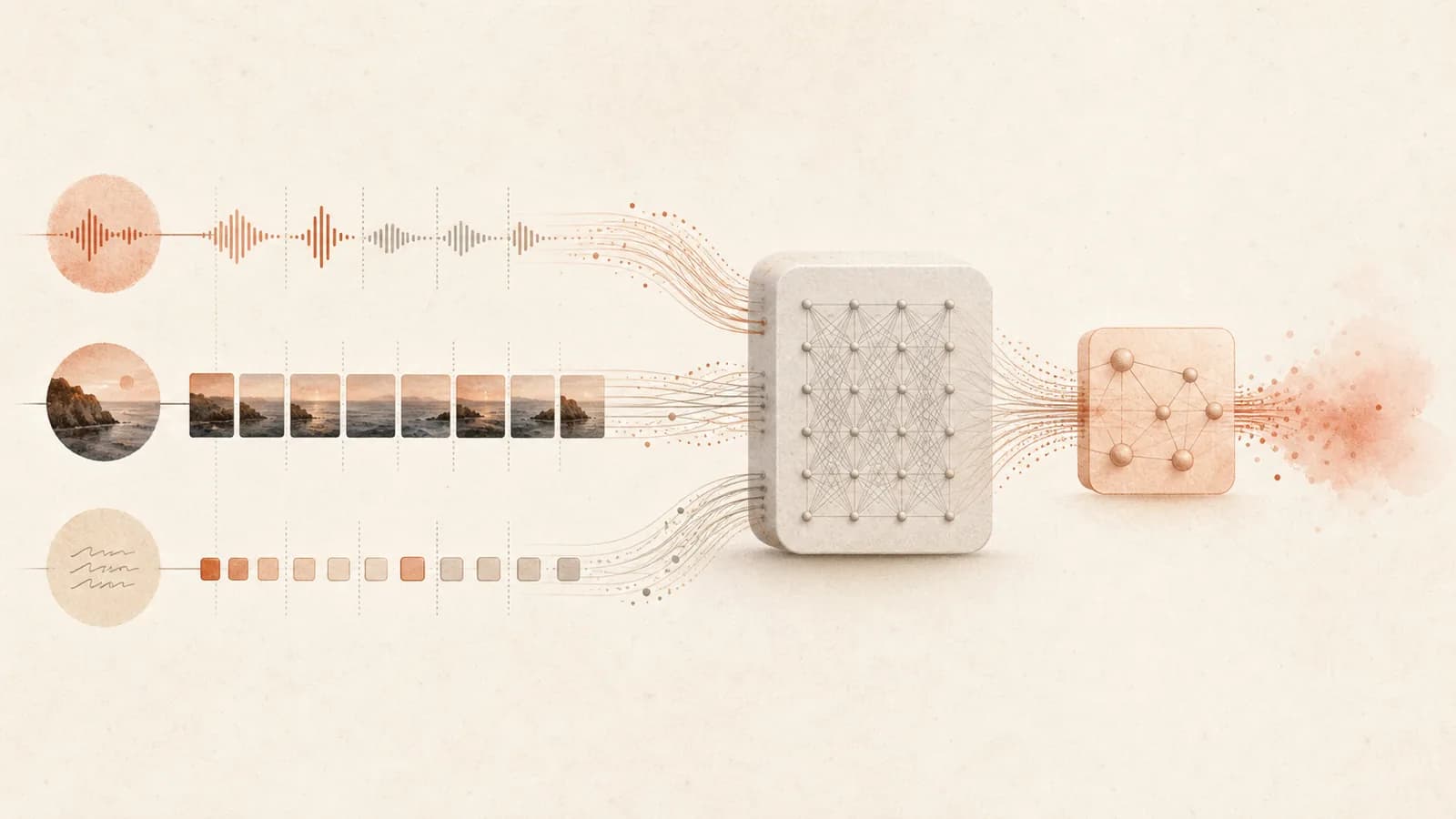
- Modalities: continuous audio + video + text in; text + audio out. Encoder-Free Early Fusion (dMel audio embedding, 40×40-patch hMLP for frames, flow head for audio out), single shared transformer, all components co-trained from scratch.
- Interaction mechanism: Time-Aligned Micro-Turns — 200ms interleaved input/output chunks, no turn boundaries.
- Reasoning: delegates deep reasoning / tool use / long-horizon work to an async background model — see Interaction / Background Model Split. Competitive on intelligence benchmarks even without the background agent.
Headline numbers (May 2026)#
- Turn-taking latency: 0.40s (FD-bench v1, audio) — best of all models compared.
- FD-bench v1.5 average: 77.8 vs ~39–54 for baselines including thinking-high models.
- FD-bench v3 (audio+tools): 82.8% response quality / 68.0% Pass@1 (with background agent).
- Audio MultiChallenge APR: 43.4% — beats every non-thinking baseline; only GPT-realtime-2.0 xhigh (48.5%) higher.
- Baselines compared: GPT-realtime-2.0 (minimal/xhigh), GPT-realtime-1.5, Gemini-3.1-flash-live-preview (minimal/high), Qwen 3.5 Omni-plus-realtime. Full table in Interactivity Benchmarks.
Limitations (acknowledged)#
- Long continuous A/V sessions accumulate context fast — careful context management still an open problem (echoes Context Window Smart Zone).
- Needs reliable low-latency connectivity; degrades badly without it.
- "Small" because larger pretrained models are currently too slow to serve in this regime — larger models promised later in 2026.
Availability#
Limited research preview "in the coming months," wider release "later this year." Feedback solicited at interaction@thinkingmachines.ai; research grants open.
The Inkling connection (July 2026)#
Inkling-Small — the preview sibling of TML's open-weights release — is a 276B MoE with 12B active: this model's exact dimensions, from the same lab, two months later, with the same encoder-free dMel/hMLP input stack. TML doesn't state the two share weights, but the announcement says Inkling is designed to be the background reasoning model this model delegates to (Interaction / Background Model Split) — so the "larger models later in 2026" promised at preview time arrived as an open-weights family whose small member mirrors the interaction model's shape.
Connections#
- Interaction Models — the model class
- Thinking Machines Lab — who built it
- Time-Aligned Micro-Turns / Encoder-Free Early Fusion / Interaction / Background Model Split — its three architectural pillars
- Full-Duplex Interaction — the interaction modes it demonstrates
- Interactivity Benchmarks — its full benchmark table and the baselines it beats
- Claude Opus 4.7 — both era-mates (mid-2026 frontier); 4.7's
xhigheffort tier mirrors GPT-realtime's minimal/xhigh, used here as a baseline config - Context Window Smart Zone — the long-session limitation
- Gemma 4 — arrives at the same encoder-free design two months later, from memory constraints rather than latency; the closest thing to independent replication of TML's architectural bet
- Inkling — the background-model family whose small member shares this model's 276B/12B shape
Sources#
- Interaction Models: A Scalable Approach to Human-AI Collaboration
- Inkling: Our Open-Weights Model — Inkling-Small's matching dimensions; Inkling as designed background model (
vendor-claim)
Cited by 13
- Inkling×4
Inkling-Small is a 276B MoE with 12B active — exactly the shape of Tml Interaction Small, TML's May…
- Thinking Machines Lab×3
Interaction Models (May 2026 research preview) — models that natively take in audio/video/text and…
- Interaction / Background Model Split×2
At the split's introduction the background model was an unnamed capability. Inkling fills the slot:…
- Interaction Models×2
An interaction model is a model that handles interaction natively — continuously taking in audio,…
- Interactivity Benchmarks×2
The evaluation surface Thinking Machines Lab uses to argue Tml Interaction Small is "the first…
- Claude Opus 4.7
Tml Interaction Small — era-mate (mid-2026 frontier from a different lab); 4.7's xhigh effort tier…
- Encoder-Free Early Fusion
Tml Interaction Small — the model that implements this design (dMel audio, 40×40 hMLP patches, flow…
- Full-Duplex Interaction
Tml Interaction Small — the model that demonstrates these interaction modes
- GPT-Live
Tml Interaction Small — the research-preview sibling: same architectural conclusions from Thinking…
- Kimi (Moonshot AI)
K3 ships a 401M MoonViT-V2 vision encoder at 2.8T scale. Encoder Free Early Fusion documents three…
- Entities — People, Orgs, Tools & Projects
Tml Interaction Small — TML's first interaction model: 276B MoE / 12B active, audio+video+text in /…
- Open Questions Backlog
Inkling ×3 (oldest 50d) — Inkling-Small's 276B/12B dimensions match Tml Interaction Small exactly.…
- Time-Aligned Micro-Turns
Tml Interaction Small — the model built on this mechanism (200ms interleaved input/output chunks)
Related articles
- Interaction Models
Thinking Machines Lab (May 2026): models that handle audio/video/text interaction natively in real time instead of via…
- Encoder-Free Early Fusion
Multimodal design with minimal pre-processing instead of large standalone encoders: TML co-trains dMel audio + 40×40-pa…
- Interaction / Background Model Split
Dual-model architecture: time-aware interaction model stays present; async background model handles deep reasoning/tool…
- Full-Duplex Interaction
Perceive-and-respond simultaneously across modalities; proactive interjection, visual-cue reactions, simultaneous speec…
- Inkling
Thinking Machines Lab's first from-scratch open-weights family (July 2026): a 975B/41B-active multimodal MoE with 1M co…