Sources#
- How we built a realtime system for responsive voice AI in six months
- Interaction Models: A Scalable Approach to Human-AI Collaboration
Summary#
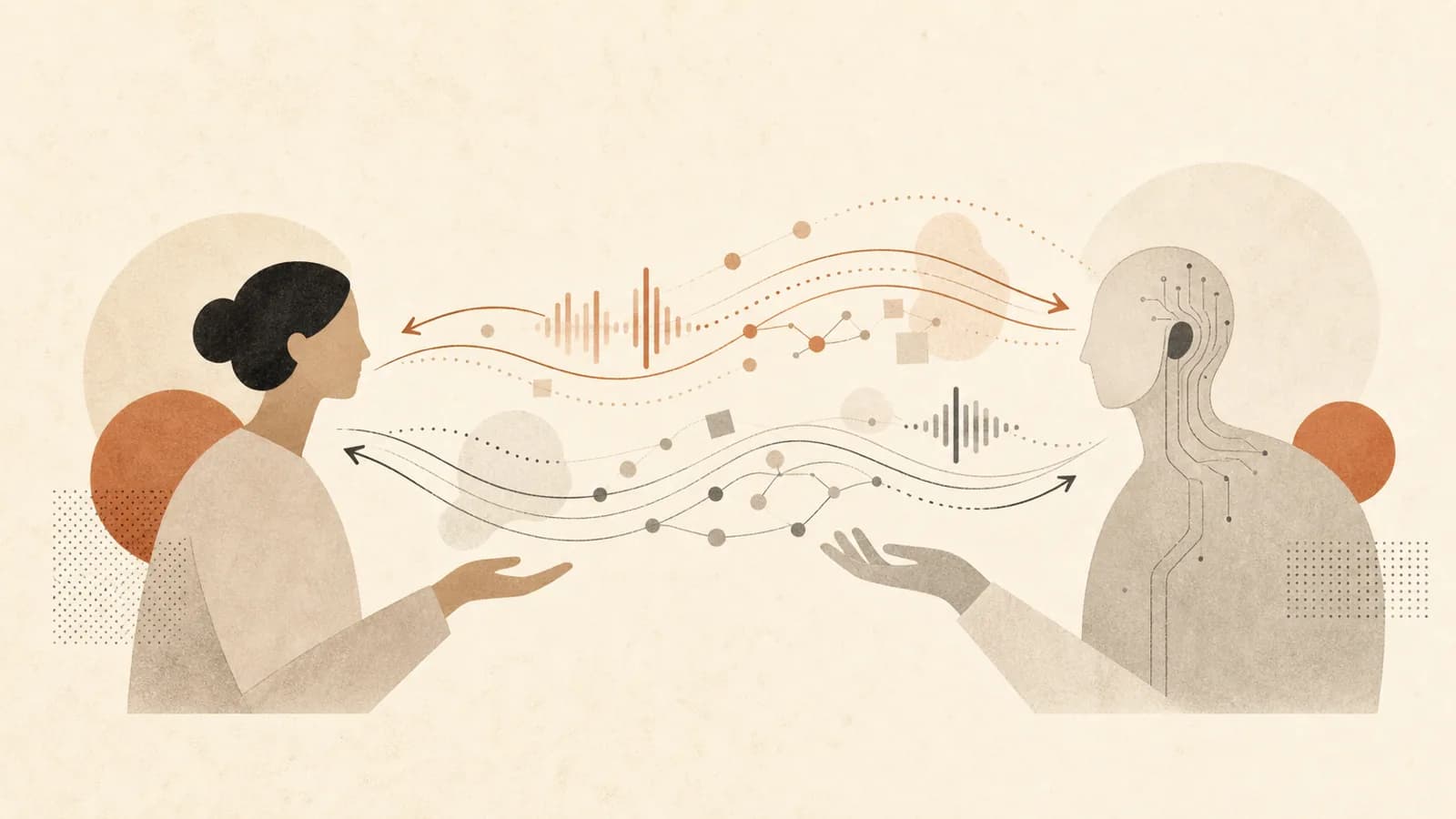
"Full-duplex" = the model perceives and responds at the same time, in a constant two-way exchange — as opposed to half-duplex turn-taking (one party at a time). Interaction Models generalize the audio full-duplex idea across audio, video, and text. The phrase the post uses: an experience that "feels more like collaborating and less like prompting."
The interaction modes it enables#
All of these are special-purpose harnesses today; in an interaction model they're special cases of model behavior (see Time-Aligned Micro-Turns):
- Proactive interjection — "interrupt when I say something wrong"; the model jumps in mid-turn when context warrants, not only at end-of-turn.
- Visual-cue reactions — "tell me when I've written a bug in my code"; "count how many pushups I do"; requires acting on a visual change with no audio cue (audio-only turn-detection harnesses fail this — they say "Sure thing!" then go silent).
- Simultaneous speech — user and model speak concurrently: "translate Spanish→English live."
- Speak-while-watching — "live-commentate this sports game."
- Time-aware speech — "remind me to breathe in and out every 4 seconds until I stop"; "how long did it take me to write this function?"
- Codeswitch correction — "every time I use another language, give me the correct word in the original language" (requires speaking at the same time as the user).
The model implicitly tracks whether the speaker is thinking, yielding, self-correcting, or inviting a response — no separate dialog-management component.
Concurrent non-speech action#
While listening and speaking, the model can simultaneously call tools, search, browse, or generate UI — weaving results back into the conversation when appropriate. The deeper/longer of these are delegated to the background model.
Prior art it builds on#
Audio full-duplex models are the existing example of bidirectional/continuous interaction; robotics and autonomous vehicles are cited as domains where real-time perception+action is a given. Interaction models apply the principle across all modalities.
In production: GPT-Live (July 2026)#
OpenAI's GPT-Live ships audio full-duplex at ChatGPT scale: "its voice model is full-duplex, which means it can listen and speak at the same time. That eliminates the need for a separate detector" — the turn detector is out of the audio path entirely, and turn-taking, interruption, and floor-holding become model behavior. Scope difference worth keeping: GPT-Live is audio-only full-duplex with concurrent tool use delegated out (Interaction / Background Model Split); TML's cross-modal generalization (visual-cue reactions, speak-while-watching) remains a research preview. The systems consequence of full-duplex — the conversation becomes a continuous media loop where every frame must arrive on schedule — is what forces the serving architecture in Live-Path Minimalism.
Connections#
- Interaction Models — parent concept
- Time-Aligned Micro-Turns — the mechanism (no turn boundaries) that makes full-duplex possible
- Encoder-Free Early Fusion — joint multimodal reasoning is what lets a visual change trigger speech
- Turn-Based Interface Bottleneck — the half-duplex status quo this replaces
- Interactivity Benchmarks — TimeSpeak / CueSpeak / RepCount-A / ProactiveVideoQA / Charades measure exactly these modes
- Interaction / Background Model Split — where the concurrent deep work goes
- TML-Interaction-Small — the model that demonstrates these interaction modes
- GPT-Live — audio full-duplex in production; the turn detector eliminated at ChatGPT scale
- Live-Path Minimalism — the serving architecture the every-frame-on-schedule constraint forces
Sources#
- Interaction Models: A Scalable Approach to Human-AI Collaboration
- How we built a realtime system for responsive voice AI in six months — OpenAI, 2026-07-29 (
case-study): audio full-duplex in production; detector removal
Cited by 11
- The Future of Agent Interfaces×4
Human collaboration · Interaction Models / Full Duplex Interaction · Human senses, speech, screen,…
- Encoder-Free Early Fusion×2
Early fusion (everything into one transformer) means the model reasons jointly over modalities…
- GPT-Live×2
OpenAI's third-generation voice system, launched July 2026 — a full-duplex voice model (Full Duplex…
- Interaction Models×2
See Full Duplex Interaction and Interactivity Benchmarks for how these are demonstrated and…
- Live-Path Minimalism×2
The serving-side architecture behind Gpt Live, stated by OpenAI as one principle: "the voice must…
- Time-Aligned Micro-Turns×2
Every interaction mode that needs a special-purpose harness today becomes a special case of model…
- Interaction / Background Model Split
Full Duplex Interaction — where the concurrent deep work goes while the interaction model stays…
- Interactivity Benchmarks
Full Duplex Interaction — TimeSpeak/CueSpeak/RepCount-A/ProactiveVideoQA/Charades each target one…
- Interaction & Multimodal
Full Duplex Interaction — Perceive-and-respond simultaneously across modalities; proactive…
- TML-Interaction-Small
Full Duplex Interaction — the interaction modes it demonstrates
- Turn-Based Interface Bottleneck
Full Duplex Interaction — the interaction modes the bottleneck currently blocks
Related articles
- Interaction Models
Thinking Machines Lab (May 2026): models that handle audio/video/text interaction natively in real time instead of via…
- Interaction / Background Model Split
Dual-model architecture: time-aware interaction model stays present; async background model handles deep reasoning/tool…
- Time-Aligned Micro-Turns
The core interaction-model move: input/output as continuous streams in ~200ms interleaved chunks, no turn boundaries; s…
- Live-Path Minimalism
GPT-Live's serving principle — "the voice must flow": the realtime media loop is the only thing on the live path; deleg…
- TML-Interaction-Small
TML's first interaction model: 276B MoE / 12B active, audio+video+text in / text+audio out, 200ms micro-turns, async ba…