Sources#
- Beyond Benchmarks 2026: Five Data Sets Grounded in the Real World
- Do Context Files Help Coding Agents? A Two-Agent Ablation Study on Real Repositories
- Engines of Growth: Global Startup Trends Report
- State of AI 2026: The Builder's Economy
- The Founder's Playbook: Building an AI-Native Startup
Summary#
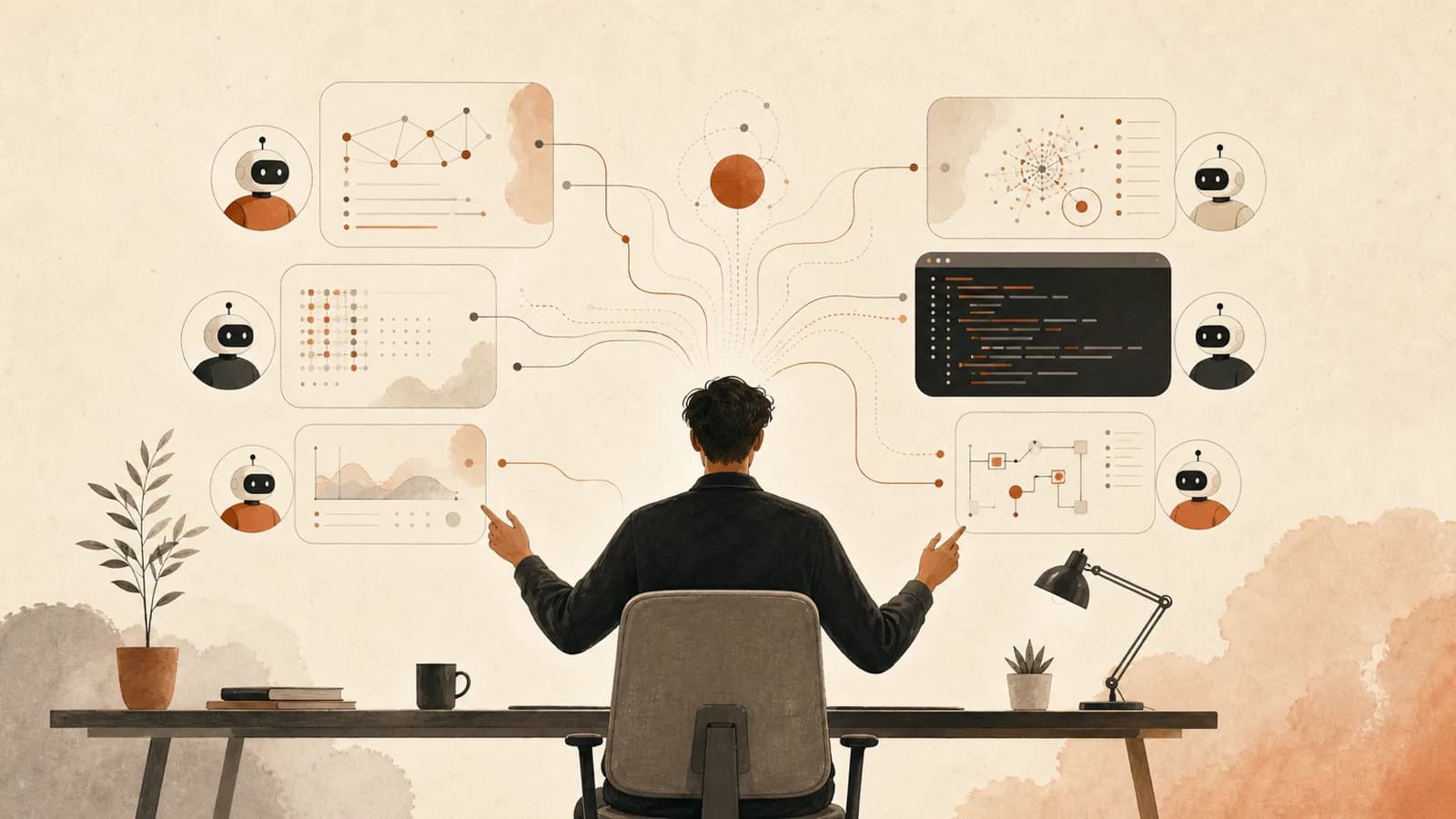
The Founder's Playbook: Building an AI-Native Startup's thesis on how the founder role changes in an AI-native startup: founders historically spent the bulk of their time in execution mode (writing code, managing people, handling day-to-day ops). The 2026 founder role is "much less individual contributor and much more orchestrator of agents" — specialized AI assistants that read files, run commands, execute code, browse the web. The founder's attention shifts up the stack from doing the work to generating ideas and directing the systems that carry those ideas out.
The most consequential implication: the wall between "people who can build" and "people with ideas worth building" has dissolved. Non-technical founders with subject-matter expertise can now build production software; technically adept founders with no business background can produce GTM strategy, financial models, and pitch decks. The founding pool expands beyond engineering-background candidates.
What the role becomes at each stage#
The orchestration shape evolves across the AI-Native Startup Lifecycle:
| Stage | Founder spends time on | AI handles |
|---|---|---|
| Idea | Hypothesis design, customer interviews, validation discipline | Research, competitive mapping, devil's advocate analysis, interview-framework audits, outreach automation |
| MVP | Scope/architecture decisions, user-feedback judgment, pivot/persevere calls | Code generation, security review, measurement framework, feedback logistics |
| Launch | Operational system design, what-to-systematize decisions, founder-only work identification | Codebase audit, technical-debt sequencing, operational-load mapping, PM operating system |
| Scale | Product narrative, board relationships, enterprise deals, founder-to-founder conversations | Enterprise support layer, GTM execution, domain-knowledge encoding, moat narrative |
The pattern: founders do less work and more direction. The work that's left is the work that genuinely requires founder judgment — taste, narrative, relationships, the decisions that compound over years.
The "lean 10-person unicorn" claim#
The playbook positions extreme leanness as deliberate target, not scrappy outlier:
"Early-stage startups in 2026 are radically different. They're extremely lean by design, often just the founder alone or a team with a few others. By centering both technical and organizational development on AI as infrastructure, they can reach product validation, early revenue, or even profitability before scaling the team."
The structural claim is that three function-specific hires that used to gate stages (engineers to build, salespeople to sell, ops people to run the business) can be substantially replaced by three Claude surfaces:
- Conversational intelligence and research ("on-call expert for every domain") — replaces consultants and partial-research-team functions
- Agentic coding ("the engineer who's always available, never blocked") — replaces contract dev shops and early engineering hires
- Workflow automation ("on-demand, automated ops team") — replaces operational/admin headcount
This does not eliminate engineering or operations work; it eliminates the headcount gate on doing engineering or operations work. The founder still has to know what to build, still has to design the workflows, still has to direct the agents.
The lean-org claim, measured (Emergence Capital, June 2026)#
Emergence Capital's Beyond Benchmarks 2026 puts numbers on the leanness the playbook only asserts, and on where the remaining headcount concentrates — five partner datasets (Carta, Pave, Ashby, Standard Metrics, Stackpack) over 50K+ operating companies:
- Team sizes at each round are down and still falling (Carta medians, 2021 peak → 2025): Seed 10.3 → 6.2, Series A 25.9 → 16.8, Series B 72.3 → 48.2; median days to first hire 214 → 284. Founders run leaner and stay solo/tiny longer than any prior cohort — the structural precondition the orchestrator role assumes, now with a 2020–2025 series behind it.
- AI companies allocate headcount structurally differently. Where they do hire, AI companies concentrate in engineering (+11pp share vs. the broader tech market; 53% vs. 42% engineering at 1,000+ employees) at the expense of customer-facing and operational functions — leaner Sales (17% vs. 19%), Customer Support (−5pp), Finance (−3pp). This is the orchestrator thesis visible in aggregate data: the support/ops functions the playbook says agents can run stay structurally lean while builder headcount is where the money goes.
The caveat matches the source: VC-published, data-partner-sourced; the Carta headcount cohort is market-wide, so the medians describe the population, not a clean measurement of the deliberately-lean orchestrator-founder tail. And note the counter-signal — the average AI company staffs up aggressively (see AI Investment Story, Not Efficiency Story), so its revenue-per-employee is currently lower than non-AI peers; the ultra-lean orchestrated org lives in the tail, not the mean.
The lean-team claim, self-reported (AWS, June 2026). AWS's Engines of Growth founder survey restates the orchestrator premise in the survey's own voice — AI-natives are "scaling output with around half the staff," and "work that previously needed dozens of engineers, years of funding, and infrastructure spread around the world can now be assembled in weeks by a small team." Its worked exhibit is Mindflow (France): a 40-person team building AI-driven IT/security/cloud automation that serves ~100 major enterprises (LVMH, Hermès, Thales, Bouygues, Uniqlo) and has saved them 316,000+ hours — a small team directing agent-driven leverage across a large enterprise book, the orchestrator shape at company scale. This is self-reported vendor marketing (treat as illustration, not measurement), and it inherits the same tail-vs-mean caveat: the survey's AI-native cohort is a curated frontier subset, not the aggressively-staffing average AI Investment Story, Not Efficiency Story measures.
The flatter, leaner org, surveyed (ICONIQ, Q2 2026). ICONIQ's State of AI 2026 (~305 AI-building software companies, empirical) measures the intent to run leaner: 33% plan a smaller team than they otherwise would, given AI efficiency gains (a further 45% plan a different role mix without net reduction, N=302). The orchestrated org's flatness shows up structurally — at $100M+ scale, 72% of 50%+-AI-revenue companies run on just 1–4 management layers vs 56% of peers, and high-growth firms are widening first-line spans of control (R&D managers with 7+ reports 21%→30%). The sharpest orchestrator exhibit is a network anecdote: one early-stage company runs unlimited tokens but holds managers to 3–5× productivity with delivery accountability (top engineers spending up to $8K/day of inference), and it "collapsed PM and designer into single-person product ownership" — the company-of-few orchestrating agent leverage rather than adding heads. This is survey-of-intent plus anecdote, not a headcount census; the full restructuring cut lives at AI-Native Organization.
The orchestration-vs-tool framing tension#
A significant tension with AI Employee Framing (Kropp et al., HBR May 2026, n=1,261): the playbook leans heavily into anthropomorphic framings — "on-call expert," "engineer who's always available," "automated ops team," "construction crew." The Kropp et al. experimental work shows that framing AI agents as employees (vs. tools) measurably:
- Reduces personal accountability for AI-produced output (−9 percentage points)
- Increases unnecessary escalation (+44%)
- Reduces error catching (−18%)
- Does not improve adoption
The playbook does not engage this evidence. The orchestration framing is positioned as enabling (founders unblocked by lack of headcount) but it is structurally close to the framings HBR's experiments tested against.
Disciplined synthesis: orchestration as a workflow design (multiple specialized agents, defined handoffs, founder direction) is structurally distinct from orchestration as a mental model of agents-as-coworkers. The first preserves accountability; the second may not. See Human-AI Accountability Redesign for the prescription on how to preserve accountability under orchestration loads.
Who newly becomes a founder#
A non-obvious effect the playbook flags:
"When the founding pool expands beyond people with engineering backgrounds, you get startups built by people with radically different lived experiences, solving real problems that the traditional tech-founder pipeline never prioritized (or perhaps even noticed)."
The implicit prediction: the 2026-2030 wave of AI-native startups will solve different problems than the 2010-2020 SaaS wave because the founders come from different professional backgrounds. Concrete examples in the playbook's resources section:
- Anything — non-technical founder running a full recruiting platform
- Kindora — nonprofit executive building charity-funder matching
- Wordsmith — lawyer-turned-CTO building legal tech
- GC AI — domain-expert founders building for how in-house legal teams actually work
The pattern: founders with deep professional context in a vertical, building the tool they personally wished existed. This connects directly to Printing Press Software Democratization — domain knowledge becomes the differentiator once coding skill is universal.
What stays human#
The playbook explicitly preserves a class of work as founder-only:
- Product narrative decisions
- Board relationships
- Enterprise deals
- Founder-to-founder conversations
- "The judgment calls that become your moat"
The Launch and Scale chapters frame the operational systems' purpose as "free your attention for the decisions only a founder can make" — not "remove the founder from the company." The orchestration role exists to amplify founder judgment, not replace it.
Connections#
- The Solo-Founder Shift — the measured qualification: this role is real but short-lived, with solo founders hiring a first employee at a median 399 days — earlier than co-founded teams. Agents relieve implementation, not the founder's serial attention ("by default, a solo founder is single-threaded")
- AI-Native Startup Lifecycle — the lifecycle this role runs through
- Engineer PM Convergence — within-company analogue (Cat Wu on Anthropic's roles merging); founder-as-orchestrator is the same shift at company-of-one scale
- Printing Press Software Democratization — macro analogy; coding becomes universal so domain knowledge differentiates
- AI Employee Framing — counter-evidence on orchestration framing's risks
- Human-AI Accountability Redesign — prescription for preserving accountability under orchestration
- Seven Powers Applied to AI — which moats this role can still build (network effects, scale, cornered resources persist; switching costs and process power erode)
- Harness Shrinkage as Models Improve — orchestration affordances will themselves shift as harness shrinks
- Claude Code / Cowork / Anthropic — the surfaces orchestration runs on
- Problem-Solution Fit Discipline — the discipline that prevents orchestration speed from outrunning founder judgment
- AI Brain Fry — cognitive cost of oversight scales with number of agents being orchestrated; risk for solo founders running many parallel sessions
- Compounding Data Moat — the role's long-term defensibility goal: encode the founder's domain knowledge into the substrate the orchestration runs on
- Founder-Led Sales Discipline — explicit counterpoint: John Glasgow argues founders should not offload sales (to an AE or an agent) until PMF; reconciled by scope — orchestrate mechanical work, not the founder's core customer-signal loop
- The AI-Native Safe-Choice Inversion — the demand-side tailwind that makes the lean AI-native startup sellable: buyers now want AI-native, giving the orchestrator-founder air cover
- Parallel Agent Orchestration — the measured form of this role: OpenAI's Codex data shows 28.6% of OpenAI workers managing 5+ concurrent agents — the orchestrator workflow with adoption numbers and a frontier-preview ceiling
- AI Investment Story, Not Efficiency Story — the counter-signal from the Emergence data: the average AI company staffs up aggressively (engineering-heavy) and posts lower revenue-per-employee than non-AI peers, so the ultra-lean orchestrated org is the tail, not the mean
- Firm AI-Spend Intensity and Headcount Growth — a second counter-signal, with an explicit population caveat: established US firms that adopt AI intensively grow headcount ~10% (broadly across roles), not shrink — so "AI enables leaner teams" is specific to AI-native startups built lean from day one, not a universal law; incumbents bolt AI onto expansion rather than substitution
- AI-Native Organization — Tan's generalization past the founder: at YC "everyone is a manager of agents now," including media, events, and finance staff — the orchestrator role diffused to every seat, encoded as skill files rather than held as a founder skill
Derived#
- Orchestration vs Employee Framing: Reconciling the Founder's Playbook with HBR's Accountability Evidence — full reconciliation of this role's orchestration framing with HBR's accountability evidence; resolves the tension flagged in this article's "Open questions" section
- The Orchestrator's Real Workload: Decision Burden, Framing Discipline, and Whether Taste Scales — the decision-burden question synthesized against the July 2026 oversight evidence: load is higher and reshaped, bounded only by structural redesign
Open Questions#
- The playbook claims non-technical founders can now build production software, but it does not address the architectural-judgment recursion problem (Agentic Technical Debt): non-technical founders may not have the vocabulary to write effective CLAUDE.md. How does that scale? (Partially answered — by deflation — Khatri 2026, arXiv 2607.27250,
empirical: in a 288-run two-agent ablation, having a Good/Excellent-ratedAGENTS.mdproduces no measurable correctness gain over having none (bounded <10–15pp), and the real file never converts a near-miss to a pass in a 36-cell probe. If the file the non-technical founder cannot write buys ~0 correctness, the recursion is a smaller tax than the playbook's own framing implies. Two reasons this doesn't close the question: the ablation measures single-session task correctness, not the cross-session architectural coherence this recursion is actually about, and the deficit it identifies as gating — implementation skill: feature design, pattern selection, exact wiring — is precisely the judgment a non-technical founder also lacks and cannot delegate to a file. The recursion may not run through the context file at all; it runs through review.) - The "lean 10-person unicorn" is asserted; no quantitative data in the playbook on actual headcount-at-PMF or headcount-at-Series-A medians for AI-native startups vs. the prior cohort. (Partially answered: Emergence Capital, June 2026 gives Carta round-medians with a 2020–2025 series — Series A 16.8 (down from the 2021 peak of 25.9), Seed 6.2 (from 10.3), Series B 48.2 — the prior-cohort comparison the playbook lacked, plus the AI-vs-all-tech headcount-allocation split (engineering-heavy, lean support). Still open: these are round-medians, not headcount-at-PMF; and the Carta cohort is market-wide, not split AI vs non-AI at Seed/A.)
- How does the orchestration role change the founder's decision burden? Fewer hands-on tasks but more parallel agent oversight; net cognitive load is unclear and may be higher (see AI Brain Fry). Partially answered: The Orchestrator's Real Workload: Decision Burden, Framing Discipline, and Whether Taste Scales — higher and reshaped: execution load is exchanged for oversight load at an unfavorable rate, because the incoming work is the error-prone kind (+39% major errors under fatigue), the invisible kind (rubber-stamped planning decisions are transcript-indistinguishable from judgment), and non-monotonic in value (HAS-Bench's returns-curve peak — over-intervention breaks tasks). The load is bounded only by deliberate structure: bounded parallelism, sampled review, high-stakes gates. Still unmeasured: founder-side oversight load directly — concurrency telemetry sums agent-hours, not human attention.
- Anthropic publishes both the playbook's anthropomorphic framing and HBR-aware accountability work (auto-mode, alignment) simultaneously without engaging the framing literature directly. The synthesis in Orchestration vs Employee Framing: Reconciling the Founder's Playbook with HBR's Accountability Evidence reconciles the tension at the operational level — orchestration as workflow design preserves accountability; orchestration as mental model of agents-as-coworkers does not — but the open question of why the playbook's marketing language doesn't reflect Anthropic's own framing-discipline work remains.
Sources#
- The Founder's Playbook: Building an AI-Native Startup — primarily Chapter 2 ("What it means to be a founder is changing") + role-shift framings throughout
- Research: Why You Shouldn’t Treat AI Agents Like Employees — counter-evidence on framing effects
- Anthropic's Boris Cherny: Why Coding Is Solved, and What Comes Next — Boris's "best person to write accounting software is a really good accountant" thesis
- How Anthropic's product team moves faster than anyone else | Cat Wu (Head of Product, Claude Code) — Cat Wu's within-Anthropic role-convergence observations
- Beyond Benchmarks 2026: Five Data Sets Grounded in the Real World — Emergence Capital, Beyond Benchmarks 2026 (June 2026): headcount-by-round medians and the AI-vs-all-tech headcount-allocation split — the empirical grounding for the lean-org claim. Note: several tables in this PDF-derived raw have collapsed multi-value cells (the Core Four table stacks Top Decile over Top Quartile into one cell —
736% 184%) — the figures quoted here come from the report's prose bullets and from the p37 headcount-allocation charts re-read in the source PDF, not from a parsed table - Engines of Growth: Global Startup Trends Report — AWS Startups, Engines of Growth (June 2026, self-reported vendor survey): the "half the staff" lean-team framing and the Mindflow 40-person exhibit
- State of AI 2026: The Builder's Economy — ICONIQ Growth, State of AI 2026: The Builder's Economy (2026-07-08,
empirical): §"Talent & Organization" — 33% plan a smaller team (N=302), flatter management layers (72% vs 56% on 1–4 layers at $100M+), widening spans of control, and the single-person-product-ownership network anecdote - Do Context Files Help Coding Agents? A Two-Agent Ablation Study on Real Repositories — Prakhar Khatri, arXiv 2607.27250, 2026-07-28 (
empirical): the context-file ablation that deflates the CLAUDE.md-recursion objection to this page's non-technical-founder claim — flat pass-rates with and without the file, and a failure triage locating the gating deficit in implementation skill rather than in written architectural intent
Cited by 30
- AI-Native Startup Lifecycle×6
The framework carries a second AI-era amendment from the same document, and it is stated by Thawar…
- AI-Native Organization×5
The org precedes the company. The AI-native shape is no longer something a startup is founded into;…
- Open Questions Backlog×4
Founder As Agent Orchestrator: The playbook claims non-technical founders can now build production…
- Agentic Technical Debt×3
Founder As Agent Orchestrator — non-technical founder pipeline raises the stakes: the founders most…
- How AI-Native Startups Avoid Speed Becoming Strategic Debt×3
Founder As Agent Orchestrator is useful only if orchestration means workflow design under founder…
- AI Investment Story, Not Efficiency Story×2
Founder As Agent Orchestrator — the same tension at the role level: the orchestrator-founder builds…
- Anthropic×2
2026 May — "The Founder's Playbook" ebook published (Anthropic Startups Program); first…
- Founder-Led Sales Discipline×2
Founder As Agent Orchestrator — the explicit counterpoint; reconciled by scope (mechanical work)…
- John Glasgow×2
Founder-led sales, even in the AI era. He got Campfire to ~$1M ARR as the sole AE doing every demo…
- Startup & Founder×2
Founder As Agent Orchestrator — Founder role shift: less individual contributor, more orchestrator…
- The Orchestrator's Real Workload: Decision Burden, Framing Discipline, and Whether Taste Scales×2
Founder As Agent Orchestrator — how does the orchestration role change the founder's decision…
- Parallel Agent Orchestration×2
Two of the three "how" margins in OpenAI's Codex usage study — concurrency (running multiple agents…
- The Solo-Founder Shift×2
Founder As Agent Orchestrator — the qualification: the orchestrator-founder is real but short-lived…
- AI Brain Fry
Solo-founder amplifier: Founder As Agent Orchestrator — running many parallel agent sessions scales…
- AI Employee Framing
Tension surface: Founder As Agent Orchestrator — the Founder's Playbook (Anthropic, May 2026) leans…
- The AI-Native Safe-Choice Inversion
Founder As Agent Orchestrator — the orchestrator-founder thesis assumes this AI-native-is-safe…
- Campfire
Founder As Agent Orchestrator — Glasgow's "don't offload sales to an AE or an agent" is an explicit…
- Claude Code
Founder As Agent Orchestrator — the founder-role shift Claude Code enables for non-engineering…
- Compounding Data Moat
Founder As Agent Orchestrator — the domain-expert founder pipeline that makes deep vertical…
- Cowork
Founder As Agent Orchestrator — Cowork plus MCP integrations is what makes the orchestrator role…
- Engineer PM Convergence
Founder As Agent Orchestrator — within-company role merging extrapolated to the…
- Firm AI-Spend Intensity and Headcount Growth
Founder As Agent Orchestrator — a counter-signal to the lean-team reading, with a population…
- Garry Tan
Founder As Agent Orchestrator — the role he prescribes to every YC founder and generalizes to…
- Harness Shrinkage as Models Improve
Founder As Agent Orchestrator — orchestration affordances themselves will shift as harness shrinks;…
- Human-AI Accountability Redesign
Solo-founder application: Founder As Agent Orchestrator — the five-pillar redesign framework…
- Open Questions Dashboard
Founder As Agent Orchestrator: How does the orchestration role change the founder's decision…
- Orchestration vs Employee Framing: Reconciling the Founder's Playbook with HBR's Accountability Evidence
Founder As Agent Orchestrator — the role-shift this synthesis governs
- Printing Press Software Democratization
Founder As Agent Orchestrator — the role-shift the democratization produces; founders newly come…
- Problem-Solution Fit Discipline
Founder As Agent Orchestrator — orchestration role amplifies confirmation bias risk; without…
- Seven Powers Applied to AI
Founder As Agent Orchestrator — the role this analysis governs: which moats a lean-unicorn founder…
Related articles
- AI-Native Startup Lifecycle
Anthropic's May 2026 reframing of Idea/MVP/Launch/Scale assuming AI infrastructure: each stage's headcount/capital/skil…
- Compounding Data Moat
Anthropic's prescription for Scale-stage defensibility: time-locked behavioral fingerprint + domain-encoded edge cases…
- Claude Code
Anthropic's agentic coding product; created by Boris Cherny late 2024; TypeScript/React on Bun (itself Claude-rewritten…
- Engineer PM Convergence
Generalists across disciplines; product taste as bottleneck skill; Anthropic Claude Code team as case study; "just do t…
- AI Employee Framing
Kropp et al. (HBR May 2026, n=1,261): framing AI agents as "employees" vs "tools" cuts personal accountability −9pp, in…