Sources#
- 2026 State of Scaling: The Great Sorting
- Beyond Benchmarks 2026: Five Data Sets Grounded in the Real World
- Engines of Growth: Global Startup Trends Report
- Founder Ownership Report 2026
- Indian AI Coding Startup Emergent Becomes a Unicorn with $130M Series C
- Inside AI-pilled engineering teams: Five lessons for scaling without losing the plot
- The Founder's Playbook: Building an AI-Native Startup
- The ICONIQ Pacesetter Index
Summary#
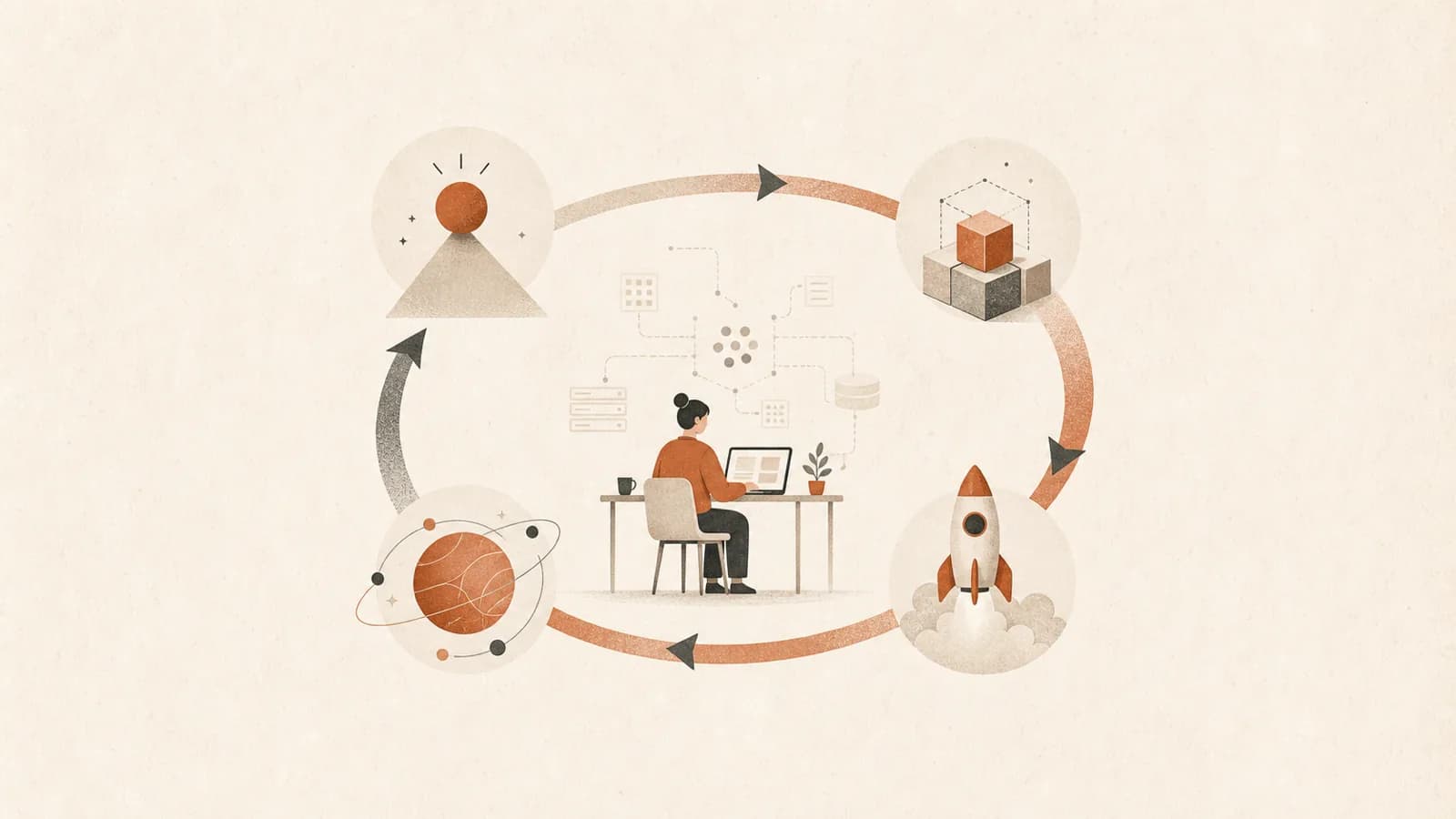
Anthropic's 2026 reframing of the canonical Lean/YC startup arc (validate → raise → hire → build → raise more → grow → hire more) into four stages explicitly assuming AI as core infrastructure: Idea → MVP → Launch → Scale. The structural change is that each new phase no longer requires a bigger team, a different skill set, or a fresh funding round. The "lean 10-person unicorn" is positioned as the deliberate target, not the scrappy outlier. Each stage retains its traditional exit criteria (problem-solution fit → product-market fit → repeatable growth → defensible scale) but the path through compresses quarters into weeks.
Source#
The Founder's Playbook: Building an AI-Native Startup (Anthropic, May 2026). 36-page ebook organized around this four-stage frame; positions Claude (Chat / Cowork / Code) as the infrastructure that makes each stage doable without traditional headcount.
The four stages#
Idea — research-oriented validation#
Goal: assemble qualitative evidence that a real problem exists and that the proposed solution addresses it, before committing build resources.
Exit criteria (all three must be yes):
- The problem is real and specific — you can name who has it, how often, how severely, what they do today.
- Your solution addresses the actual problem (not the one you originally assumed; validation often reshapes it).
- Enough signal to justify building — qualitative evidence that committing to an MVP is a reasoned decision over an act of faith.
Stage hazards (Problem-Solution Fit Discipline):
- Mistaking building for validating (a working prototype is not evidence the problem is real).
- Premature scaling (agentic coding can scale execution far ahead of validated direction).
- Loss of objectivity (AI follows your direction — confirmation bias gets a research engine).
AI's role: research partner. Devil's advocate for the hypothesis. Build TAM/SAM/SOM with pressure-tested assumptions. Competitor-mapping by tier (direct, indirect, potential acquirer, adjacent). Interview-framework audits to surface leading or future-facing questions. Claude Code enters only at the very end for a lightweight prototype to use as a prop in customer conversations — not as the product.
MVP — translate validated problem to working product#
Goal: smallest, most-focused iteration that puts the solution in front of real users and generates evidence of product-market fit. Equally important secondary goal: build without accruing the kind of Agentic Technical Debt that compounds.
Exit criteria: specific identifiable users return to it (retention), pay for it (revenue), or tell others about it (referral). Useful litmus tests:
- Sean Ellis test — >40% of active users say "very disappointed" if they could no longer use it.
- Effort test — retention starts pulling instead of pushing; the heroic founder energy required to keep users engaged drops.
Stage hazards:
- Agentic Technical Debt — compounds, not just accumulates.
- False product-market fit — early traction from founder-friends, investor portfolios, HN spikes doesn't predict week-12 behavior.
- Zero-Friction Scope Creep — when features take an afternoon, the cost-based forcing function disappears.
- Insecure by inexperience — agentic coding produces functional code, not inherently secure code. A security review before any user touches the app is the minimum responsible threshold.
AI's role: Claude Code as primary build tool, but only after architecture and scope are defined as CLAUDE.md context documents. Claude designs the measurement framework before launch. Cowork runs the operational layer (user contact lists, outreach sequences, feedback synthesis).
Launch — turn traction into a sustainable growth engine#
Goal: repeatable, channel-driven growth + production-hardened infrastructure + operational systems that free founder attention. The transition from doing the work to designing the systems that do the work.
Exit criteria (three elements):
- Growth is repeatable and channel-driven (CAC, LTV, payback period are known and defensible).
- Product handles production workloads (security/compliance in order; reliability holds under real conditions).
- Operations run without founder bottlenecks (founder is not personally handling support, triage, sprint planning, or reporting).
Stage hazards:
- Technical debt comes due — MVP shortcuts now accrue interest.
- The founder becomes the bottleneck — decisions that should take an hour take a week; support requests pile up because only the founder knows the answer.
- Security and compliance are no longer deferrable — handling customer data, payments, or regulated industries flips the risk profile.
- Expansion before ready — new markets introduce new variables that collapse the ability to interpret your own data.
AI's role: all three Claude surfaces in full use, compounding. Claude Code audits the MVP codebase for structural weaknesses. Claude triages and sequences remediation. Cowork audits the founder's operational load and categorizes (automate / delegate / founder-only).
Scale — build a defensible business#
Goal: systematic, organizationally-supported growth; build a defensible moat through accumulated depth (see Compounding Data Moat). Founder role re-centers from builder to public-facing executive (analyst briefings, IPO roadshows).
Exit criteria: threshold event, not single milestone. Three typical forms — sustainable profitability that no longer requires external capital, IPO-readiness, or acquisition. All three require systematic auditable growth + product moat under scrutiny + operationally mature organization.
The defining question: "If a well-funded incumbent copied your product today, would your users stay?"
Stage hazards:
- Delegating the operational layer (psychological + structural difficulty trusting AI systems).
- Scaling technical operations (customers want infrastructure-partner reliability, not just product features).
- Scaling organizational functions (hiring, payroll, accounting, legal — regardless of headcount).
- Building a real GTM function (organic founder-led growth hits a ceiling; need marketing, sales, analyst relations).
AI's role: the operational layer of an enterprise-scale organization run by a tiny team. Claude Code hardens code to enterprise standards (logging, monitoring, incident response, observability for enforceable SLAs). Cowork runs enterprise-support operations (ticket routing, escalation, renewal tracking). Claude builds GTM resources from scratch (segmentation, messaging, sales playbooks, analyst-relations strategy).
What's structurally new vs. the canonical lifecycle#
| Traditional lifecycle assumption | AI-native version |
|---|---|
| Each phase needs a bigger team | Headcount can stay flat through Scale |
| Each phase needs a fresh funding round | Capital efficiency makes profitability before Series A plausible |
| Each phase needs a different skill set | Founder + Claude surfaces replace most function-specific hires |
| Validation is gated by "can you build it" | Validation is gated by discipline (the building gate has dropped) |
| Scope creep gated by engineering cost | Scope creep gated by written scope discipline (cost gate has dropped) |
| Technical debt accumulates linearly | Compounds without persistent context files |
| GTM motion needs a team before it scales | Cowork can run enterprise-grade operational layer |
The empirical grounding (Emergence Capital, June 2026)#
The playbook asserts headcount/capital compression with no data. Emergence Capital's Beyond Benchmarks 2026 — five partner datasets (Carta, Standard Metrics, Stackpack, Pave, Ashby) across 50K+ operating companies, actual cap tables and outcomes rather than surveys — supplies the missing numbers:
- Headcount medians are down hard, and still falling (Carta, median employees at round, 2020→2025): Seed 10.3 → 6.2 (−39% from the 2021 peak; 2025 is the leanest on record), Series A 25.9 → 16.8, Series B 72.3 → 48.2. "Companies raising at 2021-comparable valuations are doing it with half the headcount."
- Founders hire later. Median days to first hire rose 214 → 284 since 2019 — founders stay solo/tiny longer before building out a team.
- Capital is abundant but concentrated. Total 2025 US startup fundraising $130.5B (matching 2022, still below the 2021 $220.8B peak); 44% of all capital now goes to AI companies, rising by stage from Seed 40% to Series E+ 70%.
- The bar to raise is higher and the clock is slower. Seed median post-money $24M (from $9.7M in 2019); Series A $76.6M (2.3× 2019). But time between Series A and B is 2.2 years, well above the 18-month target — so the "quarters into weeks" compression is real on headcount and build velocity, not on the fundraising cadence, where rounds are further apart and bridge rounds are elevated ("buying time rather than earning the next round").
- The ARR ramp has collapsed at the top. Together AI hit $1B ARR in under 3 years and Genspark is on track in under 2 — milestones that took Zoom 8 years and Veeva 13. The compounding dynamics that made SaaS benchmarks useful are being rewritten. A fresh 2026 exhibit: Emergent reports $120M ARR just over a year after launch (TechCrunch, July 2026,
vendor-claim) — a $1.5B unicorn built on the same collapsed ramp, though its ~$600K/head sits below top-decile AI RPE (see AI Investment Story, Not Efficiency Story), so the ramp collapses faster than the efficiency does.
This is the first hard data grounding the vault's startup domain, which until now rested entirely on the (aspirational, data-free) Founder's Playbook. The independence caveat stays attached: it is VC-published (Emergence Capital) though data-partner-sourced; the Carta cohort is market-wide (not AI-only at Seed/A), so these are population medians, not an isolated measurement of the deliberately-lean AI-native subset.
Note the counter-signal in the same report: see AI Investment Story, Not Efficiency Story — AI companies show lower revenue per employee than non-AI peers, complicating the "lean = more efficient" reading (below).
What each stage gate costs in ownership (Carta, March 2026)#
The Emergence numbers above say how many people each round is raised with. Carta's Founder Ownership Report 2026 (Carta Data Desk, Peter Walker & Kevin Dowd, empirical, medians over rounds raised 2021–2025) says what each round costs in equity — the same stage ladder priced rather than staffed:
- Median founding-team ownership: ~56% at seed → 36% at Series A. Two rounds spend roughly two-thirds of the cap table.
- Sector split at Series A: 37.5% digital vs 30.5% physical. A 7pp gap in what the same round costs, by what the company builds.
- AI teams dilute less: 27.3% vs 21.8% at Series B for AI vs non-AI founding teams, a gap the report says "holds across all fundraising stages, although to differing degrees." This is the capital-concentration finding above seen on the price margin rather than the volume margin — the 44%-of-capital-to-AI figure says AI companies take more of the money; this says they give up less of the company to get it. Carried in full at AI Investment Story, Not Efficiency Story.
- The employee pool overtakes the founders at Series C. At seed the median founding team still holds >50% while the median employee pool is 12.1%; by Series C the pool (16.8%) exceeds median founder ownership (16.1%). The founding team stops being the largest single block one round after it stops being the majority one.
The testable implication the source does not draw. An option pool is sized against a hiring plan, not against realized headcount. If the lean-org thesis is right — Seed medians of 6.2 employees and falling — pool percentages should be shrinking too, since there are fewer future hires to reserve for. They are not: the pool still grows fast enough to pass the founders by Series C. The window here (2021–2025 rounds) is mostly pre-AI-native, so this is a baseline to measure against rather than a refutation; the diagnostic is whether pool percentages at seed and Series A come down in the 2026–2027 cohorts. If they don't, pool sizing is a market norm rather than a headcount forecast, and leanness buys the founder less of their cap table back than the thesis implies.
Evidence caveat. What was ingested is the report's public landing page — an executive summary plus four highlight bullets, ~1,150 words. The full report is behind a lead-capture form and was not fetched, so these are prose figures with no per-stage table or chart behind them, and no AI-vs-non-AI split at any stage other than Series B.
The time-to-unicorn compression, surveyed (AWS, June 2026)#
AWS's Engines of Growth survey (3,413 founders/leaders, 20 countries; empirical tier but self-reported vendor marketing) supplies a third-instrument corroboration of the collapsed ramp — this time on the valuation clock rather than headcount or ARR:
- ~3.5 years to a $1B valuation, "half the staff." AI-natives reach unicorn scale in around 3.5 years, against the ~7-year pre-genAI norm — "half the time, and with half the resources." The report's own arithmetic is a modeled estimate: a company earning $1M today and compounding at the cohort's self-reported 156%/year passes $27M within 3.5 years, "enough to support a billion-dollar valuation at the multiples leading AI startups now command (around 37.5× revenue; PitchBook/Carta, 2025)." AWS notes the same direction holds "across the main studies" (roughly 3–5 years for AI companies vs 7–10 for others).
- Weighting. This is survey self-report plus a growth-rate extrapolation, not audited outcomes, so it corroborates the direction of the Emergence ARR-ramp collapse (Together AI < 3 yrs, Genspark < 2, Emergent $120M ARR ~13 mo) rather than adding independent measurement. The efficiency counter-signal still applies: see AI Investment Story, Not Efficiency Story — the average AI company staffs up and posts lower revenue-per-head, and the AWS survey's rosier read is itself flagged there as a self-report-vs-cap-table instrument split.
The map redraws: geographic and sector diffusion#
The cost-collapse this lifecycle assumes also relocates where AI-native companies can form. AWS's framing: for two decades reaching this growth meant being in a few places, Silicon Valley far ahead; now "the infrastructure that makes them possible is the same wherever a founder happens to be," so an AI-native ecosystem "can form in years rather than the decades it once took." The share of a country's startups that qualify as AI-native (locked in infographic tiles the OCR missed — read directly from image_000006/image_000007):
- Leaders (≥27%): Israel 31%, United States 30%, France 28%, Japan 28%, Singapore 27%
- Mid (19–23%): United Kingdom 23%, Germany 22%, South Korea 22%, Canada 19%, Australia 19%
- Lower (10–16%): India 16%, Saudi Arabia 15%, Malaysia 14%, Brazil 13%, Mexico 13%, Vietnam 13%, Chile 12%, Indonesia 11%, Argentina 10%, Colombia 10%
The US no longer leads outright (Israel edges it), and France and Japan sit level with the established hubs — the geographic version of the "founding pool expands" claim on Founder as Agent Orchestrator. AWS pairs this with a sector redraw ("the disruptors aren't where you'd expect"): AI-natives cluster not in pure tech but in financial services, healthcare and life sciences, and energy — industry specialists using AI to transform regulated legacy sectors, the population-scale form of the Narrow Wedge into a Legacy Market play. That concentration is also why the same survey ranks regulatory complexity (49%) alongside capital (75%) and talent (56%) as a top growth constraint.
The stage ladder priced in unit economics (ICONIQ Pacesetter Index, September 2026)#
Emergence says how many people each round is raised with; Carta says what each round costs in equity. ICONIQ's Pacesetter Index (ICONIQ Venture & Growth, 2026-09-17, empirical — quarterly financial and operating data 2024 – Q2 2026 from public software companies plus ICONIQ's own portfolio, not a survey) supplies the third rung: what each ARR band looks like on the P&L. Its cohort is selected — a "Pacesetter" has top-quartile three-year revenue growth and ICONIQ's own AI-Native or AI-Driven label — so these are the unit economics of companies that already won their band, with no control group published.
| ARR band | YoY growth (median) | Revenue/FTE (median) | Gross margin | Net magic number | Burn multiple |
|---|---|---|---|---|---|
| <$10M | 900% | $75K | 55% | 3.4x | 1.3x |
| $10M–$25M | 430% | $115K | 60% | 1.1x | 1.8x |
| $25M–$100M | 190% | $225K | 80% | 1.2x | 0.9x |
| $100M+ | 115% | $655K | 75% | 2.2x | 0.3x |
The finding that bites this page's central promise: implied headcount rises through every band, and the compression is not visible until $100M+. Revenue per FTE inverts into headcount at a given ARR. On ICONIQ's medians, a Pacesetter at ~$5M ARR carries roughly 65 people ($5M ÷ $75K) — already above the Series B headcount median of 48.2 that Emergence reports for the market as a whole. Handle the arithmetic as direction, not as a number: a band median is not a per-company ratio and does not survive being pushed to a band edge (at $100M the $25–100M row implies ~440 FTE while the $100M+ row implies ~150, which is the clearest possible proof that these are band-typical values rather than a continuous curve). But the direction is unambiguous across four bands, and it contradicts the table above: "headcount can stay flat through Scale" is not what the fastest-growing AI-forward companies actually do. What the data instead shows is a late dividend — revenue per FTE nearly triples crossing into $100M+ ($225K → $655K), so per-head efficiency arrives after the company has staffed up, not instead of staffing up. That is investment phase, then efficiency read off a stage axis rather than a time axis, and this is the vault's first stage series of it.
A second, non-obvious feature: the ladder has an efficiency trough at $10M–$25M. The $10–25M band posts the worst burn multiple of all four (1.8x median, worse than the smaller band's 1.3x — and the same inversion holds in the top-quartile column, 1.6x vs 0.8x), together with the lowest net magic number (1.1x) and still-thin margins (60%). It is the only band where efficiency goes backwards. Read against the four stages above, this is the Launch stage priced: the GTM machine is being built and paid for before it produces leverage, and it is the stage the playbook's "each phase no longer requires a bigger team" framing has least to say about. Note ICONIQ's own warning against over-reading the smallest band's flattering 3.4x magic number: "at exceptional levels of revenue growth, net magic number can be misleading — an unusually high number can signal high GTM efficiency when it actually reflects more room to invest in GTM."
What this cannot do. There is no time-to-PMF, no headcount-at-PMF, no failure rate and no non-AI comparator, and the growth column (900% median at <$10M) is largely an artifact of selecting top-quartile three-year growers at tiny revenue. Figures are rounded to the nearest multiple of 5, and "top quartile" means the 25th percentile for burn multiple and the 75th for everything else.
The compression, finally given a number — and the number is modeled (ICONIQ State of Scaling, September 2026)#
2026 State of Scaling: The Great Sorting (ICONIQ Venture & Growth, September 2026, empirical) is the 52-page annual report the Pacesetter Index above is an excerpt of, and it carries the two things the index lacked: an explicit "Others" comparator, and a time-to-scale figure. Both bear directly on this page's central promise.
The headline compression. "Quarters from $1M to $100M" (p.24–25) puts the Pacesetter curve at ~14 quarters against ~22 quarters for other software companies — ~3.5 years versus ~5.5 — with the cohort's own firmographics giving ~2–4 years on average and a named outlier tail read off the chart: Anthropic ~4 quarters, Legora ~6, Sierra ~6–7, ElevenLabs ~7, OpenAI ~8, Glean ~12. ICONIQ's prose narrows it further — "a select group of observed outliers is compressing the journey from $1M to $100M ARR to just 1–3 years."
Read the footnote before using any of it. This is the least measured exhibit in the report and it is the one most likely to be quoted: "Assumes 24 months from founding to $1M ARR if not disclosed. Assumes exponential growth from $1M ARR or product launch date… and most recent year company reached $100M ARR based on company announcements and press releases. Source: Historical filings and public company announcements." So the curve is fitted between two press-released endpoints through an assumed exponential, with the first endpoint itself assumed for any company that never disclosed it. It is not quarterly operating data like the rest of the report, and it has the shape a survivorship exercise produces: every company on the chart is one that reached $100M, so nothing in it prices the companies that took the same bet and stalled. Treat "$1M→$100M in 2–4 years" as ICONIQ's reconstruction of the winners' arc, not as a measured cohort distribution.
The headcount series, which is the datum this page actually needed (p.43, median headcount change by YoY revenue-growth cohort, n = 390 / 200 / 197 / 76 company-quarters):
| YoY revenue growth | 2022–23 | 2024 | 2025 | 2026 |
|---|---|---|---|---|
| 100%+ | 119% | 65% | 115% | 146% |
| 50–100% | 47% | 38% | 46% | 34% |
| 25–50% | 17% | 12% | 18% | 6% |
| <25% | (6%) | (5%) | 4% | 2% |
This is the clearest contradiction of the lean-unicorn framing the vault has. In the AI era's third year, the companies growing fastest are hiring hardest — 146% median headcount growth in 2026, up from 115% in 2025 and the highest reading in the series — while everyone slower has converged on roughly flat. The fan is widening, not closing. Where the Pacesetter Index gave implied headcount from a revenue-per-FTE cross-section (and was open to the objection that band medians are not a curve), this is a direct headcount measurement with a time axis, and it points the same way: AI-forward hypergrowth is staffing-intensive. The stage where headcount is supposed to stop gating is the stage where it is growing fastest.
Two caveats that matter and one that does not. The growth cohorts are not the Pacesetter cohort — this chart cuts all 137 companies by growth rate, so it is a growth effect, not an AI effect, and ICONIQ never runs the AI-vs-non-AI split that would separate them. And the 2026 n collapses to 76 company-quarters from 197, so the top line is a thinner measurement than the earlier years. The caveat that does not apply: this is operating data, not the modeled curve above.
What did not move: the functional mix (p.44). Across four years, S&M / R&D / G&A headcount shares sit at 48/38/14 → 50/38/13 → 50/37/13 → 50/41/9 under $100M and 39/39/22 → 49/38/13 → 45/41/15 → 47/39/14 above it, and ICONIQ's own reading is that "while AI is improving productivity, it has not yet meaningfully reshaped operating models." Companies are hiring more of the same shape. If AI were dissolving stage-specific headcount gates, the mix is where it would show first — see AI-Native Organization.
The implicit thesis#
The playbook reads as Anthropic's claim that the founder's job hasn't changed — find a real problem, build something that solves it, scale it — but every stage's bottleneck has moved. The bottleneck is no longer "can you build it" but "do you know what to build, can you stay disciplined while building it, and have you encoded enough domain depth that competitors can't replicate it." See Printing Press Software Democratization for the macro analogy and Founder as Agent Orchestrator for the role implication.
The staffing dimension the lifecycle omits: engineering leadership by headcount band#
The four stages above are keyed to product maturity (idea → PMF → growth → defensibility). Jessica Popp (Bessemer Operating Advisor; Inside AI-pilled engineering teams: Five lessons for scaling without losing the plot, case-study, June 2026) keys a parallel framework to engineering headcount, and the two do not line up — which is the useful part, because a company can compress the product arc and still hit the org inflections on schedule.
- Seed → 10 engineers. You need "someone who ships" — hands-on in the code, carrying IC and managerial load simultaneously. Strategic architecture sense is "a bonus, not a requirement." If the leader isn't a technical co-founder, hire for comfort with scarcity, "not someone who thrives in structure."
- 10 → 20 engineers. The first real management layer, and the band Popp calls the most consequential and most underappreciated — because this is where one-way doors appear: data store, DevOps model, testing infrastructure, quality-team structure. "Anything that impacts your team's day-to-day operations can become a core part of your engineering organization's culture. Once that happens, it will be very difficult to reverse course." The prescription is blunt: the person making these calls should have made them before.
- 20 → 50 engineers. The "loud signal" trap — by the time a leadership mismatch is undeniable it has already produced cultural damage, architectural debt, or attrition. The decision is not whether to change leadership but which kind the org needs: a people-scaling leader if the pain is organizational, the original CTO if it is product or architectural. Where both are brought in, the split should be explicit and pre-agreed ("I'm going to run a two-person architecture team and set the technology vision, and the SVP of Engineering will manage the other 50 or so people").
Where this cuts against the lifecycle's promise. The lean-unicorn thesis is that headcount gates dissolve; Popp's framework says the gates that matter at 10 and 20 engineers are architectural one-way doors, and those are set by decisions per unit of system complexity, not per unit of headcount. An AI-native team that reaches a given system complexity with fewer engineers reaches the one-way doors sooner in its headcount curve, with correspondingly less organizational experience in the room — the same directional risk Agentic Technical Debt describes at the code level, arriving at the org level. Neither source makes this connection; it is the wiki's.
The framework carries a second AI-era amendment from the same document, and it is stated by Thawar rather than Popp: at the 20–50 band the diagnostic gains a dimension, because "engineering leadership moves from managing people who write code to managing systems that orchestrate AI that writes code." The leader who covers both dimensions is called "a rare profile" — see Founder as Agent Orchestrator and Parallel Agent Orchestration for what the second dimension consists of.
case-study tier and unmeasured: an operating advisor's framework, no sample, no outcome data on orgs that followed or ignored it, published by the VC firm that employs her.
Tensions with other wiki sources#
- vs. AI Employee Framing (HBR Kropp et al., May 2026): the playbook leans hard into "orchestrate agents" / "AI as on-call expert" / "AI as engineering team" / "AI as ops team" framings. HBR's empirical work shows that exactly this kind of anthropomorphizing framing measurably reduces personal accountability (−9pp), increases unnecessary escalation (+44%), and reduces error catching (−18%). The playbook does not engage this evidence. A disciplined founder applying the playbook should retain tool-framed accountability internally even while using the "engineer who's always available, never blocked" mental shortcut.
- vs. Harness Shrinkage as Models Improve: the playbook treats Claude surfaces as fixed infrastructure (Chat / Cowork / Code). But Anthropic's own thesis (Boris Cherny, Cat Wu) is that the harness itself shrinks each release. Founders building permanent workflows around 2026 harness affordances should expect those workflows to need rewriting as capabilities migrate inward.
- vs. Claude Code Best Practices: the playbook recommends starting each Claude Code session with the scope + CLAUDE.md context, ending with a log entry. This is a stricter discipline than the official best-practices doc, framed as the founder-specific safeguard against Agentic Technical Debt.
- vs. AI Investment Story, Not Efficiency Story (Emergence Capital, June 2026): the lifecycle's core promise is that AI-native companies are radically more efficient. But Emergence's cross-company data shows top-decile AI companies generate ~39% less revenue per employee than their non-AI counterparts across every segment (the top decile is the only percentile the report splits AI vs non-AI) — "an investment story more than an efficiency story." Reconciled as a lag (the AI cohort staffs 12–18 months ahead of revenue, and AI-native RPE is growing faster and closing the gap — +58% YoY vs −6% at $100M+ top decile) and as an average-vs-tail distinction (the lean-unicorn is the deliberately-lean tail, not the aggressively-staffing mean). The strong "AI makes you more efficient" claim is not yet an aggregate empirical fact — see AI Investment Story, Not Efficiency Story.
Connections#
- The Solo-Founder Shift — what the team looks like before this lifecycle's first headcount band: solo founders are ~36% of new U.S. startups on Carta (full-year 2025, confirming the 36.3% H1 reading) and hire their first employee at a median 399 days, sooner than co-founded teams — though two-founder teams remain the modal funded team
- Carta — the cap-table instrument behind the headcount medians and the ownership ladder above, and what its on Carta denominator can and cannot see
- Founder as Agent Orchestrator — the role shift this lifecycle assumes
- Problem-Solution Fit Discipline — Idea-stage hazards and antidotes
- Agentic Technical Debt — MVP and Launch-stage technical hazard
- Zero-Friction Scope Creep — MVP-stage process hazard
- Compounding Data Moat — Scale-stage defensibility
- Claude Code / Cowork / Anthropic — product surfaces this lifecycle runs on
- Printing Press Software Democratization — macro analogy for the cost-collapse
- Seven Powers Applied to AI — moats that survive the cost-collapse
- Engineer PM Convergence — within-company analogue of the founder-role shift
- AI Employee Framing — counter-evidence on the orchestration framing
- Harness Shrinkage as Models Improve — why the specific Claude affordances will move
- Claude Code Best Practices — the CLAUDE.md discipline this lifecycle requires
- MCP and Computer Use — the integration substrate the playbook prescribes across all four stages (Gmail/Calendar in Idea, feedback loops in MVP, niche-industry-system moats in Scale)
- Evals as Product Spec — "build measurement framework before launch" is the product-level analog of feature-level evals; both are what-does-success-look-like artifacts written before the work
- Campfire / John Glasgow — a real-world instance of the lean AI-native arc (35M Series A at 12 people, doubling ARR/quarter) — and a partial counter-case: founder-led sales, not full delegation
- Emergent — a second real-world instance, at Scale: $1.5B unicorn on $120M ARR ~13 months from launch; exemplifies the collapsed ARR ramp while its $600K/head shows the efficiency dividend still lags the growth
- The AI-Native Safe-Choice Inversion — the demand-side version of the macro shift: buyers' definition of "safe" flips toward AI-native
- Narrow Wedge into a Legacy Market — the Idea/MVP-stage execution discipline (be best for a narrow profile) shown in practice
- Founder-Led Sales Discipline — a Launch/PMF-stage refinement: stay founder-led until PMF (tension with Founder as Agent Orchestrator)
- AI Accelerating AI Development — the supply-side mechanism behind the lean-unicorn demand: each employee "sits atop a pyramid of agents," so a 100-person firm can do 1,000-person work (the essay's diffusion future)
- AI Investment Story, Not Efficiency Story — the empirical counter-signal from the same Emergence dataset: AI companies show lower revenue-per-employee than non-AI peers now, which reconciles the lean-unicorn efficiency claim as a lag rather than a realized fact
- Firm AI-Spend Intensity and Headcount Growth — the population boundary on the "headcount stays flat through Scale" thesis: that promise describes AI-native firms; when established firms adopt AI intensively they expand (~10% headcount, +12% entry-level over 24 months), so "AI ⇒ leaner org" is a claim about how a company is built, not about what AI does to an incumbent that adopts it
- AI-Native Organization — the YC-side companion thesis: Tan's org-primitive mapping (skills / resolvers / trigger evals) plus tail revenue-per-head claims (Emergent ~$15M ARR at 15 people, Retell $60M at ~40) — the lean-unicorn target described as an org architecture rather than a lifecycle
- AI and Market Power — the exit market this lifecycle assumes but never measures: acquisition has displaced the IPO as the dominant exit route, and on 382,108 start-ups GenAI companies are ~21% more likely to be acquired than average (+1.6pp on a 7.58% base, doubling to +3.3pp with cohort fixed effects) while raising ~130% more VC than comparable non-AI peers. The Scale stage's realistic terminal state is being bought by an incumbent — which the OECD flag as possibly healthy (technology diffusion, credible exits fund the next cohort) and possibly not (killer acquisitions), with no data able to separate the two
- ICONIQ — the publisher of the ARR-band ladder above and of the Builder's Economy survey; the entity page carries the Pacesetter selection rule, the absent control group and the portfolio COI that discount every band figure on this page
- AI Product Economics Maturation — what the Scale stage's P&L actually looks like once AI products are the revenue: ICONIQ measures AI products at 32%→42% of revenue, gross margin 45%→53%→59%, composed pricing (consumption/outcome rising), a reshuffled provider portfolio, and FDE-driven enterprise expansion — the unit economics of the "defensible business" this stage targets
Derived#
- Orchestration vs Employee Framing: Reconciling the Founder's Playbook with HBR's Accountability Evidence — reconciles this lifecycle's orchestration framings with HBR's accountability evidence; operational checklist for the disciplined founder
- How AI-Native Startups Avoid Speed Becoming Strategic Debt — stage-by-stage discipline stack for preventing AI-native speed from becoming strategic debt
- The Orchestrator's Real Workload: Decision Burden, Framing Discipline, and Whether Taste Scales — retires this page's HBR-tension question and prices the lifecycle's oversight assumption against the July 2026 cognitive-load evidence
Open Questions#
- The playbook gives no quantitative evidence for the headcount/capital compression claims (no median time-to-PMF, no headcount-at-PMF numbers, no failure-rate data). The "lean 10-person unicorn" is asserted as deliberate target without case-study evidence in the doc itself. (Partially answered: Emergence Capital, June 2026 now supplies headcount-at-round medians — Seed 6.2 (−39% from the 2021 peak of 10.3), Series A 16.8, Series B 48.2 — plus days-to-first-hire 214→284 and capital concentration (44% of venture to AI). Still missing: median time-to-PMF, headcount-at-PMF specifically, and failure-rate data; and the Carta cohort is market-wide, not the lean-AI-native subset. See AI Investment Story, Not Efficiency Story for the efficiency counter-signal in the same data.) Extended with an ARR-band ladder, and it points against the claim (2026-09-22): The ICONIQ Pacesetter Index benchmarks a top-quartile-growth AI-forward cohort on quarterly operating financials, and its revenue-per-FTE row inverts into implied headcount at a given ARR — ~65 people at ~$5M ARR on a $75K median, rising through $115K and $225K before revenue per FTE nearly triples to $655K at $100M+. So the compression the playbook promises is visible only in the largest band, and implied headcount grows through every stage below it; the ladder is evidence against "headcount can stay flat through Scale" rather than for it. Three limits keep the bullet open and none of them is minor: band medians are not per-company ratios and break at band edges, the cohort is selected by its own investor with no control group, and ICONIQ publishes no time-to-PMF, no headcount-at-PMF and no failure rate — the three things this bullet actually asks for. What it substitutes is headcount-at-scale, which is adjacent, not the same. Extended again, with the first direct headcount series and a time-to-scale figure (2026-09-22): 2026 State of Scaling: The Great Sorting, the full report the index excerpts, adds the two closest population data yet. Time-to-scale: Pacesetters reach $100M ARR from $1M in ~14 quarters against ~22 for other software companies (~2-4 years on average; ICONIQ's outlier subset "just 1-3 years"), which is the first comparator-backed version of the compression this bullet asks about — but it is modeled, not measured: the curve assumes 24 months from founding to $1M where undisclosed, assumes exponential growth between two press-released endpoints, and is drawn only over companies that reached $100M, so it cannot carry a failure rate. Headcount: median headcount growth by revenue-growth cohort, 2022-23 through 2026, runs 119/65/115/146% for 100%+ growers against 47/38/46/34%, 17/12/18/6% and (6%)/(5%)/4/2% for the slower bands (n=390/200/197/76 company-quarters). That is a direct measurement with a time axis, and it points against the compression claim harder than the index's cross-section did: the fastest growers hire hardest and the gap is widening. Still not answered, and by now the reason is structural rather than incidental: no time-to-PMF, no headcount-at-PMF, and above all no failure rate - a living cohort re-selected each period on top-quartile growth, plotted through companies that already reached $100M, is the one instrument that can never produce one. Closing this needs a source that follows a fixed cohort forward, including its casualties.
- Founder stories in the resources section (Carta Healthcare, Anything, Cogent, Airtree, Duvo, Zingage, Kindora, Wordsmith) are short callouts — none have published outcomes or comparable-baseline data.
- The 42% "built-something-nobody-wanted" CB Insights figure is from a pre-AI era; the playbook predicts the rate will climb but doesn't cite a 2026 measurement.
Resolved Questions#
- Tension with HBR's accountability findings (above) is unresolved. The playbook's orchestration framing reads as the exact framing HBR's experimental conditions tested against. Answered: Orchestration vs Employee Framing: Reconciling the Founder's Playbook with HBR's Accountability Evidence resolved this operationally in May 2026 — orchestration as workflow design (agents, handoffs, review gates, decision rights) survives HBR's critique; orchestration as a coworker mental model (naming, delegation-without-scope) is what produces the −9pp/+44%/−18% effects, and the playbook's lifecycle needs only the former. The Orchestrator's Real Workload: Decision Burden, Framing Discipline, and Whether Taste Scales adds the July 2026 reinforcement: decision-rights gating now has measured backing (control-channel authorization 100% on safety-critical actions vs 51/54% for advisory channels), while the framing effect compounds with brain-fry in the same direction (felt control, decayed review). The residual — why Anthropic's founder marketing ignores its own framing-discipline work — is a question about Anthropic, tracked on Founder as Agent Orchestrator as
#oq/source.
Sources#
- The Founder's Playbook: Building an AI-Native Startup — Anthropic, "The Founder's Playbook: Building an AI-Native Startup," May 2026
- Beyond Benchmarks 2026: Five Data Sets Grounded in the Real World — Emergence Capital, Beyond Benchmarks 2026 (June 2026): headcount-by-round medians (Carta), fundraising concentration and valuations, ARR-ramp curves — the empirical grounding for the compression claims. Note: several tables in this PDF-derived raw have collapsed multi-value cells (the Core Four table stacks Top Decile over Top Quartile into one cell —
736% 184%) — every figure quoted here comes from the report's prose bullets, not from a parsed table - Engines of Growth: Global Startup Trends Report — AWS Startups, Engines of Growth (June 2026, self-reported vendor survey): the ~3.5-year time-to-unicorn / "half the staff" compression (modeled from 156% self-reported growth at ~37.5× revenue), the 20-country AI-native-share map (image-only), and the financial-services/healthcare/energy sector concentration
- The ICONIQ Pacesetter Index — ICONIQ Venture & Growth, The ICONIQ Pacesetter Index (2026-09-17,
empirical, not a survey: quarterly financial and operating data 2024 – Q2 2026 from "a select dataset of public software companies and our private venture and growth portfolio companies"). Source for the full ARR-band table above — growth, revenue/FTE, gross margin, net magic number and burn multiple — and for ICONIQ's own caution against over-reading the smallest band's net magic number. Selection caveat on every figure: a Pacesetter is selected on top-quartile three-year revenue growth and ICONIQ's own AI-Native/AI-Driven label, with no control group published; COI: the sample is partly the publisher's own portfolio. Parse note: the whole seven-metric × four-band table exists only as a page image (, 1216×882); all 56 cells were legible and re-verified cell-by-cell at compile time, with no?cells. "Top Quartile" is the 25th percentile for burn multiple and the 75th for every other metric; figures rounded to the nearest multiple of 5; the report PDF is lead-form gated and was not fetched. Instrument provenance at ICONIQ - 2026 State of Scaling: The Great Sorting — ICONIQ Venture & Growth, 2026 State of Scaling: The Great Sorting (September 2026,
empirical; 52-page PDF, docling-parsed). Source for the quarters-to-$100M exhibit and its modeling footnote (p.24-25), the Pacesetter firmographics (p.26), the headcount-change-by-growth-cohort series (p.43) and the functional headcount mix (p.44). The full report the Pacesetter Index above excerpts, and the origin of its "Others" comparator. Every figure above was read off the page image in a two-pass and cross-checked againstpdftotext -layout— the charts are vector art docling recovered no text from. Same selection and COI caveats as the index, plus one specific to this report:nis company-quarters, not companies (ICONIQ's own methodology footnote), so the 2026 headcount reading of 76 is thinner than it looks. Instrument provenance at ICONIQ - Inside AI-pilled engineering teams: Five lessons for scaling without losing the plot — Bessemer Atlas, 2026-06-10 (
case-study): §4, Jessica Popp's stage-specific engineering-leadership framework at the 10 / 20 / 50-engineer bands, plus Thawar's orchestration dimension at 20–50. An operating advisor's framework, no sample or outcome data
Cited by 38
- AI Investment Story, Not Efficiency Story×5
Why this belongs on this page. The two findings look like they should agree and don't: AI companies…
- How AI-Native Startups Avoid Speed Becoming Strategic Debt×5
The point is not documentation theater. It is preventing every session from guessing the company's…
- Anthropic×3
Anthropic Startups Program — VC-partner program: free API credits, top-tier rate limits, founder…
- Open Questions Backlog×3
Ai Native Startup Lifecycle (135d) — The 42% "built-something-nobody-wanted" CB Insights figure is…
- Claude Code×2
Ai Native Startup Lifecycle — Claude Code as primary MVP build tool across the four founder stages
- Claude Code Best Practices×2
Agentic Technical Debt — the failure mode CLAUDE.md primarily defends against; specifically named…
- Cowork×2
The Founder's Playbook positions Cowork as the operational layer for AI-native startups across…
- Evals as Product Spec×2
Ai Native Startup Lifecycle — "build measurement framework before launch" is the product-level…
- Founder as Agent Orchestrator×2
The orchestration shape evolves across the Ai Native Startup Lifecycle:
- Founder-Led Sales Discipline×2
Ai Native Startup Lifecycle — situates the stance within the Idea→MVP→Launch→Scale arc (it's a…
- ICONIQ×2
Ai Native Startup Lifecycle — the Pacesetter Index read as a stage ladder: unit economics by ARR…
- MCP and Computer Use×2
Ai Native Startup Lifecycle — MCP across all four founder stages
- Orchestration vs Employee Framing: Reconciling the Founder's Playbook with HBR's Accountability Evidence×2
Anthropic's Founder's Playbook (Ai Native Startup Lifecycle, May 2026) positions three Claude…
- Recursive Self-Improvement×2
Ai Native Startup Lifecycle — the diffusion scenario: each employee atop a pyramid of agents;…
- The Solo-Founder Shift×2
The follow-up's ownership figures are a stage ladder rather than a solo-vs-team comparison, so they…
- Zero-Friction Scope Creep×2
This is the connection to false product-market fit: a sprawling product with broad shallow usage…
- Agentic Technical Debt
Ai Native Startup Lifecycle — primary MVP and Launch-stage hazard
- AI Accelerating AI Development
Ai Native Startup Lifecycle — the diffusion of this acceleration into the wider economy: 100-person…
- AI and Market Power
Ai Native Startup Lifecycle — the exit-market backdrop the lifecycle assumes: acquisition has…
- AI Employee Framing
Tension surface: Founder As Agent Orchestrator — the Founder's Playbook (Anthropic, May 2026) leans…
- AI-Native Organization
Ai Native Startup Lifecycle — Anthropic's stage-by-stage playbook for the same target; Tan adds the…
- The AI-Native Safe-Choice Inversion
Ai Native Startup Lifecycle — the Founder's Playbook's macro story, told from the buyer's…
- AI Product Economics Maturation
Ai Native Startup Lifecycle — this is what the Scale stage's P&L looks like once AI products are…
- Campfire
Ai Native Startup Lifecycle — a real-world instance of the Founder's Playbook's lean-AI-native arc…
- Carta
Ai Native Startup Lifecycle — the headcount-at-round medians and the ownership ladder that give the…
- Compounding Data Moat
Anthropic's prescription for Scale-stage defensibility: time-locked behavioral fingerprint + domain-encoded edge cases…
- Emergent
Ai Native Startup Lifecycle — a real-world instance of the collapsed ARR ramp ($120M ARR ~13 months…
- Engineer PM Convergence
Ai Native Startup Lifecycle — the founder/startup version of this convergence: stage-by-stage…
- Firm AI-Spend Intensity and Headcount Growth
Ai Native Startup Lifecycle — same counter-signal at the lifecycle level: the "headcount stays flat…
- Harness Shrinkage as Models Improve
Ai Native Startup Lifecycle — founders building permanent workflows around 2026 Claude-surface…
- John Glasgow
Ai Native Startup Lifecycle — a lived instance of the lean-AI-native founder arc
- Startup & Founder
Ai Native Startup Lifecycle — Anthropic's May 2026 reframing of Idea/MVP/Launch/Scale assuming AI…
- Narrow Wedge into a Legacy Market
Ai Native Startup Lifecycle — the Idea/MVP-stage discipline of the Founder's Playbook, executed
- The Orchestrator's Real Workload: Decision Burden, Framing Discipline, and Whether Taste Scales
Ai Native Startup Lifecycle — the tension with HBR's accountability findings: the playbook's…
- Parallel Agent Orchestration
Ai Native Startup Lifecycle — the second dimension this adds to engineering leadership at the 20–50…
- Printing Press Software Democratization
Ai Native Startup Lifecycle — Anthropic's operationalization of this thesis into a stage-by-stage…
- Problem-Solution Fit Discipline
Idea-stage thesis: three defenses against premature building (time, resources, belief friction) all eroded; AI as devil…
- Seven Powers Applied to AI
Ai Native Startup Lifecycle — operationalizes the moat construction across stages; the Scale stage…
Related articles
- Founder as Agent Orchestrator
Founder role shift: less individual contributor, more orchestrator of specialized AI assistants; non-technical founders…
- Compounding Data Moat
Anthropic's prescription for Scale-stage defensibility: time-locked behavioral fingerprint + domain-encoded edge cases…
- Claude Code
Anthropic's agentic coding product; created by Boris Cherny late 2024; TypeScript/React on Bun (itself Claude-rewritten…
- Open Questions Backlog
Generated by `_system/lint.py --write-backlog`. Do not hand-edit. Domain and Watching sections carry one row per page —…
- Harness Shrinkage as Models Improve
Prompt scaffolding shrinks each model release; Cat Wu's pruning discipline; Boris Cherny "100 lines of code a year from…