The questions#
The two #oq/now items on Codex App Server Protocol:
- How does the App Server protocol compare in detail to MCP? Both expose tools to a model, but App Server is inside the Codex runtime while MCP is outside. When does each win?
- Is there an analogous protocol on the Claude side, or is Claude's equivalent exclusively the Agent SDK + tool-use API? When does "drive an existing CLI" beat "build on the SDK"?
Answer 1: Different planes, one overlapping feature — and a clean decision rule at the overlap#
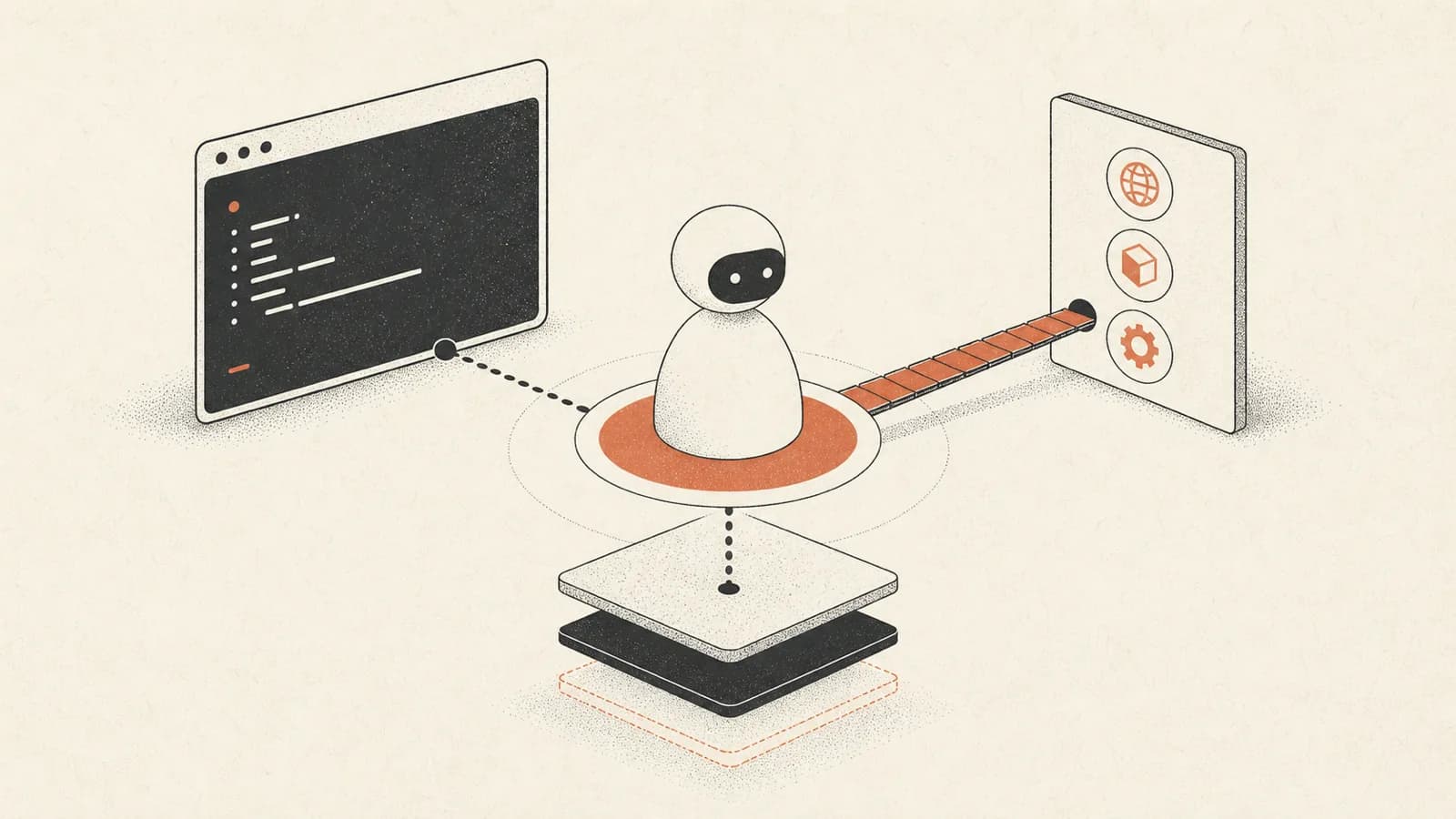
The framing "both expose tools to a model" understates the difference. The two protocols govern different boundaries:
- MCP is the model↔world tool plane. A server-client protocol where connector logic is "written once per system, consumed by every Claude surface" — the same Salesforce/Gmail/Figma connector plugs into Claude AI, Cowork, and Claude Code (MCP and Computer Use). The tool provider operates and authenticates the server; the consumer is any model in any host.
- App Server is the orchestrator↔runtime session plane. A line-delimited JSON-RPC stdio protocol whose subject matter is not tools but agent-session lifecycle: the initialize/thread-start/turn-start handshake, continuation turns reusing a
thread_id, streamed turn events, three independent timeouts, approval-policy plumbing, and token accounting (Codex App Server Protocol). None of this is in MCP's scope at all — an orchestrator using only MCP still has no way to start a turn, detect a stall, or account tokens.
Confirmed by the spec itself (added 2026-08-04). "None of this is in MCP's scope" was inferred from what MCP happened not to cover. MCP revision 2026-07-28 made it the protocol's stated position: protocol-level sessions and the
Mcp-Session-Idheader are removed, theinitialize/notifications/initializedhandshake is deleted in favor of per-request version negotiation in_meta, and cross-call state is pushed out to server-minted handles passed as ordinary tool arguments (MCP and Computer Use, Codex App Server Protocol). The two protocols have now actively diverged rather than merely differed — nothing below changes, and the boundary argument got stronger.
So for most of their surface area the question "when does each win" doesn't arise — an orchestrator like Symphony needs the session plane and the model needs a tool plane; they compose. Boris Cherny's "to the model, it's just tokens" (MCP and Computer Use) is the reason composition is cheap: at the model layer the substrates are fungible.
The genuine overlap is dynamic tool calls — App Server's experimental feature letting the orchestrator advertise tools at thread/start, "architecturally parallel to MCP but [living] inside the coding-agent's runtime" (Codex App Server Protocol). There the decision rule falls out of the two worked examples:
| Choose | When | Why |
|---|---|---|
| MCP | The capability is reusable, cross-surface, third-party | Write-once-consume-everywhere is MCP's structural property; the ecosystem, OAuth patterns, and standards-track authorization work (COAZ) all live there (MCP and Computer Use) |
| Dynamic tool calls | The capability is session-scoped and credential-sensitive | The linear_graphql pattern: the orchestrator proxies authenticated calls with its own auth, so the token never reaches the subagent container (Codex App Server Protocol, Symphony) — per-session injection an external MCP server doesn't naturally give you |
The security asymmetry deserves emphasis, because it is the strongest "App Server wins" case: MCP's documented attack surface — tool-metadata poisoning, rug-pull server updates, and malicious data relayed through legitimate servers (MCP Tool Poisoning) — exists because MCP tools are third-party-operated surfaces the agent trusts. An orchestrator-injected dynamic tool shrinks that surface to first-party code the orchestrator wrote. The costs: the feature is explicitly experimental (Symphony's security model depends on it — that page's own open question), version tolerance is by-convention rather than by-registry, and nothing is reusable outside this orchestrator.
Answer 2: No Claude-side protocol — a bracket instead, and a rule for choosing sides#
The vault documents no Claude-side equivalent of the App Server protocol. The comparison the corpus supports: Claude's parallel offering is claude -p (non-interactive CLI) plus the Claude Agent SDK, and "both let an external orchestrator drive sessions, but Codex's App Server is more explicit about a stable JSON-RPC protocol" (Claude Code Best Practices, cross-tool capability table; Codex App Server Protocol Connections). These two options bracket the App Server's position rather than matching it:
claude -p— drive the product. Cheapest integration; the orchestrator inherits the entire accumulated product harness: the permission classifier (with the load-bearing unattended behavior — auto mode aborts on repeated blocks in non-interactive mode rather than hanging on an unanswerable prompt), skills,CLAUDE.mdcontext loading, and existing MCP wiring. The cost: a text-shaped interface — the orchestrator gets output, not the structured event stream, stall detection, or token accounting the App Server specifies.- Agent SDK — build a different product. The Claude Design case is the canonical datum: the first prototype was "the Agent SDK, a very thin IDE wrapper, and an existing skill," hacked together in a weekend — full control over tools, surface, and UX, with the builder owning the harness that the CLI would have provided for free.
When does drive-the-CLI beat build-on-SDK? The corpus supports a two-condition rule:
- Drive the CLI when the product's harness is the value and the orchestration is batch/fan-out shaped. If what you want is "Claude Code, but launched programmatically over many tasks" — fan-out, pre-commit hooks, issue-loop runners — the harness you'd rebuild on the SDK (permissions, skills, context discipline, MCP connections) is exactly what the CLI already carries, and
claude -p's abort-don't-hang contract was designed for the no-human case (Claude Code Best Practices, Claude Code Auto Mode). - Build on the SDK when the agent is a different product. Different surface, different tool set, different interaction model — Claude Design needed an IDE-shaped canvas, not a terminal; inheriting Claude Code's harness would have meant fighting it (Claude Design).
The instructive middle: Symphony's own evolution shows what breaks when neither side fits. Its v1 was literally "a Codex session in tmux polling Linear" — drive-the-CLI — which "worked, not reliable"; the App Server exists because CLI-driving "doesn't scale to programmatic orchestration" (Symphony, Codex App Server Protocol). A Claude-side orchestrator with Symphony-scale needs (structured events, continuation turns, stall detection, credential-proxying tool injection over the product harness) currently has to approximate that middle layer from one side or the other — parse claude -p output, or rebuild harness on the SDK. That gap is the honest residual of this comparison: whether Anthropic ships a stable session-control protocol, or whether harness shrinkage makes the SDK route cheap enough that the middle layer never needs standardizing, is a watch item rather than an answerable question.
One consolidated takeaway#
Sort integration questions by boundary, then by operator. Tool plane (model↔world): MCP, unless the tool is session-scoped and credential-sensitive, in which case inject it from the orchestrator and keep the secret out of the container. Session plane (orchestrator↔runtime): Codex has a protocol; Claude has a bracket — take the CLI when you want the product's harness, the SDK when you're building a different product, and know that the Symphony-shaped middle is currently an approximation on the Claude side. And at the model layer none of this matters — "it's just tokens" — which is why the right architecture composes all three rather than picking one.
Cited by 4
- Codex App Server Protocol×4
App Server Vs Mcp Vs Claude Sdk — the three-boundary comparison filed from this page's two protocol…
- Claude Code Best Practices
App Server Vs Mcp Vs Claude Sdk — situates claude -p + Agent SDK as the Claude-side bracket around…
- MCP and Computer Use
App Server Vs Mcp Vs Claude Sdk — places MCP as the model↔world tool plane against the App Server's…
- Agent Systems & Harness Engineering
App Server Vs Mcp Vs Claude Sdk — Two-question synthesis on agent integration boundaries. (1) App…
Related articles
- Agent Harness Engineering
Patterns for scaffolding long-running LLM agents: environment design, progressive context disclosure, mechanical archit…
- MCP and Computer Use
Anthropic's two complementary connector mechanisms: MCP for structured programmatic access (Salesforce/Drive/Gmail/Slac…
- Claude Code Best Practices
Anthropic's guide to effective Claude Code usage: context management, verification-driven development, explore→plan→cod…
- Open Questions Backlog
Generated by `_system/lint.py --write-backlog`. Do not hand-edit. Domain and Watching sections carry one row per page —…
- Agent Context Files
The cross-vendor markdown-as-control-plane pattern: repo-versioned plaintext (CLAUDE.md / AGENTS.md / SOUL.md / WORKFLO…