資料來源#
- An open-source spec for Codex orchestration: Symphony.
- Anthropic's Boris Cherny: Why Coding Is Solved, and What Comes Next
- Auto mode for Claude Code
- Best Practices for Claude Code
- Full Walkthrough: Workflow for AI Coding — Matt Pocock
- How Anthropic's product team moves faster than anyone else | Cat Wu (Head of Product, Claude Code)
- Introducing Claude Opus 4.7
- Tips & Best Practices
- Tutorial: Team Telegram Assistant
摘要#
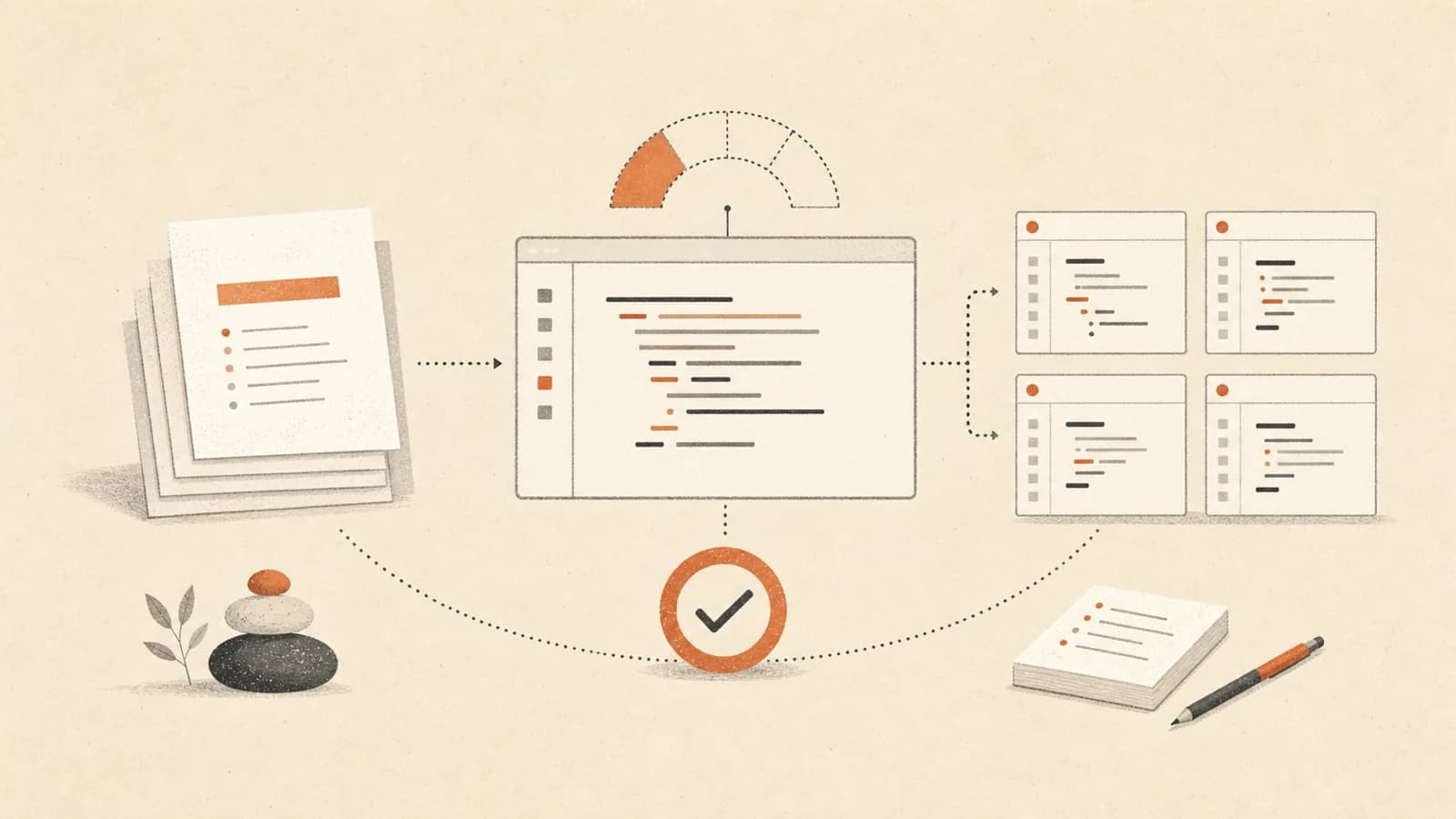
Anthropic 官方的 Claude Code 有效使用指南,圍繞單一核心限制組織而成:內容視窗很快就會填滿,而隨著填滿程度提高,效能也會下降。所有最佳實務都源自於管理這項稀缺資源——透過以驗證驅動的開發、結構化內容(CLAUDE.md)、積極的工作階段管理,以及透過平行工作階段進行水平擴展。
細節#
以內容視窗作為首要限制#
內容視窗容納整段對話:訊息、檔案讀取結果與指令輸出。單次除錯工作階段就可能消耗數萬個 token。內容填滿後,Claude 會「忘記」較早的指示,並犯下更多錯誤。歸根究柢,每項最佳實務都是在管理這項資源。關於其底層機制(平方級注意力縮放,以及約 100K-token 的 smart-zone 標記),請參閱內容視窗 Smart Zone。
模型層級的放大因素(由 Claude Opus 4.7 引入,在目前的 Claude Opus 4.8 中仍然存在):更新後的 tokenizer 會將相同輸入映射為多出 1.0–1.35 倍的 token,而 Opus 4.7「在較高 effort 等級下會思考更多」——尤其是在 agentic 設定的後續回合。Claude Code 的預設 effort 已提升至 xhigh。這些因素會疊加:在 4.6 的 high 下能容納的工作階段,在 4.7 的 xhigh 下可能會明顯變得更緊。請先在真實流量上測量,再相信從 4.6 延續而來的直覺。可用的反制手段包括:降低 effort、設定工作任務預算(API)、明確要求簡潔,或設定簡短風格的輸出上限(另見依規模而定的提示敏感度)。
以驗證驅動的開發#
最具槓桿效益的單一實務:讓 Claude 有方法驗證自己的工作。提供測試、截圖、預期輸出或 linter 指令。沒有驗證時,Claude 會產生看似合理但實際損壞的程式碼,而人類就會成為唯一的回饋迴圈。
關鍵模式:
- 提供包含輸入與預期輸出的具體測試案例
- 若是 UI 變更,貼上截圖並要求 Claude 比對其結果
- 提供錯誤訊息,而不只是說「建置失敗」,以處理根本原因
- 使用 Claude in Chrome 擴充功能進行自動化 UI 測試
探索 → 規劃 → 編碼工作流程#
將研究與實作分開。針對多檔案變更或不熟悉的程式碼,使用 Plan Mode。當範圍明確、且能用一句話描述差異時,跳過規劃。
更積極的變體是:設計概念拷問(Matt Pocock 的 grill-me skill)將「要求 agent 提出計畫」替換為「讓 agent 訪談你,直到你們在任何計畫存在之前達成共同理解」。另見垂直切片 Tracer Bullets,了解如何將產生的 PRD 切分為 agent 可直接領取的 Kanban 工單;以及給 Agent 使用的深層模組,了解如何維持適合 agent 的程式碼庫形狀。
環境設定#
- CLAUDE.md:每個工作階段都會載入的持久指示。只納入 Claude 無法從程式碼推斷出的內容——bash 指令、非預設的程式碼風格、工作流程規則、架構決策、陷阱。毫不留情地刪減:如果 Claude 沒有這項指示也能正確完成某事,就刪掉它。把它當成程式碼:出問題時檢視,並透過觀察行為變化來測試。使用
@path匯入以實現模組化。對創辦人/單人建構者而言,每個工作階段以 CLAUDE.md 作為架構內容開始,並在每個工作階段結束時更新它的嚴格紀律,是抵禦代理式技術債的主要防線——這類債務會複利(不只是累積),因為當內容未被持久化時,每個工作階段都必須重新推導基礎決策。 - Skills(
.claude/skills/):按需載入的領域知識與可重複使用工作流程,不會在每個工作階段載入。使用/skill-name呼叫。 - Subagents(
.claude/agents/):在隔離內容中執行、且工具範圍受限的專門助理。適合處理需要讀取大量檔案、又不想使主要內容混亂的工作。 - Hooks:在 Claude 工作流程中特定時點執行的確定性腳本。不同於 CLAUDE.md(僅提供建議),hooks 能保證執行。
- MCP servers:透過
claude mcp add連接外部工具(Notion、Figma、資料庫)。 - Plugins:從 marketplace 打包的 skills + hooks + subagents + MCP。
- Permissions:auto mode(以分類器核准為基礎,介於預設提示與
--dangerously-skip-permissions之間)、allowlists,或 OS 層級的 sandboxing。
工作階段管理#
- 不相關任務之間使用
/clear——防止內容污染 /compact <instructions>——保留指定內容的目標式摘要/rewind或Esc+Esc——將對話、程式碼或兩者還原至任一檢查點- 使用 Subagents 進行調查——在獨立內容中探索,再回報摘要
/btw——永遠不會進入對話歷史的側邊問題- 在同一問題上修正失敗兩次後,使用
/clear,並將學到的內容納入重寫後的提示
擴展模式#
- 非互動模式:
claude -p "prompt",用於 CI、腳本、pre-commit hooks。支援 JSON 與串流輸出。 - 平行工作階段:desktop app(隔離 worktrees)、web(隔離 VM),或 agent teams(共用協調任務的工作階段)。
- Writer/Reviewer 模式:一個工作階段進行實作,另一個以全新內容進行審查(不會對自己的程式碼產生偏見)。
- Fan-out:針對大型遷移,在檔案間迴圈執行
claude -p。使用--allowedTools限制權限範圍。 - 針對無人值守執行的 Auto mode:分類器會阻擋高風險操作、允許例行工作。在非互動模式下重複遭到阻擋時會中止。
- 迴圈與 routines:
/loop(在 CLI 中以 cron 排程的重複工作)與 routines(伺服器端變體)。讓 Kanban 待辦清單在 AFK 狀態下持續清空;這是將規劃成本分攤至多次執行的主要機制。另見 Agent Loop Pattern。
平行生態系統與跨工具概念對照#
Claude Code 是多個逐漸匯聚的 coding-agent 生態系統之一。它與 Hermes Agent(Nous Research)及 Codex(OpenAI)的能力存在對應關係:
| 能力 | Claude Code | Hermes | Codex |
|---|---|---|---|
| 專案內容檔案 | CLAUDE.md | AGENTS.md(專案)+ SOUL.md(個性,分開) | AGENTS.md |
| 工作階段壓縮 | /compact <instructions> | /compress | (透過 Codex App Server thread compaction) |
| 工作階段中途切換模型 | /model | /model | 工作階段層級設定 |
| 平行 subagents | .claude/agents/ 中的 Subagents | delegate_task | 由 Symphony orchestrator 產生 |
| 非互動/程式化 | claude -p、Claude Agent SDK | 腳本中的 hermes CLI | Codex App Server(JSON-RPC stdio) |
| 多使用者團隊部署 | 每個工作階段的 claude -p | Hermes Gateway(Telegram/Discord/Slack/WhatsApp),搭配 allowlist 或 DM 配對 | Symphony(由 issue tracker 驅動的 daemon) |
| 權限閘門 | auto mode 分類器 | 每種模式的核准(once/session/always/deny);在 container backend 下跳過 | 依 Symphony spec 定義的實作 |
| 記憶體模型 | 對話 + CLAUDE.md | 有界的 MEMORY.md(約 2,200 字元)+ USER.md(約 1,375 字元) | 由檔案系統驅動 |
三者共有的結構性洞見是:agent 行為透過由 repo 版本控制的 markdown 檔案設定(CLAUDE.md/AGENTS.md/SOUL.md/WORKFLOW.md)。這種模式在各家供應商間已足夠一致,看起來像是一項正在形成的標準。(規劃中的專門Agent Context Files概念頁面將使其正式化。)
最大的架構分歧是:Claude Code 採用工作階段優先模式,並可選擇非互動模式;Hermes Gateway 與 Symphony 在團隊規模部署時則採用daemon 優先模式。工作階段與 daemon 的分野,是 2026 年部署架構的主導選擇。
常見失敗模式#
| 模式 | 修正方式 |
|---|---|
| 廚房水槽式工作階段(混合不相關任務) | 任務之間使用 /clear |
| 重複修正(失敗修正超過 2 次) | /clear,將學到的經驗寫入重寫後的提示 |
| 過度詳細的 CLAUDE.md | 刪減;若需確定性則改用 hooks |
| 先信任後驗證的落差 | 始終提供驗證標準 |
| 無限探索 | 縮小範圍,或使用 subagents |
相關連結#
- Agent Harness Engineering — Claude Code 的 CLAUDE.md、skills 與 hooks,是 OpenAI 和 Anthropic 研究團隊所描述之 harness engineering 模式的實際實作
- LLM-as-Compiler Knowledge Base — CLAUDE.md 檔案在此知識庫的 LLM-as-compiler 架構中扮演 schema 層
- LLM-Driven Vulnerability Research — Claude Code 是 Anthropic 弱點研究 scaffold 的執行環境;所有 Mythos Preview findings 都使用了 Claude Code 的 agentic 能力
- Client-Side Agent Optimization — 直接挑戰「使用最強模型」這項預設:Claude Opus 4.6 搭配較便宜 planner 的組合,在 HotpotQA 上比全 Opus 高出超過 40 個百分點。AgentOpt 的 httpx interception 與
claude -p非互動模式相容 - 依規模而定的提示敏感度 — 補充內容視窗管理:簡潔限制既能提升容易過度思考問題的準確度,也能保留內容預算。當大型模型的冗長輸出可能掩蓋推理錯誤時,以驗證驅動的開發尤其重要
- Claude Code Auto Mode — 完整說明環境設定與擴展模式中提到的「auto mode」權限選項
- Claude Opus 4.7 — 引入了重塑 CLAUDE.md 與工作階段管理寫法的字面指令遵循能力及 tokenizer 膨脹
- Claude Opus 4.8 — 現在大多數 Claude Code 工作所鎖定的模型(自 2026-05-28 起普遍可用);它是 4.7 的直接升級版,因此上方的內容預算指南可以原封不動沿用。環境設定一節有一項注意事項:4.8 對提示注入的穩健性低於 4.7,因此狹窄的工具權限更有價值
- Hermes Agent — 來自 Nous Research 的平行生態系統;許多 Claude Code 模式可直接對應(
/compress↔/compact、delegate_task↔ subagents、AGENTS.md↔CLAUDE.md);差異(Gateway daemon、有界記憶體檔案、SOUL.md分拆)凸顯各自的設計選擇 - Codex App Server Protocol —
claude -p+ Claude Agent SDK 在 OpenAI 端的對應方案;兩者都能讓外部 orchestrator 驅動工作階段,但 App Server 更明確地採用穩定的 JSON-RPC stdio 協定 - Symphony — daemon 優先的部署原型;Claude-Code 對應方案會以 Symphony 將 Codex 連接至 Linear 的相同方式,把
claude -p加上 subagents 接入 issue tracker - Ticket-Driven Agent Orchestration — 非互動模式穩定後自然形成的協調模式;將單一工作階段最佳實務橋接至團隊規模部署
- 內容視窗 Smart Zone — 驅動本文所有內容管理實務的底層限制
- 設計概念拷問 — 探索→規劃→編碼更積極、以對齊優先的變體
- 垂直切片 Tracer Bullets — 由 loop primitive 清空 Kanban 待辦清單所需的任務分解模式
- 給 Agent 使用的深層模組 — 讓 Claude Code 的審查與驗證模式可靠的程式碼庫形狀;push 與 pull 的指示傳遞
- Agent Loop Pattern —
/loop與 routines,作為取代逐步提示的新世代 primitive - 模型進步下的 Harness 縮減 — 為何最佳實務提示與 CLAUDE.md 區段會隨每次模型發布而縮短;Cat Wu 在每次發布時進行刪減的紀律
- Claude Code — entity 層級頁面
- AI Native Product Cadence — 這些最佳實務產物,是以該內部節奏運作的團隊對外公開的成果
- Engineer PM Convergence — 本指南含蓄鎖定的「具備產品品味的工程師」人格
- 代理式技術債 — CLAUDE.md 主要防範的失敗模式;在創辦人手冊中有明確命名
- AI-Native Startup Lifecycle — 將 CLAUDE.md 從「最佳實務」提升為「MVP 生存紀律」的創辦人階段框架
- MCP and Computer Use — 「以自訂工具擴充 Claude Code」擴展模式背後的 connector substrate;MCP 與 computer use 是讓外部系統成為 agent 行動介面的方式
- Evals as Product Spec — 「以驗證驅動的開發」的嚴格形式:十個優秀 evals 以功能層級編碼完成的樣貌,補充本文規定的工作流程層級驗證
衍生內容#
- When to Use Claude Opus 4.6 for Work — 「內容視窗作為首要限制」的框架,啟發 Claude Code 的推論:Opus 的冗長輸出會更快消耗預算
- Opus 4.6 → 4.7 Changes and Multi-Agent Coding Considerations — 將 subagents、Writer/Reviewer 與擴展模式指南應用於 Opus 4.7 多 agent 團隊
- Learning to Co-Work with AI: A Software Engineer's Field Guide — 將最佳實務提煉為每位工程師的技能發展實戰指南(六大技能群組、每日實務、反模式、90 天計畫)
待解決的問題#
- CLAUDE.md 在指示開始遺失前的最佳長度是多少?是否存在可測量的門檻?
- Writer/Reviewer 模式與 agent 對 agent 審查相比如何(如 OpenAI 的 Codex 工作流程)?
- 何時 subagent 的額外成本會超過內容隔離帶來的效益?
資料來源#
- Best Practices for Claude Code
- Auto mode for Claude Code — 權限模式擴展
- Introducing Claude Opus 4.7 — tokenizer/xhigh 預設值對內容預算的影響
Cited by 46
- Learning to Co-Work with AI: A Software Engineer's Field Guide×5
Build a CLAUDE.md / AGENTS.md for every project you own. Treat it like code: review when things go…
- Claude Code Auto Mode×4
Compared to OS-level sandboxing (mentioned in Claude Code Best Practices alongside auto mode),…
- Where Does Agent Harness Work Remain Durable as Models Improve?×3
Across Agent Harness Engineering, Claude Code Best Practices, and Hermes Agent, the stable work is:
- Open Questions Backlog×3
Claude Code Best Practices (37d) — Does the instruction-count ceiling hold for conditional policy,…
- Opus 4.6 → 4.7 Changes and Multi-Agent Coding Considerations×3
Claude Code Best Practices#Context Window as Primary Constraint applies to each agent in isolation.…
- Writer/Reviewer vs Agent-to-Agent Review×3
Codex, Claude Code, Claude Opus 4 7, Claude Code Best Practices — the two products' review surfaces…
- AI-Native Startup Lifecycle×2
vs. Claude Code Best Practices: the playbook recommends starting each Claude Code session with the…
- Opinions on Using AI Tools & the Future of the Software Engineering Role×2
This matches the official tooling guidance: Claude Code Best Practices and Agent Harness…
- App Server vs MCP, and the Claude-Side Equivalent: Three Boundaries for Driving Agents×2
The vault documents no Claude-side equivalent of the App Server protocol. The comparison the corpus…
- Claude Opus 4.7×2
Anthropic claims the net is favorable on their internal coding eval across effort levels, but…
- Code as Source of Truth×2
Checking the spec into the codebase isn't just freshness hygiene — it's what makes mechanical…
- Instruction Compounding×2
So the pruning obligation this page establishes is necessary but not sufficient: a context file…
- LLM-as-Compiler Knowledge Base×2
The schema layer (Karpathy's term) is the same artifact category as SPEC.md/WORKFLOW.md —…
- MCP and Computer Use×2
Hermes Agent — third-party agent product that consumes MCP (mentioned in cross-tool capability…
- Symphony×2
Symphony vs. Claude Code agents: parallel ecosystems. Symphony is daemon-first (always-on,…
- Ticket-Driven Agent Orchestration×2
Claude Code Best Practices — Claude Code's claude -p non-interactive mode is the building block for…
- When to Use Claude Opus 4.6 for Work×2
Claude Code Best Practices — context-window constraint, verification discipline, session management
- Agent Context Files
Claude Code Best Practices — the CLAUDE.md convention and the prune-ruthlessly discipline; the…
- Agent Control Plane Patterns: Tickets, Loops, Specs, and Memory Files
Layered agent control-plane synthesis: tickets as durable work graph, loops as execution primitive, specs/context files…
- Agent Harness Engineering
Claude Code Best Practices — practical application of many harness engineering principles in Claude…
- Agent Loop Pattern
Claude Code Best Practices — the best-practices guide treats /loop as a core workflow primitive
- Agentic Technical Debt
Claude Code Best Practices — official Anthropic guidance on CLAUDE.md; the playbook frames the same…
- AI Native Product Cadence
Claude Code Best Practices — the public artifacts of a team operating at this cadence
- Blast Radius (Agentic)
Claude Code Best Practices — sandboxed execution + write-access restrictions as a reference…
- Classifier Gates vs OS Sandboxing: The Defense-in-Depth Story for Auto Mode and Cowork
Unattended operation. AFK loops and fan-out are auto mode's raison d'être, and the human who would…
- Claude Code
Anthropic's agentic coding product; created by Boris Cherny late 2024; TypeScript/React on Bun (itself Claude-rewritten…
- Claude Sonnet 5
Sonnet 5 uses an updated tokenizer — the same kind of change Opus 4.7 introduced — so the same…
- Client-Side Agent Optimization
Claude Code Best Practices — directly challenges the implicit "use the strongest model" default.…
- Codex App Server Protocol
Claude Code Best Practices — Claude's claude -p non-interactive mode plus the Claude Agent SDK are…
- Cost-per-Task Over Cost-per-Token
Claude Code Best Practices — where this guidance is applied per session (effort defaults, context…
- Deep Modules for Agents
Claude Code Best Practices — module map in CLAUDE.md sits in the same family
- Design Concept Grilling
Claude Code Best Practices — the explore→plan→code workflow has the same shape; grill-me is the…
- Engineer PM Convergence
Claude Code Best Practices — engineer-with-taste is the user persona Claude Code targets
- Evals as Product Spec
Claude Code Best Practices — verification-driven development; evals as the strict version
- Hermes Agent
Claude Code Best Practices — Hermes is the closest parallel ecosystem; many concepts map directly…
- Least Agency
Claude Code Best Practices — Claude Code's deny-by-default permissions and write-access…
- LLM-Driven Vulnerability Research
Claude Code Best Practices — Claude Code is the runtime used for all vulnerability research; the…
- Agent Systems & Harness Engineering
Claude Code Best Practices (hub) — Anthropic's guide to effective Claude Code usage: context…
- Orchestration vs Employee Framing: Reconciling the Founder's Playbook with HBR's Accountability Evidence
Bounded parallelism (Cat Wu's "simple setups work better"; Claude Code Best Practices explicitly…
- Scale-Dependent Prompt Sensitivity
Claude Code Best Practices — the context-window-as-primary-constraint framing pairs naturally with…
- Shared Harness, Differentiated Surfaces
Claude Code Best Practices — the configure-don't-abstract pole on sub-agents (.claude/agents/…
- The Verifiability Thesis
RL training rewards verified outcomes, so the gradient flows hardest toward domains where…
- Vertical Slice Tracer Bullets
Claude Code Best Practices — the task-decomposition pattern that fills the Kanban backlog the loop…
- Vibe Coding vs. Agentic Engineering
Claude Code Best Practices — concrete agentic-engineering practice (explore→plan→code,…
- Xiaohongshu
The company also names two internal agent surfaces in the paper: context-gc (interactive chat…
- Zero Trust for AI Agents
Claude Code Best Practices — Claude Code's deny-by-default permissions, sandboxing, managed…
Related articles
- Agent Harness Engineering
Patterns for scaffolding long-running LLM agents: environment design, progressive context disclosure, mechanical archit…
- Harness Shrinkage as Models Improve
Prompt scaffolding shrinks each model release; Cat Wu's pruning discipline; Boris Cherny "100 lines of code a year from…
- Client-Side Agent Optimization
AgentOpt's framing of developer-controlled agent optimization (model-per-role, budget, routing) as distinct from server…
- Claude Code
Anthropic's agentic coding product; created by Boris Cherny late 2024; TypeScript/React on Bun (itself Claude-rewritten…
- Open Questions Backlog
Generated by `_system/lint.py --write-backlog`. Do not hand-edit. Domain and Watching sections carry one row per page —…