資料來源#
- An open-source spec for Codex orchestration: Symphony.
- LLM Knowledge Bases
- llm-wiki
- The New Physics of Business — Garry Tan, Y Combinator
摘要#
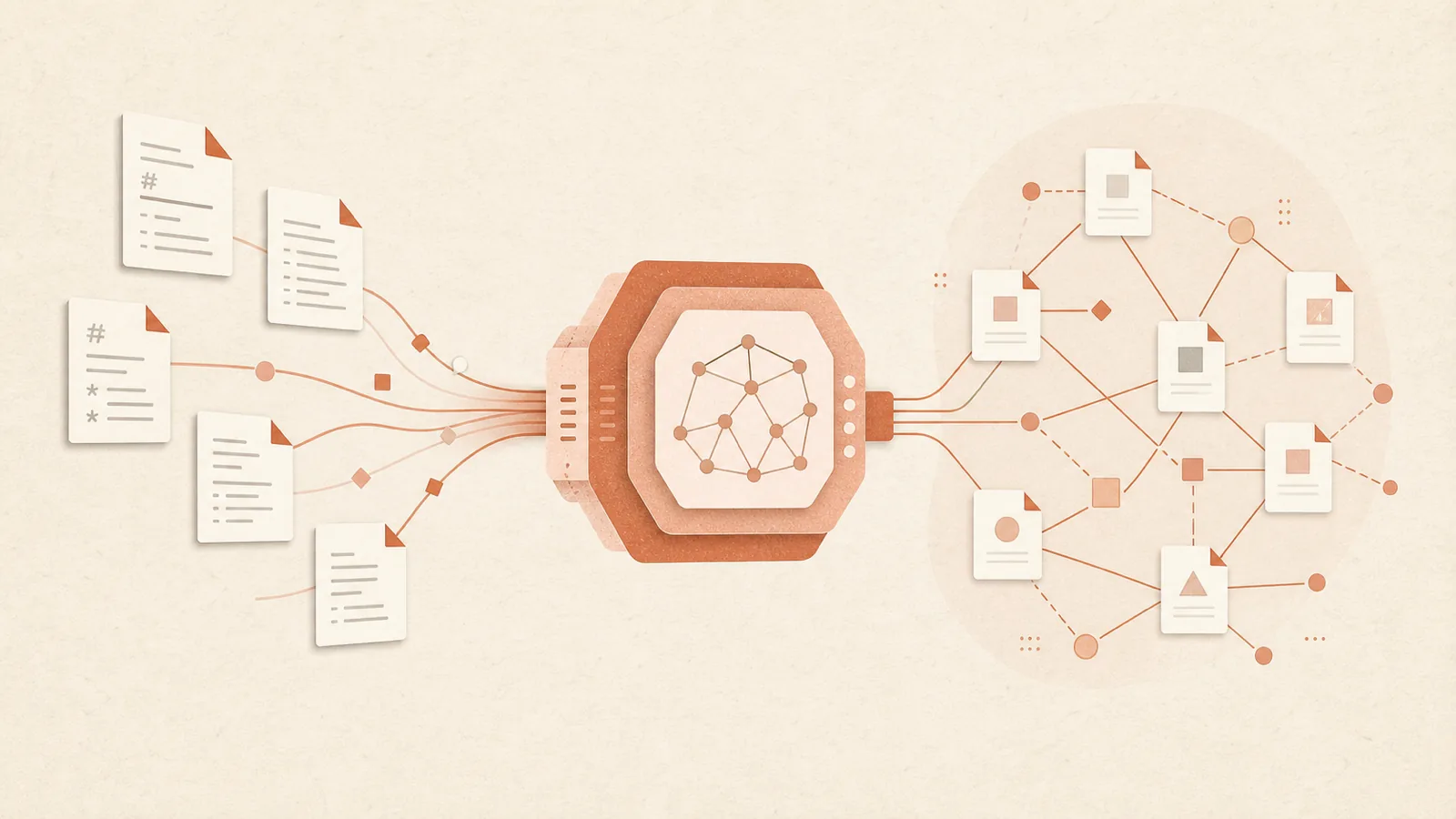
這是一種由 Andrej Karpathy 發起的架構模式,其中 LLM 扮演編譯器:讀取原始來源文件,逐步產生結構化、彼此連結的 markdown wiki。不同於依賴嵌入與向量資料庫的傳統 RAG 系統,這種方法使用 wiki 自身的索引檔案與 LLM 的 context window 進行檢索;在個人知識庫規模(約 100 篇文章、400K 字)下已經足夠。
詳情#
四階段 Pipeline#
系統以持續循環的方式運作:
- Ingest — 原始內容(透過 Obsidian Web Clipper 收集的網頁文章、論文、repo 筆記)以 markdown 檔案形式進入
raw/staging 目錄。 - Compile — LLM 讀取
raw/,建立索引檔案(所有文件的摘要)、概念文章(依主題整理,包含反向連結與交叉引用),以及衍生輸出(投影片、圖表、歸檔的查詢答案)。LLM 會自動維護概念之間的連結圖。 - Query & Enhance — 使用者在 Obsidian 中瀏覽 wiki、透過 Q&A agent 提出研究問題,或使用 CLI/網頁工具搜尋。關鍵在於,查詢產生的所有輸出都會回存至 wiki,因此每次探索都會累積價值。
- Lint & Maintain — LLM 稽核不一致之處、透過網路搜尋補足遺漏資訊、發現新的概念間連結,並提出後續問題。完成 lint 後,循環回到 compile。
關鍵設計決策#
- 不使用向量資料庫 — 在個人規模下,索引檔案加上 LLM context window 已足以進行檢索,因此可消除 embedding pipeline 的複雜度。規模更大時,可使用像 qmd 這樣的本機搜尋引擎(結合 BM25/向量搜尋與 LLM 重新排序,可作為 CLI 與 MCP server)來補強索引。
- 增量編譯 — 新的原始文件會整合進現有 wiki 結構;已建立索引的文件絕不重新處理。
- 探索永遠會累積 — 每個查詢答案、圖表與衍生產物都會回存至 wiki。這是它相較於 RAG 的核心差異:知識只需編譯一次並持續更新,而不是每次查詢都重新推導。
- 由 LLM 負責寫作 — 人類很少直接編輯 wiki;LLM 負責編譯、連結與維護。人類的工作是尋找來源、探索,以及提出正確問題。
- Wiki 是持久且會複利的產物 — 交叉引用已經存在、矛盾已被標記、綜合結果已反映所有讀過的內容。每加入一個來源、每提出一個問題,wiki 都會更加豐富。
三層架構(來自 Karpathy 的 Gist)#
Karpathy 的原始設計文件明確說明了這套架構:
- Raw sources — 經過策展且不可變的來源文件(文章、論文、圖片、資料)。LLM 會讀取但不修改它們,這是事實來源。
- The wiki — LLM 產生的 markdown 檔案:摘要、實體頁面、概念頁面、比較與綜合整理。LLM 完全負責這一層:建立、更新、交叉引用並維持一致性;人類則閱讀它。
- The schema — 設定文件(CLAUDE.md/AGENTS.md),告訴 LLM wiki 的結構、應遵循的慣例,以及要執行的工作流程。人類與 LLM 會隨時間共同演進這套 schema。
索引與導覽#
兩個特殊檔案有助於在大規模 wiki 中導覽:
- index.md — 以內容為導向的目錄,列出每個頁面的一行摘要,並按類別整理。LLM 回答查詢時會先讀取它,再深入相關頁面。在中等規模(約 100 個來源、數百個頁面)下運作良好。
- log.md — 按時間排列、只能追加的操作紀錄(匯入、查詢、lint pass)。如果使用一致的前綴(例如
## [2026-04-02] ingest | Article Title),就能用 unix 工具解析。
使用情境#
這種模式適用範圍廣泛:
- 個人:目標、健康、心理學——歸檔日誌、文章與 podcast 筆記
- 研究:用數週/數月閱讀論文,建立具備演進中論點的完整 wiki
- 閱讀書籍:按章節建立伴讀 wiki,整理角色、主題與情節線索(像個人的粉絲 wiki)
- 企業/團隊:由 Slack 討論串、會議逐字稿與客戶通話餵入內部 wiki,再由人類審查更新
- 任何知識累積:競爭分析、盡職調查、旅程規劃、課程筆記
為什麼有效#
知識庫的瓶頸不是閱讀或思考,而是簿記:更新交叉引用、保持摘要最新、記錄矛盾,以及維持數十個頁面之間的一致性。人類會放棄 wiki,因為維護負擔增長得比價值更快。LLM 不會感到厭倦、不會忘記更新交叉引用,還能一次處理 15 個檔案。
思想脈絡#
Karpathy 將這套方法連結到 Vannevar Bush 的 Memex(1945)——一個在文件之間建立聯想路徑的個人策展知識儲存庫。Bush 的願景比後來的網路更接近這種模式:私有、持續策展,且文件之間的連結與文件本身同樣有價值。Bush 無法解決的部分,是誰來維護它;這部分由 LLM 負責。
變體#
Elvis Saravia 描述了一種自動化匯入的變體:經過調整的 Skill agent 每日策展研究論文,使用 qmd CLI tool 為它們建立索引,再將已索引的知識庫餵給以 MCP tools 建構的互動式 artifact generator。這會在數百篇論文之間產生可探索的互動式視覺化。
未來方向#
Karpathy 提到,可以使用 wiki 產生合成訓練資料,並對 LLM 進行 fine-tune,讓它在權重中「知道」這些資料——將個人知識庫轉變為個人化模型。
公司大腦:組織規模的模式(Garry Tan 的 GBrain)#
這套架構在野外最突出的姊妹版本(2026 年 7 月,practitioner-opinion)是 Garry Tan 的公司大腦——他採 MIT 授權的開源 GBrain,「實際上就是 agents 的 Postgres」。他的表述是**「圖書館加上圖書管理員」**:組織的完整紀錄(電子郵件、會議、決策及其推理、事後檢討)是圖書館,而承擔關鍵作用的是圖書管理員——檢索層會依每項任務決定哪些「三本書」要放進 agent 的 context(他以工作記憶作比喻:agent 能容納約 1M tokens ≈ 三本 Harry Potter,相對於人類的 7±2;「決定你的 agents 是天才還是金魚的問題,是誰決定桌上打開哪三本書」)。他的個人實例約有 220,000 頁,主要由 agents 從 20 年的電子郵件、會議與筆記編譯而成。
Tan 預先回應了「這不就只是 RAG 嗎」的質疑,方式與本頁完全一致——「retrieval 是基本原語,就像 Postgres 只是 B-trees……Retrieval 很容易。真正值得檢索的內容才是產品。」值得從他的說法保留的是衛生準則,這與本 vault 自身的設計獨立趨同:
| Tan 的失效模式/處方 | 本 vault 的機制 |
|---|---|
| 「每個事實都要有 Provenance」 | evidence: 分級+逐來源引用(Non-Malleable Memory Authority (TMA-NM) 證明,在對抗性情境下,不綁定來源的內容信任是不健全的) |
| 「新資訊與舊資訊衝突時進行矛盾檢查」 | 明確標記矛盾的 compile rule |
| 「一位人類加 agent 組成的圖書管理員,其實際工作是修剪」 | lint pass |
| 「沒有人策展的大腦會變成搜尋功能很棒的垃圾場」 | 這正是 compile/lint 存在的原因——未經策展的儲存庫進行檢索時,會「帶著十足信心」呈現過時事實 |
他的總結——「把大腦當成 production infrastructure,它就會複利;把它當成傾倒場,你會得到一個非常有自信、卻以無人能追溯的方式犯錯的 agent」——是本頁「探索永遠會累積」的作業版本,並明確呈現失效分支。他的經濟觀點也值得記錄:「模型品質是租來的,但如果你建立自己的大腦,你就擁有那個大腦」(Compounding Data Moat:知識儲存庫層級的資料護城河)。
作為編譯來源的 Spec(Symphony 的跨語言 Fuzz)#
目前在野外最具體的 LLM-as-compiler 延伸:OpenAI 的 Symphony 團隊將 SPEC.md 視為來源,請 Codex 以 Elixir、TypeScript、Go、Rust、Java 與 Python 實作。他們接著利用各實作之間的差異找出 spec 中的模糊處,並加以簡化。
這項技術真正新穎之處在於:
- LLM 就是編譯器(markdown → N 種目標語言中的可運作 orchestrator)。
- 多個實作是 spec-fuzzing 訊號——凡是實作出現差異的地方,都代表 spec 的約束不足。這類似於編譯器驗證中的 differential fuzzing,但來源語言變成英文/markdown。
- Spec 才是持久產物,而非編譯輸出。OpenAI 明確表示,他們不打算將 Symphony 維護為獨立產品——它是一個參考實作,使用者可以讓自己的 coding agent 依此執行。
對本 vault 的啟示:
_system/compiler-prompt.md在結構上類似 Symphony 的SPEC.md——兩者都定義 agent 應如何將一類產物(原始文件/Linear tickets)轉換為另一類產物(wiki 文章/運作中的 orchestrator)。- 對知識庫而言,透過多語言進行 spec-fuzzing 是過度設計,但這個想法可以泛化:如果
compiler-prompt.md由不同模型家族(Claude、GPT、本機模型)執行時產生意義不同的 wiki,差異就會指出規格不足之處。 - Schema 層(Karpathy 的用語)與
SPEC.md/WORKFLOW.md屬於同一類產物——由 repo 版本控管、定義 agent 行為的 markdown。參見 Claude Code Best Practices(CLAUDE.md)、Hermes Agent(AGENTS.md/SOUL.md)、Symphony(WORKFLOW.md)的交叉連結。
相關連結#
- Code as Source of Truth — 將 specs/skills 納入 repo,是套用於程式碼的 compiler-wiki 模式
- 這個概念是本 Obsidian vault 的基礎架構(參見
_system/compiler-prompt.md) - Agent Harness Engineering — 共用 repo-local knowledge 作為 system of record 的模式;OpenAI 的 AGENTS.md-as-table-of-contents 對應了本 wiki 的 schema 層
- Claude Code Best Practices — CLAUDE.md 檔案在 Claude Code 對此模式的實作中充當 schema 層
- LLM-Driven Vulnerability Research — vulnerability research scaffold 使用 SHA-3 cryptographic commitments 作為可驗證知識編譯的形式;Claude Code 的 agentic capabilities 驅動 discovery pipeline
- Client-Side Agent Optimization — wiki 的 compile/query/lint 階段本身就是 agent pipeline;不同階段可以分配給不同模型(便宜模型負責 index drift checks,強模型負責 cross-reference synthesis),再將組合最佳化
- Symphony — LLM-as-compiler 超越知識庫的最具體延伸:OpenAI 將
SPEC.md編譯成 6 種語言的實作,並利用差異作為 spec-fuzzer 來消除模糊性 - Ticket-Driven Agent Orchestration — Symphony 的
WORKFLOW.md在結構上與此處的 schema 層屬於同一類產物;兩者都是由 repo 版本控管的 markdown,讓 LLM 將其「編譯」成行動 - Agent Context Files — spec-as-document 模式是將 LLM-as-compiler 套用至 context file;Symphony 將 SPEC 編譯成 6 種語言的 spec-fuzzing 是最清楚的實例
- Design Concept Grilling — Brooks 的「design concept」(任何產物之前的共同理解)是對齊層的類比:wiki 捕捉什麼是真的,grilling session 捕捉我們同意什麼;兩者都把 LLM 視為編譯夥伴,而非一次性輸出的生成器
- Andrej Karpathy — 發起了這個模式(llm-wiki gist),並在 2026 年 5 月的訪談中再次確認這是他的日常實踐——從讀過的文章建立 wiki 並查詢它
- Software 3.0 — Karpathy 對「過去不是程式的新資訊處理任務」的經典例子:將文件重新編譯成 wiki,在 Software 1.0/2.0 中是不可能的
- Outsource Your Thinking, Not Your Understanding — Karpathy 的模式為何有效:「每當我看到資訊投影的不同方式,我就獲得洞見」——wiki 是建立理解的工具,而不只是檢索工具
- Memory and Context Poisoning — 此模式承襲的對抗性威脅面:任何允許 agent 寫入持久記憶的系統,都需要完整性驗證與來源歸因控制,才能讓編譯後的儲存庫維持可信
- LLM-Assisted Grey-Literature Theory Building — 用於研究綜合的相同架構邊界:LLM 將數千份原始文件編譯成結構化、以引文為基礎的產物(因果理論),但詮釋步驟仍由人類負責——自動化 codes→theory synthesis 產生了 15,029 個膚淺且重複的陳述,這是「LLM 負責簿記,而非判斷」的負面結果回聲
- Garry Tan — GBrain 是組織規模的姊妹版本(圖書館+圖書管理員、記憶加衛生);與本 vault 的 provenance/矛盾/修剪設計獨立趨同
- AI-Native Organization — 公司大腦是 Tan 的 AI-native 組織的記憶層;組織的 skills 負責路由工作,大腦提供組織已知的內容
- Non-Malleable Memory Authority (TMA-NM) — 「每個事實都要有 provenance」背後的對抗性案例證明:從記憶的內容或 lineage 推導出的 authority 可以被洗白;來源必須在寫入時綁定
- Compounding Data Moat — 「模型品質是租來的,但你擁有自己的大腦」:策展知識儲存庫是超越模型存取權的持久資產
- Latent vs. Deterministic Space — 本 vault 的實作範例:在 latent compiler 周圍配置 deterministic generators/linters(
build.py/lint.py)
開放問題#
- 不使用向量資料庫的方法在什麼規模下會失效?Karpathy 的約 100 篇文章能放進 context,但 1,000 篇以上呢?
- 編譯期間,如何處理來源之間互相衝突的資訊?
- 概念文章的最佳粒度是什麼——每篇文章一個概念,還是依主題聚類?
- 合成訓練資料 → fine-tuning pipeline 在實務上有多有效?
衍生內容#
- What Are AI Tools? — 探索本 wiki 涵蓋哪些 AI tools 的查詢
資料來源#
- LLM Knowledge Bases
- llm-wiki
- The New Physics of Business — Garry Tan, Y Combinator — Garry Tan 的 AI Engineer 演講(2026-07-17,
practitioner-opinion):公司大腦章節(GBrain、圖書館+圖書管理員、記憶加衛生)
Cited by 36
- Code as Source of Truth×5
Fung states check-it-into-the-repo as a workflow prescription. Google Cloud's Open Knowledge Format…
- Open Questions Backlog×5
Llm As Compiler Knowledge Base (28d) — Would a pre-deployment quality gate on a compiled page catch…
- Agent Context Files×4
The pattern generalizes upward. The same "plaintext spec as load-bearing artifact" instinct shows…
- Andrej Karpathy×4
He closes the interview by tying education back to Llm As Compiler Knowledge Base: "anytime I see a…
- When Knowledge Layers Disagree: Context Files vs Memory, and Conflicting Sources at Compile Time×4
Both answers rest on one principle the corpus establishes independently at the security layer and…
- Where Does the Why Live?×4
Cheap building dissolved specification and relocated alignment into the artifact — but it orphaned…
- Crystallizing Agent Work into Workflows×3
Llm As Compiler Knowledge Base — the same compile move on knowledge rather than behaviour, and the…
- Garry Tan×3
His open-source project (MIT-licensed, built in the open): a company brain — "the library plus the…
- Knowledge-Centric Self-Improvement×3
That last sentence is the compile-time contradiction rule of Llm As Compiler Knowledge Base arrived…
- Owning Your Externalized Cognition×3
"Isn't this just RAG?" — "Sure, and Postgres is just B-trees." Retrieval is the primitive, not the…
- AI-Assisted Error Analysis×2
Llm As Compiler Knowledge Base, arriving from the eval side: the expensive artifact is
- Latent vs. Deterministic Space×2
Llm As Compiler Knowledge Base — this vault as an instance: deterministic generators and linters…
- LLM-Assisted Grey-Literature Theory Building×2
Why it failed is the general lesson: practitioners use inconsistent terms, and the same term for…
- Memory and Context Poisoning×2
This is the adversarial counterpart to the benign persistent-memory designs elsewhere in the wiki —…
- Outsource Your Thinking, Not Your Understanding×2
Karpathy ties the thesis directly to the LLM-wiki pattern he originated: building a personal wiki…
- Software 3.0×2
A subtler point: previous code operated over structured data. Software 3.0 enables operations that…
- Symphony×2
External release — Extracted to a standalone SPEC.md. OpenAI asked Codex to implement the spec in…
- Agent Harness Engineering
Llm As Compiler Knowledge Base — shares the pattern of repository-local knowledge as system of…
- Agent Quality Flywheel
Llm As Compiler Knowledge Base — the same compile boundary with parameters as the output layer…
- AI-Native Organization
Llm As Compiler Knowledge Base — the company brain (library + librarian) is the AI-native org's…
- Authority and Audit Survive Abundance
This leg is not retrieval-partisan, and the corpus's honest entry here is that it binds the…
- Azalia Mirhoseini
AI as a compiler is the direction she names as personally most exciting: generate low-level…
- Claude Code Best Practices
Llm As Compiler Knowledge Base — CLAUDE.md files serve as the schema layer in this vault's…
- Client-Side Agent Optimization
Llm As Compiler Knowledge Base — the wiki's own compile / query / lint phases could be modeled as…
- Compounding Data Moat
Llm As Compiler Knowledge Base — the moat as a knowledge store: Tan's "model quality is rented, but…
- Document Parsing as the Retrieval Bottleneck
Llm As Compiler Knowledge Base — the strongest opposing view in the corpus, and the disagreement is…
- The HTML Artifact Lifecycle: Where Plan History Lives, and When Disposable Becomes Durable
The compiled-store precedent: this vault's own architecture regenerates derived views (index…
- Layerwise Omission Attribution
Llm As Compiler Knowledge Base — this vault sitting inside the taxonomy. "OCR table-structure loss"…
- LlamaIndex
Llm As Compiler Knowledge Base — the architectural rival: this vault's compile-once wiki against…
- LLM-Driven Vulnerability Research
Llm As Compiler Knowledge Base — the responsible disclosure process uses SHA-3 cryptographic…
- Agent Systems & Harness Engineering
Llm As Compiler Knowledge Base — Karpathy's architecture: LLM incrementally compiles raw docs into…
- Non-Malleable Memory Authority (TMA-NM)
Llm As Compiler Knowledge Base — the benign-curation face of the same requirement: Tan's…
- Repository Exploration Subagent
Llm As Compiler Knowledge Base — the compile-at-ingest counterpart: Cognition's DeepWiki…
- Ticket-Driven Agent Orchestration
Llm As Compiler Knowledge Base — the wiki's /compile and /lint are themselves ticket-like work…
- What Are AI Tools?
Llm As Compiler Knowledge Base — architecture pattern for LLM-powered knowledge bases
- What Makes a Self-Improvement Artifact Transfer?
Llm As Compiler Knowledge Base — this vault — is the same bet made for a human-and-LLM reader:…
Related articles
- Open Questions Backlog
Generated by `_system/lint.py --write-backlog`. Do not hand-edit. Domain and Watching sections carry one row per page —…
- Harness Shrinkage as Models Improve
Prompt scaffolding shrinks each model release; Cat Wu's pruning discipline; Boris Cherny "100 lines of code a year from…
- Agent Context Files
The cross-vendor markdown-as-control-plane pattern: repo-versioned plaintext (CLAUDE.md / AGENTS.md / SOUL.md / WORKFLO…
- Agent Harness Engineering
Patterns for scaffolding long-running LLM agents: environment design, progressive context disclosure, mechanical archit…
- Loop Engineering
Replacing yourself as the agent's prompter by designing the system that prompts it: a recursive-goal loop built from fi…