Sources#
Answer#
Based on the knowledge base, "AI tools" refers to products and services built on top of large language models and related AI technologies that people use for practical work. The wiki currently covers two facets of AI tools:
1. AI Products & Services (Consumer/Professional)#
Claude (by Anthropic) is the primary AI product documented in this wiki. It is an LLM-based assistant used for tasks like report generation, research, and general-purpose reasoning.
2. AI-Powered Toolchains (Developer/Knowledge Worker)#
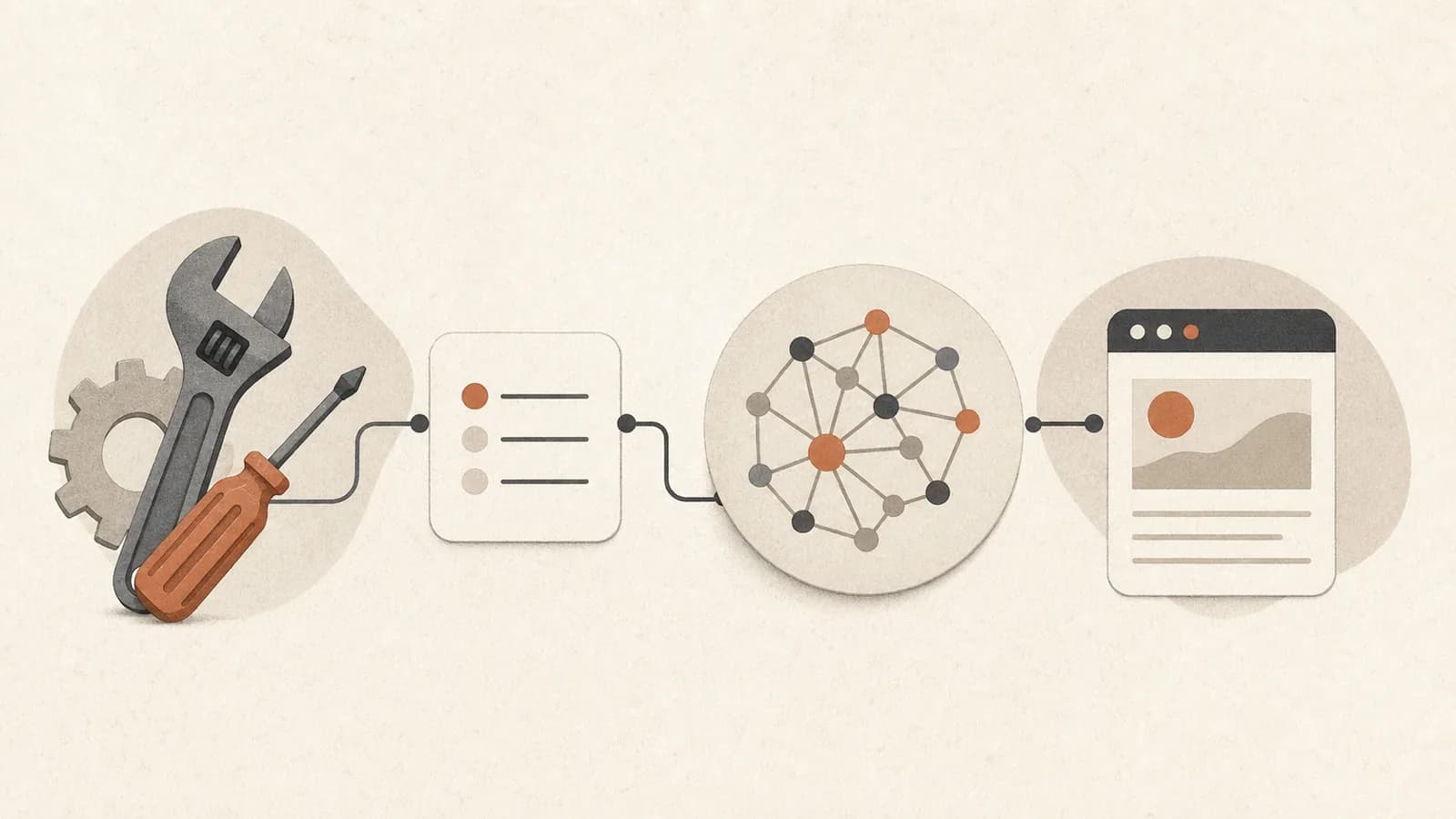
The wiki documents a class of AI tools that use LLMs as components in larger workflows rather than as standalone chat interfaces:
-
LLM-as-compiler pipelines — Andrej Karpathy's architecture where an LLM incrementally compiles raw documents into a structured wiki. The LLM acts as a build tool (compiler), not a conversational agent. Tools in this pipeline include:
-
Obsidian Web Clipper — converts web pages to markdown for LLM ingestion
-
Q&A Agents — LLM-powered research tools that query the wiki and file answers back
-
Search engines — "vibe-coded" naive search over wiki content, usable via CLI or web UI
-
qmd CLI (github.com/tobi/qmd) — used in Elvis Saravia's variant for indexing research papers
-
MCP (Model Context Protocol) tools — used in Saravia's variant to build interactive artifact generators that produce explorable visualizations across research corpora.
Key Distinction#
The wiki implicitly distinguishes between two modes of AI tooling:
- AI as a service — products like Claude where the user interacts with the model directly (chat, Q&A)
- AI as infrastructure — systems where the LLM is embedded into an automated pipeline, doing structured work (compilation, indexing, linting) with minimal human interaction per step
The knowledge base itself (this Obsidian vault) is an instance of the second category — it uses Claude Code as a compiler to maintain a structured wiki.
Gaps in Coverage#
Notable AI tool categories not yet covered include:
- Image/video generation tools (Midjourney, DALL-E, Sora)
- Code assistants beyond Claude Code (GitHub Copilot, Cursor)
- Voice/speech AI (Whisper, ElevenLabs)
- AI search engines (Perplexity, SearchGPT)
- Open-source LLM toolchains (LangChain, LlamaIndex, vLLM)
Sources#
- LLM-as-Compiler Knowledge Base — architecture pattern for LLM-powered knowledge bases
- LLM Knowledge Bases — Karpathy's and Saravia's LLM knowledge base approaches
Cited by 2
- LLM-as-Compiler Knowledge Base
What Are Ai Tools — query exploring what AI tools are covered in this wiki
- Agent Systems & Harness Engineering
What Are Ai Tools — Overview of AI tools landscape and categories
Related articles
- Agent Context Files
The cross-vendor markdown-as-control-plane pattern: repo-versioned plaintext (CLAUDE.md / AGENTS.md / SOUL.md / WORKFLO…
- Agent Harness Engineering
Patterns for scaffolding long-running LLM agents: environment design, progressive context disclosure, mechanical archit…
- Agent Quality Flywheel
Google's eval-fix loop packaged as a skill your coding agent drives: Build & Test → Ship & Monitor → Learn & Refine, ex…
- Authority and Audit Survive Abundance
Joint answer to two #oq/now questions. (1) At a model upgrade neither prescription governs the other: shrinkage governs…
- Claude Code Best Practices
Anthropic's guide to effective Claude Code usage: context management, verification-driven development, explore→plan→cod…