Sources#
Summary#
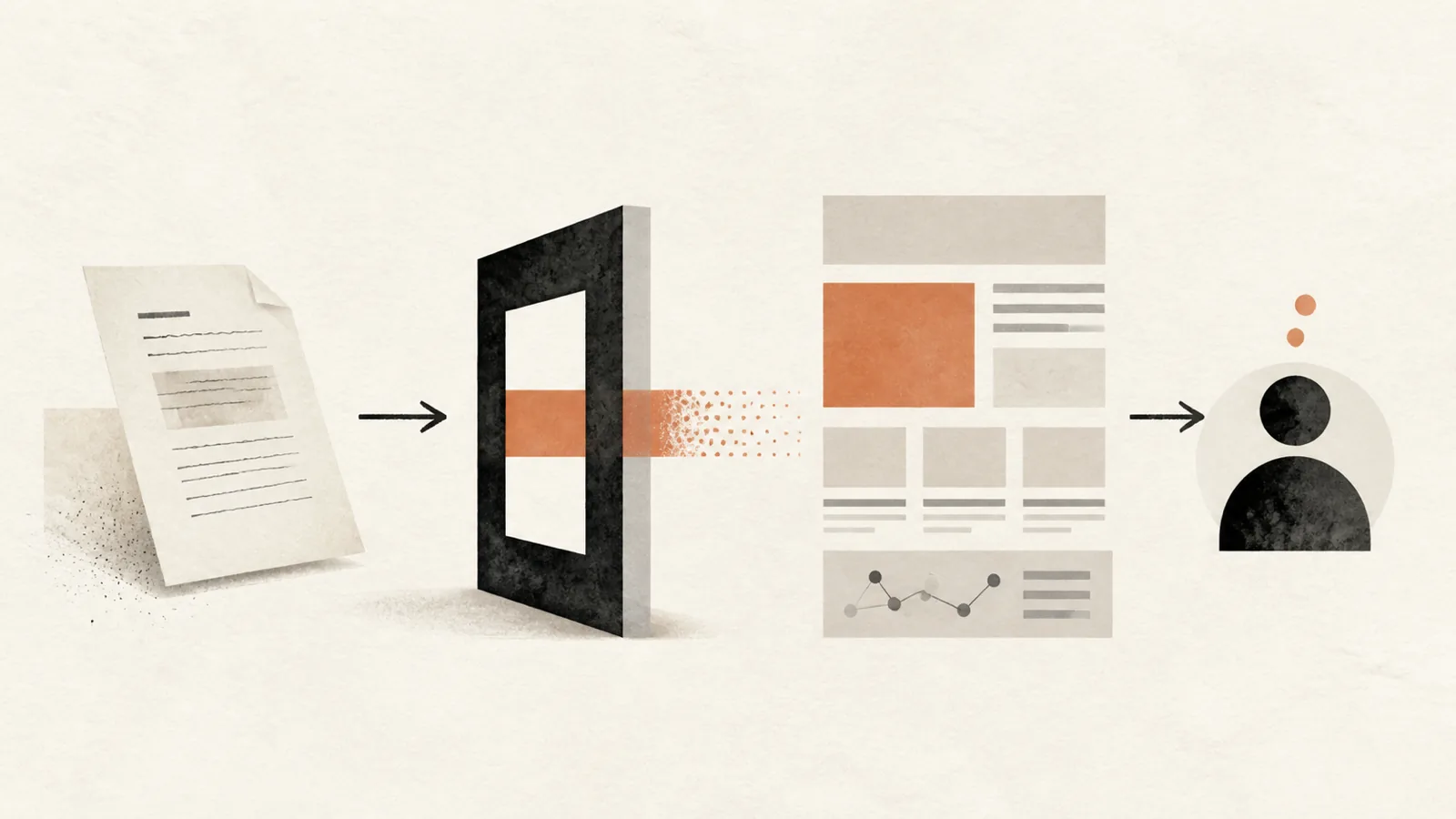
An AI infrastructure company (GitHub org run-llama) whose Python/TypeScript framework was one of the two default ways to build RAG applications in 2023–24. By 2026 it describes itself as "the leading platform for agentic document OCR", and co-founder Jerry Liu (@jerryjliu0) states the repositioning plainly when publishing the deck this page is compiled from: "our core focus today is narrowly focused on SOTA document parsing for agents." The framework remains, but the product is the parser.
The stack, as of mid-2026#
| Component | Shape | Position |
|---|---|---|
| LiteParse | Apache 2.0, local, CLI or in-browser, zero cloud, zero LLM | PDF → spatial text: every token tagged with x/y/width/height/font/style, plus region detection (headings, tables, figures, footnotes). Group by y for rows, by x for columns |
| LlamaParse | hosted, vision-based, async batch API, per-page pricing | "Where LiteParse stops." Markdown out by default — real tables, captioned charts, footnotes attached to anchors, reading order intact. parse_mode="agentic" runs vision per page |
| LlamaExtract | Pydantic schema in, validated typed JSON out | Schema-first path that skips the retrieval pipeline entirely; every extracted value carries page + bounding box as a citation |
| LlamaCloud | managed pipeline (parse · index · retrieve · extract · hosted Workflows + traces) | The same interventions without running the infra |
| Workflows | llama_index.core.workflow — event-driven graph, typed Pydantic events, durable Context, send_event/collect_events, stream_events | The orchestration primitive; steps are async functions wired implicitly by their type signatures |
| ParseBench | ~2,000 human-verified enterprise pages, 5 dimensions, arXiv 2604.08538 | Published on Hugging Face (open-weight models, run locally, no API keys) and Kaggle (frontier models, hosted submission). Same harness both sides |
The two-tier parser split is the structurally interesting choice: give away the deterministic, layout-preserving core as Apache 2.0 and charge for the vision layer that handles scanned pages, dense tables and hostile multi-column layouts. It sets up the "spend budget upstream" argument without requiring a purchase to act on it.
Pricing and benchmarking as positioning#
Two deliberate contrasts with how the rest of the stack is sold, both worth noting as arguments rather than as facts about quality:
- Per-page, not per-token. "Flat, knowable, line-itemable. No token roulette. Budget a 10k-doc pipeline before you write code." Cost predictability is pitched as the differentiator against using a general VLM directly.
- A published benchmark the vendor leads. ParseBench scores semantic correctness rather than text overlap, releases its dataset and eval harness, and puts open-weight and frontier numbers on the same scale — genuinely useful, and also the artifact on which LlamaParse Agentic tops the Pareto frontier. The deck's own hedge is the right one to carry: "check before you ship — the numbers will be lower than the vendor quotes." Document Parsing as the Retrieval Bottleneck records where the accompanying figure's caption overstates the specialist advantage against high-setting frontier VLMs.
People#
- Jerry Liu (@jerryjliu0) — co-founder; published the deck via an X thread (2026-05-25) framing it as "a full tour through RAG, document context, and AI agents, from 2023 to 2026" and using it to explain the company's narrowing to parsing.
- Pierre-Loic Doulcet (@hexapode) — author and presenter of the 116-slide AI Engineer Singapore 2026 workshop that is this vault's only LlamaIndex source; the whole of Document Parsing as the Retrieval Bottleneck is compiled from it.
Neither has a page here yet — one source each, and their claims are attributed on the concept page rather than to a capsule biography.
Connections#
- Document Parsing as the Retrieval Bottleneck — the company's central technical argument, and the page compiled from its workshop: the bottleneck moved out of the model, out of the retriever, into the document. LiteParse (spatial text), LlamaParse (Markdown), LlamaExtract (schema-first) and ParseBench (measurement) are the four rungs of the fix stack it prescribes
- Crystallizing Agent Work into Workflows — LlamaIndex Workflows are the concrete event-driven implementation of the workflow layer that page treats abstractly: typed events as the contract between steps, durable context across a human-review pause, declarative fan-out/fan-in
- Deep Research Agents — deep research shipped as one of four reference Workflow patterns (decompose → parallel sub-retrieval → composed cited answer), alongside contract review, due diligence, and a never-terminating "living knowledge base" that watches sources and republishes fact-level diffs
- LLM-as-Compiler Knowledge Base — the architectural rival: this vault's compile-once wiki against LlamaIndex's parse-and-retrieve-per-query pipeline, disagreeing on whether retrieval survives cheap long context and agreeing that structure lost at ingest is unrecoverable downstream
Sources#
- Beyond RAG: Building Agentic Document Workflows with LlamaIndex — Pierre-Loic Doulcet, Beyond RAG: Building Agentic Document Workflows with LlamaIndex, AI Engineer Singapore 2026 (116 slides,
practitioner-opinion), plus the Jerry Liu X thread that released it. Direct vendor COI throughout: product claims here are the company's own positioning, and the ParseBench standings are the vendor's own benchmark. The customer-logo slide OCR'd into noise (CCMCX,Opepsi,MIcheliN,tabst) and no customer list is carried from it; the "Backed By" slide legibly shows Norwest and Greylock
Cited by 2
- Document Parsing as the Retrieval Bottleneck×3
Llamaindex — the vendor behind the deck, its parser/extraction/workflow stack, and the benchmark it…
- Entities — People, Orgs, Tools & Projects
Llamaindex — The RAG-framework company (run-llama) that narrowed its focus to document parsing for…
Related articles
- Authority and Audit Survive Abundance
Joint answer to two #oq/now questions. (1) At a model upgrade neither prescription governs the other: shrinkage governs…
- Crystallizing Agent Work into Workflows
Malik's production lifecycle at Azure Networking: treat agent exploration as a discovery mechanism, not an execution mo…
- Layerwise Omission Attribution
Rajan: omission — a decision-critical fact silently missing from an answer — is a pipeline property assignable to one o…
- Agent Systems & Harness Engineering
Map of Content for the agent-systems domain — 48 concepts. Harness engineering, agent loops and orchestration, context…
- Open Questions Backlog
Generated by `_system/lint.py --write-backlog`. Do not hand-edit. Domain and Watching sections carry one row per page —…