資料來源#
摘要#
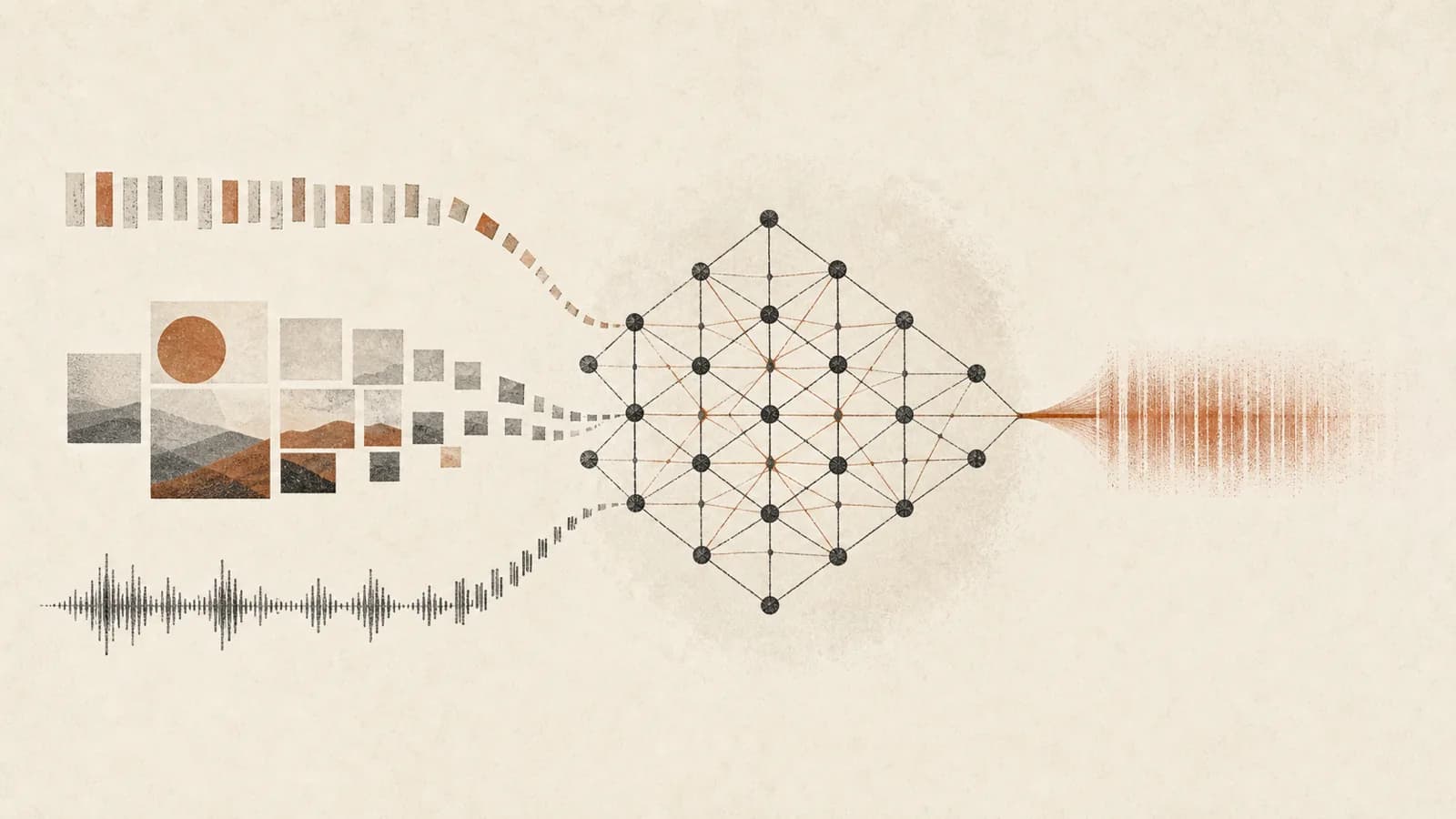
互動模型中的一項多模態設計選擇:不把音訊與視訊送進大型、獨立的編碼器(也不透過獨立的類 TTS 解碼器輸出音訊),而是採用最少前處理與一個單一 transformer,讓所有元件從頭共同訓練。「無編碼器」是相對而言的——仍有輕量的嵌入層——但沒有 Whisper 規模的音訊編碼器,也沒有獨立的 TTS 模型。
元件(一次 200ms 微回合)#
輸入(文字/畫格/音訊的任意子集):
- 文字 → token embedding(標準)。
- 影像/視訊畫格 → 切分成 40×40 patches,由 hMLP 編碼(Touvron et al. 2022)。
- 音訊 → 以 dMel 輸入(Bai et al. 2024),再由輕量嵌入層(「embedding bag」)轉換。
單一共享的 Transformer 消化融合後的輸入。
輸出:
- 文字 → unembedding(標準)。
- 音訊 → 產生 mel 的 flow head(Lipman et al. 2022)。
所有元件都與 transformer 一起從頭共同訓練——不是把預訓練編碼器/解碼器拼接起來。
為何重要#
- 避免大型獨立編碼器/解碼器的延遲與複雜度——當你每 200ms 都必須執行一次時尤其重要(見時間對齊微回合)。
- 早期融合(所有內容進入同一個 transformer)意味著模型能跨模態共同推理,而不是只處理已由編碼器消化的輸出——這是「一邊說話、一邊對視覺提示做出反應」等能力的先決條件(見全雙工互動)。
- 從頭共同訓練符合苦澀教訓:減少人手設計的模組邊界,增加端到端學習。
獨立佐證:Gemma 4 12B(2026 年 7 月)#
上述設計原本只建立在單一來源與單一實驗室之上。Gemma 4(empirical)從無關的起點得到相同架構——而這是更有趣的一致,因為兩者的動機不同。
TML 移除編碼器,是為了達到 200 ms 延遲預算。DeepMind 移除編碼器,則是為了記憶體:在邊緣硬體上「減輕對獨立編碼器的需求,並降低記憶體碎片化」。結論相同,理由正交。當兩個以不同目標最佳化的實驗室都收斂到刪除同一元件時,該元件可能並非承重元件。
Gemma 4 12B 的實作:
- 視覺。 將 48×48×3 RGB patches 通過單一 35M 矩陣乘法,取代 550M ViT。在最後一個 LayerNorm 之前,將以 2D 座標為基礎的位置嵌入加入 patch 表徵。
- 音訊。 305M、以 USM 為基礎的 conformer 被完全捨棄。原始 16 kHz 音訊被切成 40 ms 的區塊——每個是 640 維向量——再直接投影到 LLM 嵌入空間。完全不加入位置編碼:音訊本來就是時間序列。
Table 8 就是證據。無編碼器的 12B 在英文 FLEURS ASR 上達到 0.063 WER,在 CoVoST de→en 上達到 41.9 CorpusBLEU;相較之下,擁有編碼器的 E4B 分別為 0.065 與 42.0。依這些數字來看,丟掉 305M conformer 沒有付出任何代價。DeepMind 自己的說法是:「不需要專用音訊編碼器,也能達到具競爭力的音訊文字效能。」
報告未提及的兩項保留#
這不是受控消融實驗。 無編碼器模型是12B;有編碼器的比較對象是具 4.5B 有效規模的 E4B。12B 擁有更多 LLM 容量,可以吸收被捨棄編碼器原本負責的工作。「不使用編碼器仍可達到具競爭力的效能」這項主張獲得支持。更強的主張——「移除編碼器不需付出代價」——在論文任何地方都沒有測試;同規模的對照組就能定案,但並未執行。
確實存在經測量的退化,而且很具體。 將視覺 token 從 1120(Table 6)削減至 280(Table 12)後,12B 的退化程度不符合規模排序:
| 模型 | InfographicVQA Δ | OmniDocBench 1.5 Δ(↓ 越好) |
|---|---|---|
| 31B | −9.2 | +0.070 |
| 26B-A4B | −11.5 | +0.120 |
| 12B(無編碼器) | −29.7 | +0.244 |
| E4B | −15.2 | +0.126 |
| E2B | −19.3 | +0.206 |
12B 的跌幅比比它更大與更小的模型都嚴重——這是整個家族唯一違反排序的成員,而它也是唯一的無編碼器成員。這個效應侷限於影像中的密集文字任務:MMMU Pro(−1.4)與 MATH-Vision(−3.0)的退化則符合正常情況。一種合理解讀是,35M 線性投影不進行特徵壓縮,因此模型必須把解析度花在 ViT 原本會花參數的地方。如此一來,讀取小字就受 token 預算限制。
如果這個解讀正確,無編碼器並非免費——它用視覺 token 換取編碼器參數,這是推理成本的取捨,而不是節省。報告既未回報,也未評論這項反轉。
相關連結#
- 互動模型 — 父概念
- 時間對齊微回合 — 為何最少前處理是硬性要求(200ms 預算)
- 互動/背景模型分離 — 架構的另一半
- 全雙工互動 — 聯合多模態推理正是視覺+音訊插話成為可能的原因
- 苦澀教訓 — 「從頭共同訓練,捨棄模組化編碼器」是苦澀教訓式的做法
- TML-Interaction-Small — 實作此設計的模型(dMel 音訊、40×40 hMLP patches、flow head),從頭共同訓練
- Gemma 4 — 第二個獨立實例:直接捨棄其 305M 音訊 conformer 的 12B 開放權重模型
- 推理效率即能力 — DeepMind 的動機是記憶體而非延遲;而密集文字退化暗示,節省其實是參數換 token 的取捨
- 開放權重前沿差距 — 移除編碼器是讓小型 dense 模型仍能競爭的槓桿之一
開放問題#
- 在匹配規模下,無編碼器模型仍能匹敵嗎? 兩個來源都沒有執行這項消融。TML 從頭共同訓練所有內容;Gemma 4 在四個模型上凍結編碼器、在一個模型上移除編碼器,而且規模不同。
- 密集文字退化是投影式視覺路徑的內在特性,還是 12B 特定訓練執行的產物?這項預測可以證偽:無編碼器 31B 應在 280 tokens 下呈現相同的 InfographicVQA 斷崖。
- TML 同時刪除編碼器,並從頭共同訓練。Gemma 4 同時刪除編碼器,並從頭訓練 12B,但在其他地方保留凍結的編碼器。「無編碼器 + 從頭開始」的哪一半真正發揮作用?
資料來源#
- Interaction Models: A Scalable Approach to Human-AI Collaboration
- Gemma 4 Technical Report — §2.3(無編碼器架構)、Table 8(無編碼器的音訊)、Tables 6 & 12(280 與 1120 視覺 token 的退化)(
empirical)
Cited by 14
- Gemma 4×3
Encoder Free Early Fusion — Gemma 4 12B is the second independent instance of the design, and the…
- The Bitter Lesson×3
Encoder Free Early Fusion — co-train all modality components from scratch in one transformer rather…
- Google DeepMind×2
Gemma 4's 12B is also the second independent instance of Encoder Free Early Fusion, arrived at for…
- Inference Efficiency as Capability×2
5. Removing the encoders. The 12B's 550M vision encoder becomes a 35M matmul and its 305M audio…
- Inkling×2
Encoder-free multimodality: audio in as dMel spectrograms, images as 40×40-pixel patches through a…
- Interaction Models×2
Time Aligned Micro Turns, Interaction Background Model Split, Encoder Free Early Fusion — the three…
- Kimi (Moonshot AI)×2
K3 ships a 401M MoonViT-V2 vision encoder at 2.8T scale. Encoder Free Early Fusion documents three…
- TML-Interaction-Small×2
Modalities: continuous audio + video + text in; text + audio out. Encoder Free Early Fusion (dMel…
- Full-Duplex Interaction
Encoder Free Early Fusion — joint multimodal reasoning is what lets a visual change trigger speech
- Interaction / Background Model Split
Encoder Free Early Fusion — the other half of the architecture (the perception/generation side)
- Interaction & Multimodal
Encoder Free Early Fusion — Multimodal design with minimal pre-processing instead of large…
- Open Questions Backlog
Encoder Free Early Fusion ×3 (oldest 63d) — Does an encoder-free model at matched size still match?
- The Open-Weight Frontier Gap
Encoder Free Early Fusion — one of the levers that lets a 31B dense model contend at all
- Time-Aligned Micro-Turns
Encoder Free Early Fusion — the complementary "minimal pre-processing" choice that makes streaming…
Related articles
- Compute-Controlled Benchmarking
Noam Brown's critique: the single-number benchmark grid is broken because it ignores test-time compute — plot performan…
- Interaction Models
Thinking Machines Lab (May 2026): models that handle audio/video/text interaction natively in real time instead of via…
- Open-Weight Elicitation Irreversibility
A wiki-drawn synthesis of Brown and Gemma 4: if dangerous capability scales with inference budget, then an open-weight…
- TML-Interaction-Small
TML's first interaction model: 276B MoE / 12B active, audio+video+text in / text+audio out, 200ms micro-turns, async ba…
- Gemma 4
Google DeepMind's July 2026 open-weight multimodal family (Apache 2.0): 2.3B–31B dense plus a 26B/4B-active MoE, adding…