Sources#
- GDPval: Evaluating AI Model Performance on Real-World Economically Valuable Tasks
- Google's AI & Economy ATLAS v1.0: Mapping Gemini Usage in the Economy
Summary#
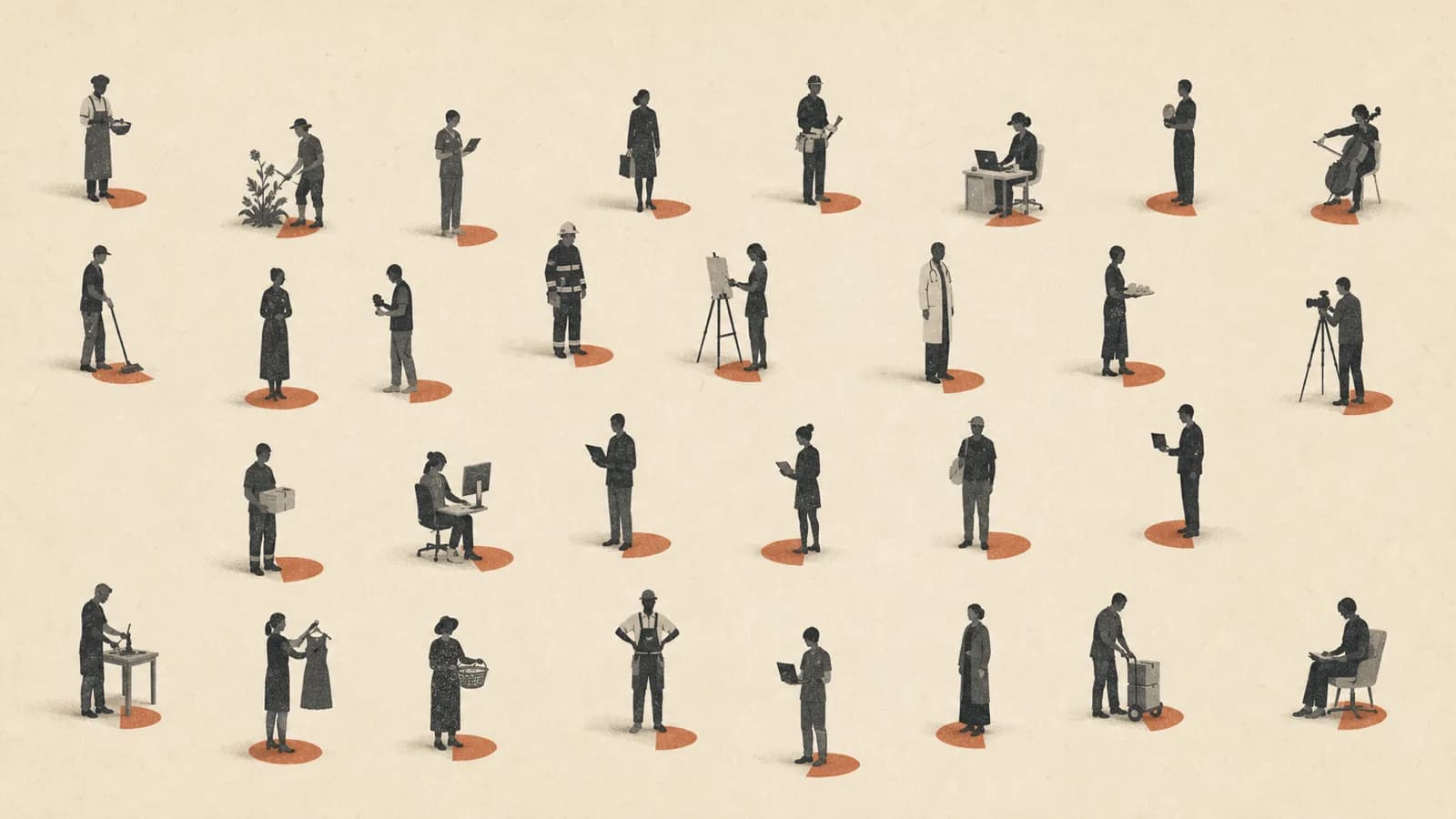
The headline result of Google's ATLAS v1.0: AI has reached almost every kind of job and almost none of the work inside them. Gemini usage appears in 68% of detailed O*NET occupations, which together employ 88.4% of US civilian workers — but within the occupations where it appears, workers use it for a median of 21% of that occupation's tasks. Breadth is nearly universal; depth is a fifth.
"Task saturation" is ATLAS's operational primitive: the share of an occupation's constituent O*NET task statements where usage clears a minimum-users threshold (25 unique users globally for a task; 50 for an occupation). It is a presence measure, not a volume measure — deliberately, because presence is far more robust to classifier noise than exact frequency (Usage-Telemetry Classifier Validation).
Evidence note.
empirical— 14.65M de-identified Gemini interactions, April 6–19 2026, mapped to O*NET v30.2. First-party, consumer-and-free-API surfaces only, observational. The task-level numbers rest on a classifier whose exact O*NET task accuracy is 22.6%; ATLAS mitigates by measuring presence rather than counts and by aggregating into Autor–Thompson task types (70.4% agreement). See Google AI & Economy ATLAS for full limitations.
The distribution#
| Cut | Result |
|---|---|
| Detailed occupations with any observed usage | 68% (≈88.4% of US employment) |
| O*NET tasks with observed usage, overall | ~20% |
| Occupations with zero task saturation | 29% |
| Occupations with ≥25% of tasks saturated | 30% (44–50% of US employment) |
| Occupations with ≥50% of tasks saturated | 11% (26–31% of US employment) |
| Occupations with ≥75% of tasks saturated | 3% (9–10% of US employment) |
| Median saturation, conditional on any usage | 21% |
The most-saturated occupations are software QA analysts and testers, HR specialists, document management specialists, market research analysts, and network/systems administrators — roles whose task lists are unusually text-shaped. The least saturated, among those with any usage at all, are teachers (special education, kindergarten, postsecondary English) and midwives. The largest occupations with no observed usage are food preparation workers, fast-food cooks, dining attendants, and short-term substitute teachers.
The extensive margin is gated by physicality#
What separates the 29% of occupations with zero saturation from the rest is not skill, wage, or prestige — it is how much of the job is physical. Occupations with zero saturation have markedly higher shares of manual tasks; cognitive and interpersonal tasks, especially non-routine cognitive, dominate the occupations where AI shows up at all.
But the boundary is porous, and this is ATLAS's most underrated finding: manual trades do use AI, for the cognitive tasks embedded in physical work. Industrial machinery mechanics (44% manual tasks) generate thousands of conversations about analyzing test results and machine error messages. Automotive service technicians (83% manual) generate over ten thousand conversations about testing vehicle components, rewiring systems, and inspecting parts for wear — with more than 2× the multimodal conversation share of the work baseline. The blue-collar exclusion narrative is wrong in the specific way that matters: AI enters physical work through its diagnostic and interpretive layer, and it enters through the camera.
The intensive margin concentrates in non-routine cognitive work#
Applying the Autor–Thompson (2025) five-way task classification — routine/non-routine × cognitive/manual, plus non-routine interpersonal:
| Task type | Share of O*NET universe | Share of Gemini interaction volume |
|---|---|---|
| Non-routine cognitive analytic | 35% | 65% |
| All cognitive (routine + non-routine) | ~50% | 86% |
| Manual | 28% | ~5% |
| Interpersonal | 22% | ~9% |
This is the discontinuity with prior technology waves. Autor et al. (2003) and Acemoglu & Autor (2011) modeled digitalization as routine-biased: computers substituted for codifiable work and complemented non-routine problem-solving, producing job polarization. LLMs invert the target — the tasks they absorb most are precisely the non-codifiable ones that rules-based computing could never reach. As ATLAS puts it, "AI-related impacts will not be cabined to routine tasks."
Intent: automation is rare, and confined to routine work#
ATLAS classifies each conversation cluster's intent into five categories. The pattern is the report's central rebuttal to the mass-displacement narrative:
| Intent | Non-routine cognitive | Routine cognitive | Interpersonal | Manual |
|---|---|---|---|---|
| Task Automation (end-to-end) | 6.5% | 26.9% | 2.9% | 4.2% |
| Partial Drafting & Generation | 41.5% | 43.8% | 37.3% | 7.0% |
| Review & Refinement | 3.8% | 4.5% | ~1% | ~0.6% |
| Ideation & Strategy | 18.6% | 2.6% | 31.1% | 6.0% |
| Information Retrieval & Learning | 29.6% | 22.2% | 27.6% | 82.1% |
Three things fall out. Automation intent is 4× higher for routine cognitive work than non-routine — the old substitution logic still holds where tasks are codifiable, it just no longer describes the bulk of usage. Manual-task usage is overwhelmingly learning: 82.1% information retrieval, which is the mechanic reading a diagnostic, not a machine replacing them. And interpersonal work splits between drafting and ideation with almost no automation — the AI writes the difficult email, it does not have the conversation.
ATLAS is careful that this is intent, not outcome: it cannot see the work happening outside Gemini, so it cannot say what fraction of the whole job AI completed. And it notes that even genuine task automation "does not necessarily equate [to] job automation, as coordination costs, complementary tasks and organizational frictions are highly prevalent" — the same argument Organizational Complements to AI makes from the adoption side.
The expertise inversion#
The finding that sits least comfortably with the rest of the wiki. ATLAS replicates Autor & Thompson's expertise measure (100 minus the average Standard Frequency Index of a task statement's lemmatized words — expert vocabulary is rare but low-entropy), sorts ~19,000 O*NET tasks into expertise quartiles, and computes how over-represented Gemini usage is relative to the task universe in each:
| Task type | Q1 (lowest expertise) | Q2 | Q3 | Q4 (highest) |
|---|---|---|---|---|
| Non-routine cognitive | 2.60× | 1.64× | 1.72× | 1.78× |
| Routine cognitive | 0.89× | 1.65× | 1.60× | 1.18× |
| Interpersonal | 0.68× | 0.42× | 0.26× | 0.38× |
| Manual | 0.14× | 0.23× | 0.17× | 0.23× |
Usage is most over-represented on the lowest-expertise non-routine cognitive tasks — 2.6× baseline, well clear of the 1.6–1.8× flat band across the other three quartiles. Yet the people doing the using skew rich and educated: a 1% increase in an occupation's median earnings is associated with >2.5% higher usage intensity (2.68 univariate; 1.86 controlling for education, R² 0.337), and weighting US median earnings by Gemini conversations moves it from $62,252 to $82,919 — and to $86,157 when weighted by tokens.
So the composition is: high-expertise workers, using AI disproportionately on their low-expertise tasks. That is the augmentation reading in its strongest form, and it is compatible with Returns to Expertise in Agentic Coding rather than opposed to it — the expert brings the judgment, and offloads the parts that don't need it. Autor & Thompson's model says which way this cuts: automating an occupation's inexpert supporting tasks raises the scarcity of the remaining human expertise, lifting wages while lowering employment; automating its expert tasks erodes barriers to entry and depresses wages. ATLAS's data currently points at the first.
Why this is contested rather than settled#
ATLAS explicitly stages the two readings of its own wage gradient rather than picking one:
- "Professionals are automating themselves out of existence" — high-wage white-collar workers are the heaviest users, and they are pointing AI at the cognitive core of their jobs.
- "Augmentation deepening the premium" — those workers are automating routine cognitive tasks and collaborating on non-routine ones, which raises returns to the non-routine human skills, widening the gap against everyone who can't use AI well.
Underneath sits the micro–macro gap (Imas & Shukla 2026): controlled experiments consistently find AI compresses the expert premium (novices catch up), while real-world observational studies find it widens. The reconciling mechanism ATLAS names is the endogenous adoption margin — adoption isn't randomly assigned, so the catch-up scenario requires broad uniform access while the run-away scenario follows from concentrated adoption via task selection (low-skill workers apply AI where it doesn't help), complementary judgment (verification requires human capital), and seniority-biased demand (firms substitute away from entry-level hiring while senior staff amplify).
Where the number is fragile#
Two caveats to attach whenever the 21% is quoted:
- It is a task-level statistic from a classifier that gets exact task assignment right 22.6% of the time. Google names this gulf itself and calls it "a caution against over-relying on hyper-specific task analysis." The mitigations are real — presence rather than frequency, aggregation into Autor–Thompson types where agreement is 70.4%, human raters approving 85.8% of task labels as economically reasonable — but they mitigate, they don't eliminate. Full treatment at Usage-Telemetry Classifier Validation.
- It disagrees with the AEI. ATLAS observes ~20% of tasks against Anthropic's 36% (Handa et al. 2025) and 49% combined (Appel et al. 2026), and attributes the gap to its stricter privacy thresholds. On automation the gap is wider still and definitional: ATLAS's <10% for non-routine cognitive vs Anthropic's 43–45% overall — and ATLAS notes Anthropic's automation share has been rising over time while its own snapshot has no time dimension at all.
Connections#
- GDPval Benchmark — the complementary cut of the same labor market, selected by a different instrument and answering a different question. ATLAS samples observed usage and asks what share of an occupation's tasks AI touches at all; GDPval selects occupations top-down by wage mass (the five highest-paying predominantly-digital occupations in each of the nine sectors contributing over 5% of U.S. GDP, 44 in total, $3T of annual earnings) and asks whether the delivered artifact beats the incumbent professional's. The pairing is the useful part: this page's answer is broad-but-shallow (68% of occupations, 21% of the median occupation's tasks), and GDPval's is that on the deep end of the highest-wage slice, win-or-tie rates against the professional run 12.4% to 47.6% with a steep duration gradient. Neither instrument sees the other's margin — usage telemetry cannot tell you whether the output was any good, and a win rate cannot tell you whether anyone is actually using the model for that task
- Task Crossover — the moving denominator under this page: saturation measures what share of an occupation's tasks AI reaches, while crossover finds that which tasks belong to the occupation is itself shifting (43.5% of occupation-specific use is outside the user's own job)
- Google AI & Economy ATLAS — the program and dataset this finding comes from
- Anthropic Economic Index — the rival measurement; observes 36–49% task coverage and 43–45% automation against ATLAS's ~20% and <10%, on a different product with a different classifier
- Exposure Taxonomy: Observed, Theoretical, Reported, Anticipated — task saturation is a stricter observed exposure measure from a second lab; the four-way exposure distinction is what keeps "68% of occupations" from being read as "68% of jobs are at risk"
- Returns to Expertise in Agentic Coding — the composition here (expert workers using AI on low-expertise tasks) is the mechanism behind the expertise premium, not a counterexample to it: the human supplies the judgment and offloads what doesn't need it
- Organizational Complements to AI — ATLAS's own caveat that task automation ≠ job automation because coordination costs and organizational frictions bind, stated from the usage side
- Usage-Telemetry Classifier Validation — the measurement floor under every number on this page
- The Household Production Boundary — the other 86.5% of usage; task saturation describes only the 13.5% of conversational AI that is work
- Conversation-to-Delegation Shift — the delegation reading from OpenAI's Codex data; ATLAS's <10% automation intent is measured on consumer surfaces that exclude exactly the agentic coding traffic where delegation concentrates
- Jagged Intelligence (Ghosts, Not Animals) — the task-level rather than job-level shape of AI capability is what makes saturation partial by construction
- Role Averaging, Not Role Elimination — occupations losing a fifth of their tasks to AI collaboration, not their existence
- Market-Priced AI Exposure (the AI Premium) — the market's skill map penalizes analytical/scientific work and rewards interactive/relational, which is the same manual-and-interpersonal-under-represented pattern priced from the equity side
- Firm AI-Spend Intensity and Headcount Growth — the firm-level counterpart: intensity-gated headcount growth under AI adoption, which is what shallow-and-collaborative diffusion should produce
- Printing Press Software Democratization — the QA-analyst and document-specialist saturation ceiling is what happens when a text-shaped job meets a text-shaped tool
- Post-Scarcity Macroeconomics — the physicality gate measured here is the exact variable Musk's abundance forecast turns on: his claim is that humanoid "end effectors" open it, and ATLAS's extensive-margin measurement is how you would ever check
Open Questions#
- ATLAS is a two-week snapshot with no time dimension, while the AEI reports automation share rising. Does median task saturation move at all over a year, and in which direction?
- The expertise inversion (2.6× on lowest-expertise non-routine cognitive tasks) is measured on consumer surfaces. Does it hold on enterprise and agentic-coding traffic, where the task mix is deliberately harder?
- Autor & Thompson predict opposite wage effects depending on whether AI absorbs an occupation's expert or inexpert tasks. ATLAS's snapshot points at inexpert. What signal would show the crossover if it happens?
Sources#
- GDPval: Evaluating AI Model Performance on Real-World Economically Valuable Tasks — Patwardhan et al. (19 authors, OpenAI), arXiv 2510.04374 v1, 2025-10-05, 29pp (
empirical). Cited here only for the contrasting selection instrument: §2.1 and Table 1 (nine sectors each over 5% of Q2-2024 GDP; five highest-wage predominantly-digital occupations per sector, 44 total, $3T in annual earnings), §2.1 step 2 and A.7 (the GPT-4o O*NET digital-task classifier at a 0.60 weighted threshold, validated against Acemoglu & Autor 2011), and §3.1 Figure 5 for the win-rate range. Full treatment and COI on GDPval Benchmark - Google's AI & Economy ATLAS v1.0: Mapping Gemini Usage in the Economy — ATLAS v1.0 §3 Work Usage (§3.3 Occupational AI Usage, §3.4 Task Coverage, §3.5 Task Characteristics, §3.6 Task Intent, §3.7 Expertise, §3.8 Earnings and Education), Figures 3–9, Tables 1–2
Cited by 18
- Open Questions Backlog×4
Task Saturation: Autor & Thompson predict opposite wage effects depending on whether AI absorbs an…
- Post-Scarcity Macroeconomics×4
The wiki's value here is not the forecast but the structure: this is the fullest statement of the…
- Exposure Taxonomy: Observed, Theoretical, Reported, Anticipated×3
Task Saturation — a depth measure orthogonal to all four exposure measures here: not what share of…
- Usage-Telemetry Classifier Validation×3
Task Saturation — the headline finding most exposed to this error, and the reason its task-type…
- GDPval Benchmark×2
Two design choices that are easy to miss. The tasks were sourced by occupation wage mass, not by AI…
- Google AI & Economy ATLAS×2
ATLAS v1.0: Mapping Gemini Usage in the Economy (July 23, 2026) — → Task Saturation, Household…
- Organizational Complements to AI×2
Weigh it accordingly. The 30–40% is a theoretical-exposure number (the share of tasks a model could…
- Returns to Expertise in Agentic Coding×2
The caveats are real: ATLAS measures consumer surfaces and free API only (no enterprise, no agentic…
- Task Crossover×2
The denominator is moving. Task Saturation measures how deeply AI penetrates a reached occupation's…
- Conversation-to-Delegation Shift
Task Saturation — the same delegation boundary read off surfaces rather than tools: ATLAS finds…
- Firm AI-Spend Intensity and Headcount Growth
Task Saturation — the task-level shape consistent with headcount growth rather than displacement:…
- The Household Production Boundary
Task Saturation — the other 13.5%; the work-side finding this page is the complement to
- Is Breadth Cheap Now? Specialist Ramp Speed and Domain-Expert-as-Builder at Scale
Primary-job building as population-level practice: still unshown. Three structural caveats keep…
- Jagged Intelligence (Ghosts, Not Animals)
Task Saturation — jaggedness measured at economy scale: AI reaches 68% of occupations but a median…
- Market-Priced AI Exposure (the AI Premium)
Task Saturation — the usage-side counterpart to this page's skill map: ATLAS finds manual (5% of…
- AI Economics & Labor
Task Saturation — Google ATLAS's marquee work finding — AI reaches 68% of detailed occupations…
- Printing Press Software Democratization
Task Saturation — where the democratization ceiling currently sits: the most-saturated occupations…
- Role Averaging, Not Role Elimination
Task Saturation — the labor-data version: occupations shed a fifth of their tasks to AI…
Related articles
- Returns to Expertise in Agentic Coding
Anthropic's 400K-session study: domain expertise (not coding skill) is what amplifies an agent — experts get 2× the act…
- Organizational Complements to AI
The general-purpose-technology argument: AI productivity gains depend on complementary workflow, skill, and org-design…
- Exposure Taxonomy: Observed, Theoretical, Reported, Anticipated
Four distinct ways to measure AI's reach into an occupation — observed exposure (tasks seen done with Claude), theoreti…
- Conversation-to-Delegation Shift
OpenAI's Codex usage study (June 2026): the move from conversational AI ('asking') to agentic AI ('delegated production…
- Task Crossover
OpenAI's Work at the Frontier (800K+ US ChatGPT work messages mapped to O*NET, July 2026): 16.8% of work messages and 4…