Sources#
- Agentic coding and persistent returns to expertise
- Anthropic Economic Index report: Cadences
- Helping People Choose Careers in the Age of AI
- How Organizations Use AI: Evidence from ChatGPT
What it is#
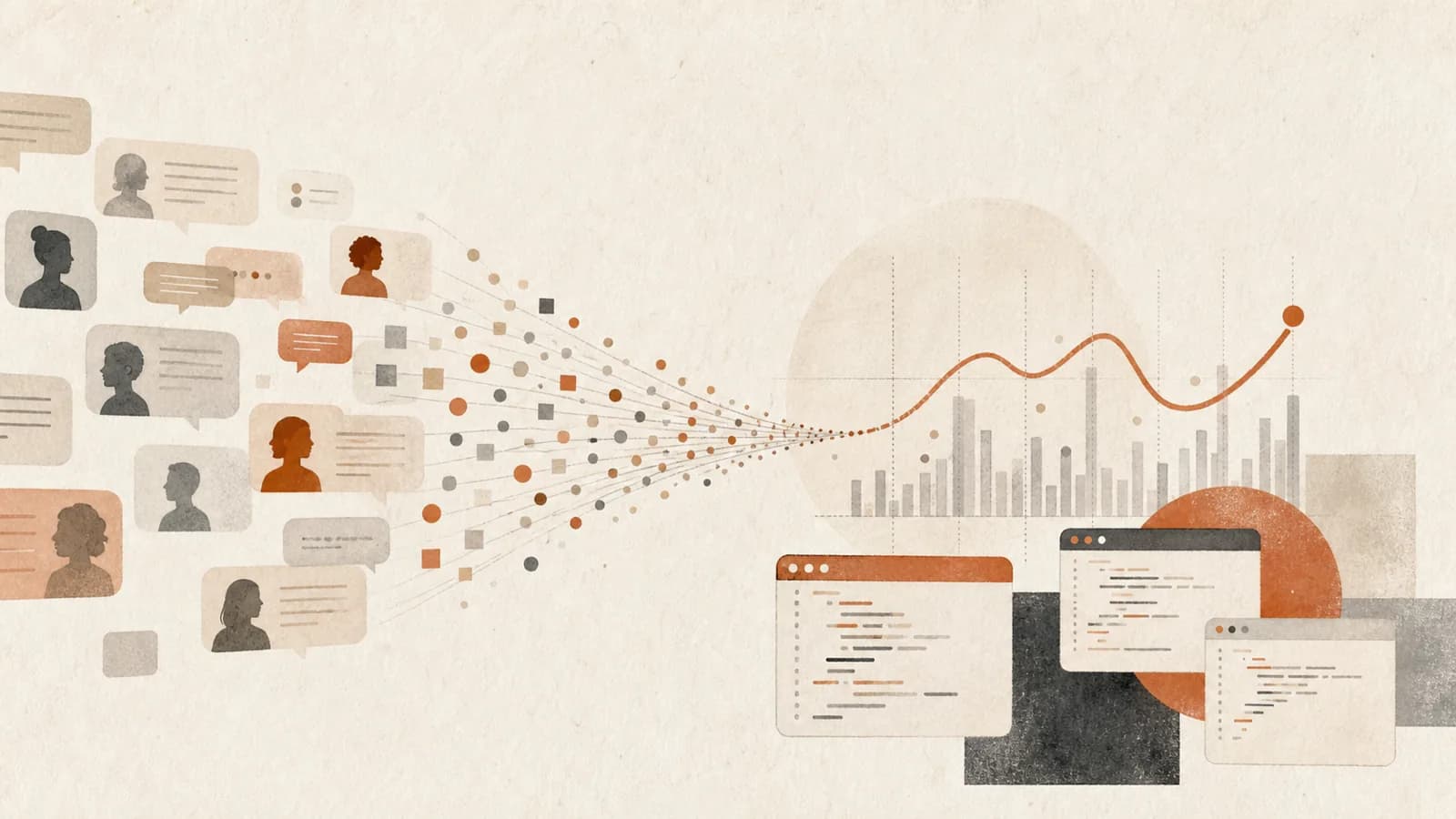
The Anthropic Economic Index (AEI) is Anthropic's ongoing economic-research program studying how AI diffuses into economic life, read primarily off privacy-preserving usage telemetry — a slice of real Claude conversations, classified by another instance of Claude, with humans never reading raw transcripts and low-count cells filtered for privacy (the Clio methodology). Where most AI-labor research works from occupational task lists or surveys of what models could do, the AEI's distinctive move is to measure what people are actually doing with the product, at scale, across Claude Code, Cowork, Claude.ai, and the first-party API.
Recurring authors include Zoe Hitzig, Maxim Massenkoff, Eva Lyubich, Ryan Heller, and Peter McCrory (the Cadences report adds Szymon Sacher and Shaoyi Zhang).
Methodological evolution#
The program has steadily widened its instrument:
- Seven-day samples → continuous hourly telemetry. Earlier reports drew on weekly windows; the Cadences report (June 2026) introduced continuous daily/hourly sampling, which is what made temporal usage rhythms visible.
- Task/request → artifact classification. Cadences added a classifier for the output of each conversation, not just the request — the artifact primitive.
- Telemetry → linked survey. The Anthropic Economic Index Survey (launched April 2026) asks users directly about their experience and links responses to their usage via privacy-preserving methods (~9,700 linked respondents in Cadences). This extends the program from behavior-only to behavior-plus-perception — the exemplar case of combining both signals rather than choosing one.
- Adjacent instruments: the Anthropic Interviewer (81,000 user interviews, December 2025) and the Anthropic Public Record (a nationally representative survey of 50,000+ Americans) provide corroboration beyond the user base.
Recurring primitives it introduced#
- Automation vs. augmentation — whether a conversation delegates a whole task or collaborates iteratively; operationalized by the collaboration-mode classifier (Directive, Feedback Loop, Task Iteration, Learning, Validation). See The Automation–Optimism Link.
- Observed vs. theoretical exposure — later joined by reported and anticipated exposure from the survey. See Exposure Taxonomy: Observed, Theoretical, Reported, Anticipated.
- Returns to expertise — domain understanding, not coding skill, amplifies the agent. See Returns to Expertise in Agentic Coding.
Reports in this wiki#
- Cadences (June 26, 2026) — usage cadences, conversation artifacts, and the first Economic Index Survey findings. → AI Usage Cadences, Conversation Artifacts, Exposure Taxonomy: Observed, Theoretical, Reported, Anticipated, The Automation–Optimism Link
- Agentic coding and persistent returns to expertise (June 2026) — the 400K-session returns-to-expertise study. → Returns to Expertise in Agentic Coding, Agentic Coding Work-Composition Shift
The data releases as third-party infrastructure#
The AEI publishes its task-level data, and by mid-2026 outside economists were building independent instruments on top of it. Steele & Cruz (American University / CU Boulder, July 2026) construct a new occupational AI-exposure measure from the September 2025 release (Appel et al. — 1,909,132 global Claude queries from Aug 4–11 2025, 50.5% Free/Pro and 49.5% API, each mapped to one of 17,659 O*NET tasks and to one of the five collaboration modes), combined with OpenAI's GWA-level usage. They then place it alongside six other instruments including the AEI's own Massenkoff & McCrory measure — and find the two Anthropic-usage-derived instruments correlate at ρ = 0.89 with each other while correlating poorly with everything built from task ratings, patents, or rubrics. See Exposure Taxonomy: Observed, Theoretical, Reported, Anticipated for the head-to-head.
Two things follow for the program. The release format — task-level counts split by collaboration mode — is doing real work as shared infrastructure, which is the strongest available answer to the single-provider criticism (Market-Priced AI Exposure (the AI Premium) contrasts the AEI's one-lab scope against its own 400+-model panel): a single lab's data can still support instruments the lab did not build. And the ρ=0.89 pair is the clearest demonstration that AEI-derived exposure measures form a family — an outside team using different assumptions, a different feasibility model, and a second lab's data still lands near the AEI's own measure, because the ranking is inherited from the usage data.
The rival instrument: Google ATLAS (July 2026)#
Google's AI & Economy ATLAS v1.0 (July 23, 2026) is the AEI's direct methodological counterpart — the same instrument class (privacy-preserving LLM classification of a lab's own conversation logs, mapped onto official statistical taxonomies) aimed at the same question, on a different product and a much broader user base (Gemini App + AI Mode + Gemini API, 14.65M interactions, 150 countries). ATLAS explicitly positions itself against the AEI and names its deltas: pooling a chat app with an AI search surface and a developer API, recursive traversal of nested SOC/O*NET taxonomies in one pipeline, randomized classifier options to defeat position bias, synthetic-data validation, ATUS mapping for non-work usage, and penetration-adjustment for cross-country comparison.
The two programs disagree on levels while agreeing on direction. ATLAS observes AI usage in ~20% of O*NET tasks against the AEI's 36% (Handa et al. 2025) and 49% combined (Appel et al. 2026) — ATLAS attributes the gap to its stricter privacy thresholds. More consequentially, ATLAS classifies <10% of non-routine-cognitive conversations as end-to-end automation intent, against the AEI's 43–45% automation share — a gap that is mostly definitional (binary augmentation/automation vs a five-category intent classifier where anything short of end-to-end counts as collaboration), and one ATLAS sharpens by noting the AEI's automation share has been rising over time. On GDP elasticity the two nearly agree: 0.9 for Gemini vs 0.7 for Claude.
The asymmetry that now matters most: ATLAS published its classifier-validation numbers and the AEI has not. The Clio pipeline's accuracy against ground truth at the task and occupation level is not public, so the AEI's headline quantities carry an unquantified error bar where ATLAS's carry a measured one. See Usage-Telemetry Classifier Validation.
Connections#
- Anthropic — the parent lab; the AEI is its economic-research output
- Google AI & Economy ATLAS — the rival program from Google; same instrument class, disagreeing levels on task coverage and automation share, and the first in the genre to publish classifier-validation results
- Usage-Telemetry Classifier Validation — the measurement layer both programs depend on; ATLAS quantified it, the AEI has not
- Returns to Expertise in Agentic Coding — the program's flagship coding-specific finding
- AI Usage Cadences · Conversation Artifacts · Exposure Taxonomy: Observed, Theoretical, Reported, Anticipated · The Automation–Optimism Link — the four concepts filed from the Cadences report
- Agentic Coding Work-Composition Shift — the companion work-composition analysis
- Telemetry vs. Survey Measurement — the AEI is the case that resolves the dichotomy by linking usage telemetry to survey responses
- The Enterprise AI Adoption Gradient — the closest sibling measurement in the corpus, on a near-disjoint sample. OpenAI's August 2026 ChatGPT Enterprise study is the same instrument class — first-party, classifier-mediated product telemetry from a frontier lab — aimed at a question this program cannot reach: which firms adopt, read off paid administrative workspace records joined to Compustat financials. The units differ all the way down. The AEI samples conversations across consumer, Cowork, Claude Code and API surfaces and maps them onto O*NET tasks; the OpenAI study counts organization-weeks inside paid enterprise workspaces and maps them onto NAICS industries, job-title classes and a proprietary 60-category taxonomy. The AEI can say what kind of work an economy does with AI and cannot link any of it to a firm; the OpenAI study can join usage to a balance sheet and sees only enterprise buyers of one product. Their numbers should be read side by side and never pooled. One asymmetry runs the AEI's way and one against it: OpenAI publishes no accuracy figure for either of its classifiers, matching this program's own unpublished-validation gap — but it does publish its sample sizes, its linkage procedure and the disclosure-motivated random-sampling step that contaminates its control group, which is more methodological detail than the AEI reports releases with
- Conversation-to-Delegation Shift — OpenAI's Codex usage study is the cross-lab counterpart; it explicitly cites the AEI's returns-to-expertise work
- Claude Code · Cowork — the products whose usage the index measures
- Does the Augmentation/Automation Split Govern Skill at Work? — the program's automation-share axis put under load: it welds Directive to Feedback Loop and excludes the collaboration-mode classifier's own Learning category, so it cannot separate the two use modes a randomized learning experiment shows diverge — and the rising drift ATLAS names (43–45%) points toward the hollow arm while measuring delegation, not skill. The decomposition it asks for is a re-aggregation of data the program already has
Sources#
- Anthropic Economic Index report: Cadences — Anthropic Economic Index report: Cadences (June 26, 2026)
- Agentic coding and persistent returns to expertise — Anthropic Economic Research (June 2026)
- Helping People Choose Careers in the Age of AI — Steele & Cruz, arXiv 2607.15506 (2026-07-16),
empirical; §2 (contributions), §4 (the query-based construction from the September 2025 release), §4.4 (correspondence). Parse warnings and a source-internal contradiction in this source are recorded on Exposure Taxonomy: Observed, Theoretical, Reported, Anticipated. - How Organizations Use AI: Evidence from ChatGPT — Chatterji, Holtz, Rakholia, Tambe & Weeratunga (OpenAI + Columbia + Wharton), How Organizations Use AI: Evidence from ChatGPT, arXiv 2608.12236 (2026-08-12,
empirical). Cited here only for the instrument comparison above — samples, units of analysis and classifier-validation posture. Full treatment at The Enterprise AI Adoption Gradient
Cited by 24
- Exposure Taxonomy: Observed, Theoretical, Reported, Anticipated×5
Claude side — 1,909,132 global queries from the third AEI release (Appel et al., Aug 4–11 2025;…
- AI Usage Cadences×3
> Evidence note. empirical — privacy-preserving classifiers over continuously-sampled Claude.ai,…
- The Automation–Optimism Link×3
The most counterintuitive result of the Anthropic Economic Index's June 2026 Cadences survey…
- Conversation Artifacts×3
Anthropic Economic Index — the research program; this is its Chapter-2 contribution (the artifact…
- Google AI & Economy ATLAS×3
The report states its own methodological deltas against Anthropic (Handa et al. 2025; Massenkoff et…
- AI Adoption in Scientific Work×2
Over-representation. Gemini volume across the six research-intensive SOC families runs 1.8× their…
- Conversation-to-Delegation Shift×2
Anthropic's AEI Cadences report (June 2026) supplies the surface-comparison from the Claude side.…
- The Enterprise AI Adoption Gradient×2
Against Anthropic Economic Index, this is the closest sibling measurement in the corpus and the…
- Market-Priced AI Exposure (the AI Premium)×2
Cross-provider, not single-lab. The panel spans OpenAI, Anthropic, Google, Meta, DeepSeek, Qwen,…
- Returns to Expertise in Agentic Coding×2
Complementarity accrues to the experienced, substitution to the young. Regressing occupation-level…
- Stanford Digital Economy Lab×2
Exposure is an occupational attribute, borrowed from elsewhere. Two primary measures: the GPT-4 β…
- Task Saturation: Broad but Shallow AI Diffusion×2
It disagrees with the AEI. ATLAS observes ~20% of tasks against Anthropic's 36% (Handa et al. 2025)…
- Usage-Telemetry Classifier Validation×2
The entire genre of AI-usage economics — Anthropic's Economic Index, OpenAI's Codex study, Google's…
- Anthropic
Anthropic Economic Index — Anthropic's economic-research program measuring Claude's diffusion into…
- Claude Code
Conversation To Delegation Shift — the AEI Cadences report finds Claude Code drives higher AI…
- Codified vs Tacit Knowledge Exposure
The knowledge index is not the only instrument in the paper pointing this way, and the second one…
- Cognitive Capability Profiling for Task Suitability
Anthropic Economic Index, ATLAS or any other external exposure measure.
- Cowork
Conversation Artifacts — Cowork's outputs (decks, dossiers, inbox triage) are among the artifacts…
- Experimental Learning Impact of Generative AI
Does the same use-mode split govern workplace skill accumulation (the open question Automation…
- Google DeepMind
This places DeepMind opposite Anthropic's Economic Index on the wiki's usage-measurement axis, and…
- The Household Production Boundary
Anthropic Economic Index — the rival program, which measured non-work usage far more thinly; ATUS…
- Entities — People, Orgs, Tools & Projects
Anthropic Economic Index — Anthropic's recurring economic-research program measuring how Claude…
- Telemetry vs. Survey Measurement
Anthropic Economic Index — the program that resolves this page's dichotomy: it links usage…
- Does the Augmentation/Automation Split Govern Skill at Work?
Anthropic Economic Index: automation share 43–45%, and — the observation ATLAS uses when disputing…
Related articles
- Conversation-to-Delegation Shift
OpenAI's Codex usage study (June 2026): the move from conversational AI ('asking') to agentic AI ('delegated production…
- Exposure Taxonomy: Observed, Theoretical, Reported, Anticipated
Four distinct ways to measure AI's reach into an occupation — observed exposure (tasks seen done with Claude), theoreti…
- Returns to Expertise in Agentic Coding
Anthropic's 400K-session study: domain expertise (not coding skill) is what amplifies an agent — experts get 2× the act…
- Organizational Complements to AI
The general-purpose-technology argument: AI productivity gains depend on complementary workflow, skill, and org-design…
- AI Usage Cadences
AEI Cadences report: continuous hourly telemetry reveals AI usage carries the rhythms of daily life — personal use spik…