Sources#
What it is#
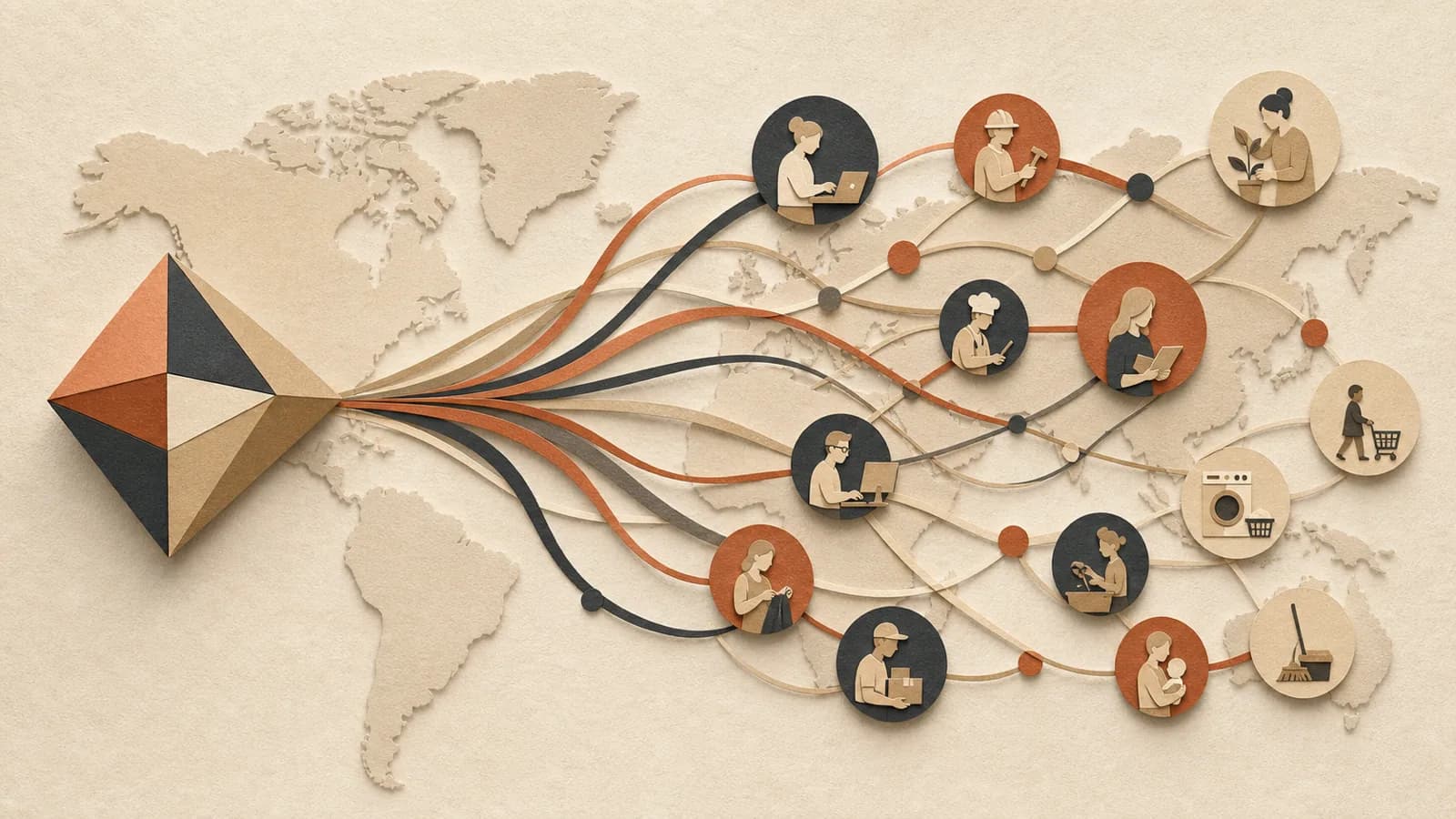
ATLAS — Activity, Task, Landscape, and Adoption Study — is Google's ongoing economic-research program measuring how AI is actually used, read off Gemini usage logs. ATLAS v1.0 (July 23, 2026) is the first release: 14,653,926 de-identified interactions sampled from the Gemini App, Google AI Mode, and the Gemini API between April 6 and April 19, 2026, clustered and mapped onto BLS/O*NET occupations and tasks for work usage and the American Time Use Survey lexicon for non-work usage. Coverage: 800+ occupations, ~4,000 work tasks, 300 household activities, 150 countries, 143 languages.
It is the structural counterpart to the Anthropic Economic Index: same instrument class (privacy-preserving classification of a lab's own conversation logs), same question (where is AI landing in the economy), different product, different user base, and — as it turns out — different numbers.
Authors are drawn from Google and Google DeepMind; Zanna Iscenko and Scott Strand are the corresponding authors, with James Manyika and Fabien Curto Millet among the senior names. Diane Coyle (Cambridge) and David Autor (MIT) are credited for guidance and review, and Coyle contributes a signed guest comment on the household production boundary — an unusual move that puts named external economists inside a first-party vendor report.
Evidence note.
empirical— large-scale measured usage with a documented pipeline, published classifier-validation results, and stated limitations. But it is first-party: Google measuring Google's own surfaces, over a two-week window, with Gemini models doing the summarizing, clustering, and classifying. Not independently reproducible; the raw logs cannot be released. The evidence tier reflects the methodology, not independence.
The pipeline#
- Work / non-work split. An automated classifier routes each interaction into one of two pipelines. This binary gates everything downstream (93.7% accuracy on a balanced synthetic set).
- Summarize, then cluster. Conversations are summarized individually (full text discarded), then grouped by OCTO (Observation Clustering and Taxonomy Organisation), a bespoke DeepMind clustering and hierarchical-taxonomy tool, and re-summarized at the cluster level.
- Map to official taxonomies. Work clusters → BLS 2018 SOC + O*NET v30.2 occupations and task statements. Non-work clusters → BLS 2024 ATUS Activity Lexicon (three tiers).
- Bespoke overlays. Intent (five categories), task expertise (Autor–Thompson Standard Frequency Index replication), Autor–Thompson routine/non-routine × cognitive/manual/interpersonal task types, and multimodality. Gemini 3.1 Flash-Lite does the classification.
- Validate. Three ways — synthetic ground truth, inter-rater agreement, human approval. See Usage-Telemetry Classifier Validation.
Privacy governance is four-layered: DLP filters strip PII before processing; internal log identifiers are replaced with mathematically unlinked UUIDs; two rounds of summarization discard the underlying text; and k-anonymization drops any cluster representing fewer than 10 unique users. Neither raw conversations nor individual summaries are retained in the final dataset.
How Google says it differs from the AEI and OpenAI#
The report states its own methodological deltas against Anthropic (Handa et al. 2025; Massenkoff et al. 2026) and OpenAI (Chatterji et al. 2025) — worth recording because they are the reasons the numbers diverge:
- Wider surface pool — a standalone chat app, an AI search experience, and a developer API pooled together, rather than one product family.
- Scale — 15M interactions, with clustering rebuilt for that volume.
- Recursive nested taxonomies — SOC and O*NET traversed in a single pipeline rather than classified separately.
- LLM-assisted category annotation — taxonomy category descriptions are expanded by a model to give the classifier more context.
- Randomized classifier options — option order is shuffled to defeat the documented position bias in LLM classification (the same bias family LLM-Judge Validation measures).
- Synthetic-data validation — accuracy measured against a generated ground truth, since real logs have none.
- ATUS mapping for non-work — the substantive expansion; prior work treated non-work usage thinly.
- Penetration adjustment for cross-country comparison — raw usage divided by a StatCounter Gemini-share proxy, so the map reads as AI diffusion rather than Google's regional footprint.
Global diffusion (§5)#
ATLAS's third analytical block, and the part most specific to having a globally-deployed consumer surface:
- Adoption scales with wealth. Penetration-adjusted conversations per capita against log GDP per capita gives a slope of ~0.9 — a 1% increase in GDP per capita is associated with a 0.9% increase in usage. (Anthropic's international index found 0.7 for Claude.) The relationship survives restricting to free services, so it is not simply ability to pay.
- The concentration is severe. The lowest-usage quintile of countries holds 17% of world population and generates 2% of conversations; the top quintile holds 11% of population and drives 30% — 2.8× its proportional share.
- Internet access is a real but partial bottleneck. Normalizing by internet users rather than population nearly triples Sub-Saharan Africa's adoption metric, but does not close the gap.
- The interest–adoption gap. Relative Google Trends search interest in AI is highest in South and Southeast Asia and East Africa — exactly the regions in the lowest usage quintiles — and lowest in Western Europe and Japan, which lead per-capita usage. Google's reading: in mature markets AI has already stopped being a thing you search for and become background utility.
- The work-share inversion. By absolute per-capita work conversations, high-income countries lead. By share of a country's conversations that are work-related, the ranking flips: Africa surges into the top quintile, the US and EU fall to the bottom. Google offers three candidate explanations and endorses none — goal-directed usage under metered data costs, leisure dilution in rich countries, or an artifact of excluding enterprise Gemini subscriptions that are more common in the US and EU.
- API usage is far more concentrated than conversational usage, in established tech hubs. The stated reason is that APIs need engineers, cloud infrastructure, and capital, and are billed per token — with tokenization bias making non-Latin-script languages structurally more expensive per unit of text.
- Language. 143 languages clear the privacy threshold; English is just over a third of conversations, Spanish 12%, Arabic ~7%, Portuguese ~6%. Non-primary-language use is 26% for work vs 24% for non-work — near-parity, which disproves the hypothesis that users code-switch into English for high-stakes tasks. It is highest in volunteer (21.9%), religious (20.5%), and civic (18.5%) activity, i.e. driven by the sociolinguistic character of the activity, not its economic value. But it costs: non-primary English conversations run 9–12% more turns and 18–20% more tokens after fixed effects.
- Multimodality skews the other way. Non-OECD work conversations are roughly twice as likely to include a generated image or video; media generation is most common in Africa, least in Europe.
Where ATLAS and the AEI disagree#
The two programs measure the same construct and get materially different levels. ATLAS names most of these itself:
| Quantity | ATLAS v1.0 | Anthropic Economic Index |
|---|---|---|
| Share of O*NET tasks with observed usage | ~20% | 36% (Handa et al. 2025); 49% combined (Appel et al. 2026) |
| Automation vs. collaboration | <10% automation intent for non-routine cognitive work; 26.9% for routine cognitive | 43–45% automation, 52–57% augmentation — and rising over time |
| GDP elasticity of adoption | 0.9 | 0.7 |
The task-share gap ATLAS attributes to its stricter privacy thresholds. The automation gap is largely definitional: Anthropic uses a binary augmentation/automation split, ATLAS a five-category intent classifier where "Task Automation" means end-to-end execution of the core task and everything short of that (drafting, review, ideation, retrieval) counts as collaboration. The two are not measuring the same cut, which is itself the finding — the headline "is AI automating or augmenting?" number is an artifact of where you draw the line. Treat direction as corroborated across labs and levels as method-dependent.
Limitations (author-stated)#
- No paid Gemini API content — so enterprise usage via Google Cloud is under-represented. Paid API request counts by country are used for geography only.
- No Workspace, AI Overviews, Translate, Maps, Flow, Antigravity, or Gemini Notebook — products with billions of users, and the ones where agentic coding and world models would show up.
- Behavioral interactions, not outcomes. A completed conversation is not evidence that the user's goal was met, time was saved, or value was created.
- Current adoption, not potential. Non-adopters are invisible; this is the frontier of use, not the frontier of usefulness.
- Probabilistic classification. Granular occupation and activity findings carry more uncertainty than major-group trends — see Usage-Telemetry Classifier Validation for how much more.
- Two weeks in early April 2026, which overlaps US tax season — ATLAS flags this as inflating tax-adjacent occupations.
- Observational throughout. No causal identification of anything.
Reports in this wiki#
- ATLAS v1.0: Mapping Gemini Usage in the Economy (July 23, 2026) — → Task Saturation: Broad but Shallow AI Diffusion, The Household Production Boundary, Usage-Telemetry Classifier Validation
Connections#
- Anthropic Economic Index — the direct rival program; same instrument class, different product and user base, and disagreeing levels on nearly every headline quantity
- Task Saturation: Broad but Shallow AI Diffusion — ATLAS's marquee work-side finding: broad but shallow diffusion
- The Household Production Boundary — its most novel contribution, and the one no prior usage study attempted at this resolution
- Usage-Telemetry Classifier Validation — the program's genuine methodological gift: the first published accuracy numbers for the classifier layer every usage-economics study depends on
- Google DeepMind — co-author of the report and builder of OCTO, the clustering tool underneath it
- Conversation-to-Delegation Shift — OpenAI's Codex study, the third lab's usage instrument; ATLAS's API-vs-conversational split (98.8% of API traffic is work-related) is the same delegation/conversation boundary seen from the surface side
- Exposure Taxonomy: Observed, Theoretical, Reported, Anticipated — ATLAS supplies observed exposure from a second lab; its task-saturation measure is a stricter version of the same primitive
- Telemetry vs. Survey Measurement — ATLAS is a telemetry instrument that repeatedly checks itself against survey data (Ipsos/Google, Pew) rather than choosing one
- Market-Priced AI Exposure (the AI Premium) — a fourth instrument on a fourth axis; ATLAS's GDP gradient and the AI premium's absence in emerging markets are the same divide priced two ways
- Organizational Complements to AI — ATLAS's enterprise blind spot is precisely where the complements story lives, which is why it can't speak to firm-level adoption
- Gemma 4 · Google DeepMind — the sibling Google artifacts in this wiki
Open Questions#
- ATLAS excludes paid API, Workspace, AI Overviews, and Antigravity — the surfaces where agentic and enterprise usage concentrate. Does the "shallow, collaborative, non-automating" picture survive when v2 includes them, or is it an artifact of measuring the consumer surfaces?
- ATLAS and the AEI disagree by 2–4× on automation share and task coverage. Would running both classifiers over both labs' logs reconcile the gap, or is cross-lab usage measurement structurally incomparable?
- The work-share inversion has three candidate explanations (goal-directed usage under data costs, leisure dilution in rich countries, excluded enterprise subscriptions) and ATLAS endorses none. Which one is it?
Sources#
- Google's AI & Economy ATLAS v1.0: Mapping Gemini Usage in the Economy — Google's AI & Economy ATLAS v1.0: Mapping Gemini Usage in the Economy (Iscenko, Strand et al., Google & Google DeepMind, July 23, 2026); §2 Data and Methods, §5 Global Diffusion, Appendices A–B
Cited by 12
- The Household Production Boundary×3
Google Ai Economy Atlas — the program; this is the analytical block with no prior counterpart in…
- Task Saturation: Broad but Shallow AI Diffusion×3
The headline result of Google's ATLAS v1.0: AI has reached almost every kind of job and almost none…
- Anthropic Economic Index×2
Google Ai Economy Atlas — the rival program from Google; same instrument class, disagreeing levels…
- Google DeepMind×2
A fourth posture beyond frontier lab, theorist, and open-weight shipper: economic measurement of…
- Usage-Telemetry Classifier Validation×2
The entire genre of AI-usage economics — Anthropic's Economic Index, OpenAI's Codex study, Google's…
- Does the Augmentation/Automation Split Govern Skill at Work?×2
The mix is drifting the wrong way. The AEI's automation share is 43–45% and rising (as ATLAS notes…
- AI Usage Cadences
Google ATLAS (July 2026) finds the same after-hours signal in Gemini logs — roughly half of all…
- Exposure Taxonomy: Observed, Theoretical, Reported, Anticipated
Google ATLAS (July 2026) supplies a second lab's observed exposure on the same O\NET substrate, and…
- Entities — People, Orgs, Tools & Projects
Google Ai Economy Atlas — Google's recurring economic-research program measuring Gemini usage…
- Open Questions Backlog
Google Ai Economy Atlas ×3 (oldest 47d) — ATLAS excludes paid API, Workspace, AI Overviews, and…
- Returns to Expertise in Agentic Coding
Google ATLAS (July 2026) supplies a cross-lab observation that looks like a contradiction and…
- What the Instrument Can Resolve: Two Headline Numbers and Their Missing Denominators
google atlas — ATLAS v1.0, Appendix B: Classifier Validation. B.1 (Mellow & Sider 1983 at 17% /…
Related articles
- Conversation-to-Delegation Shift
OpenAI's Codex usage study (June 2026): the move from conversational AI ('asking') to agentic AI ('delegated production…
- Market-Priced AI Exposure (the AI Premium)
Borri-Liu-Tsyvinski: market-implied AI exposure built from 380T tokens of realized OpenRouter consumption — an AI Facto…
- Usage-Telemetry Classifier Validation
Google ATLAS is the first AI-usage-economics program to publish accuracy numbers for the LLM classifiers every such stu…
- Anthropic Economic Index
Anthropic's recurring economic-research program measuring how Claude usage maps to and diffuses through the economy — p…
- Exposure Taxonomy: Observed, Theoretical, Reported, Anticipated
Four distinct ways to measure AI's reach into an occupation — observed exposure (tasks seen done with Claude), theoreti…