Sources#
Summary#
The economic half of Musk's July 2026 Economist interview (prediction — a forecast with no measurement behind it; every claim below is attributed, not asserted). Asked how his companies will make money in ten years, he answers that the question dissolves: "Money won't matter in 2036." The argument is not hand-waving about abundance — it has an explicit macro mechanism and an explicit physical precondition, and both are checkable. What it lacks, by his own admission, is a transition path.
The wiki's value here is not the forecast but the structure: this is the fullest statement of the post-scarcity position by someone building the robots, set against measurement pages (Task Saturation: Broad but Shallow AI Diffusion, The Household Production Boundary) that can already test two of its premises.
The precondition: intelligence needs end effectors#
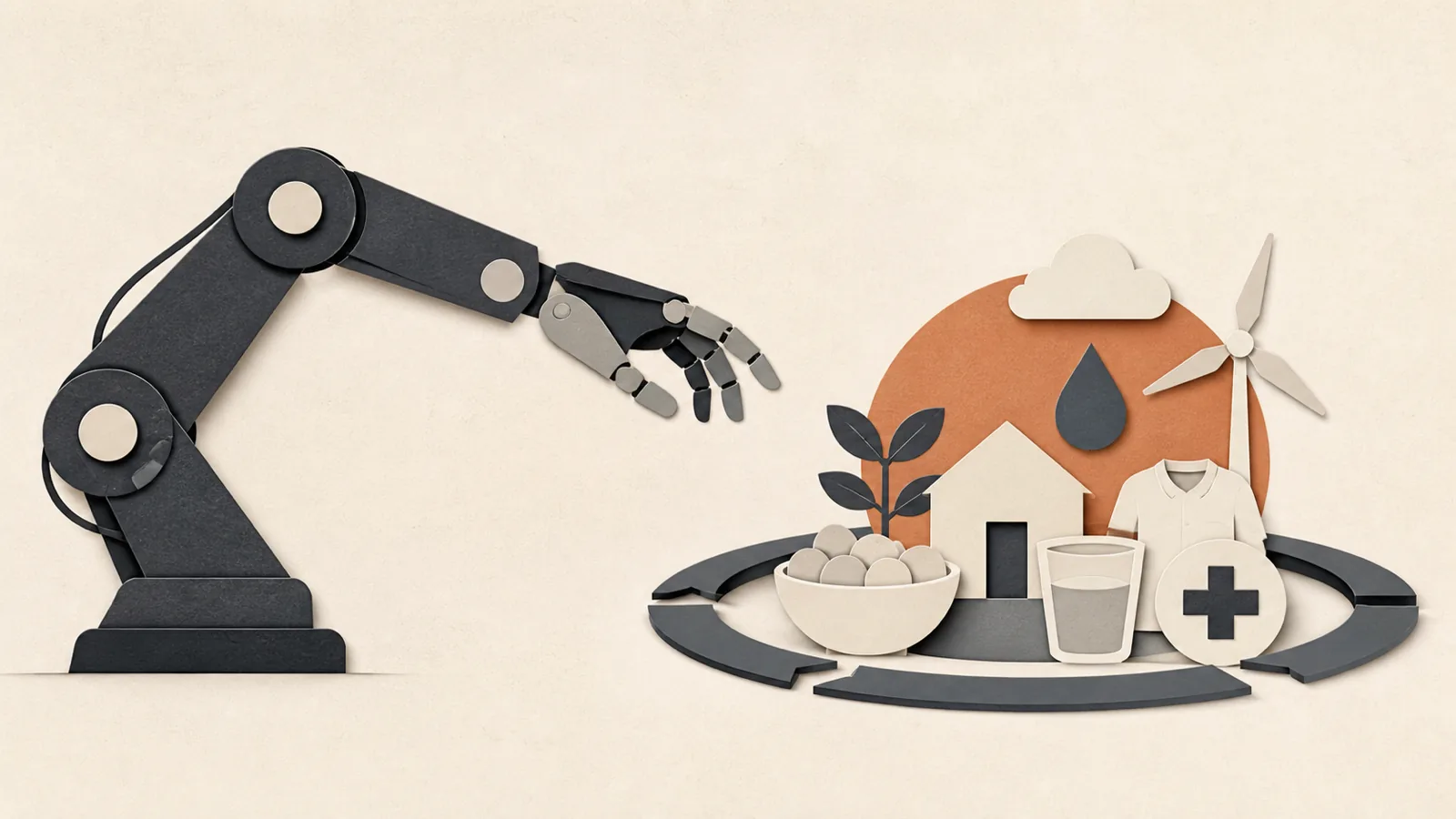
Musk's framing of the economy is deliberately narrow — "an economy is the production of goods and provision of services" — and his claim is that AI currently supplies only half of what produces those:
"What we have right now advancing very rapidly is digital intelligence… but it's still somewhat confined to the digital realm. It doesn't have end effectors. You need the end effectors in the form of humanoid robotics… and then you can go from intelligence manifesting itself only digitally to shaping atoms."
Vast robot count × vast digital intelligence = "a sort of a quasi-infinite economy." This is the load-bearing physical premise, and it is the one the wiki can already interrogate. Task Saturation: Broad but Shallow AI Diffusion finds AI reaching 68% of detailed occupations but only 21% of tasks in the median occupation, with the extensive margin gated by physicality — which is exactly the gap Musk says humanoid robots close, measured from the other side. Google ATLAS's finding is the strongest available statement of how much of the economy is currently out of reach for want of end effectors; Musk's is a claim about when that gate opens. They are the same variable.
The complement is Advantages of Digital Intelligence: the properties that make digital intelligence scale (replication, speed, shared experience) are precisely what a robot fleet inherits when the same model drives many bodies — Musk describes the robot as "more or less an end effector… with some amount of local intelligence but managed by a large AI model."
The load-bearing argument is about deflation#
The interviewer presses the obvious objection to universal transfers: "If you just issue checks, you're going to have inflation." Musk's answer is the most specific economic claim in the interview:
"Inflation is simply the ratio of money to goods and services. So if the goods and services output increases dramatically — if it increases a thousand percent — you can literally print… provided the creation of that money is less than the rate at which goods and services increase, you will actually have deflation. So I'll make a prediction, which is that deflation will be the issue, not inflation."
The structure is: the quantity theory run in the unusual direction. Normally the money-supply term is the fast-moving one; his claim is that AI-plus-robots makes the output term the fast-moving one, by enough orders of magnitude that ordinary fiscal profligacy cannot outrun it. From that, two policy conclusions follow directly and he states both — "the Treasury should just simply issue people checks" (his phrase for the outcome is universal high income), and "in a future where money is [ir]relevant, I think taxation also becomes somewhat irrelevant," this from someone who says he expects to "pay many trillions in tax" and is "fine with that."
The interviewer's response is worth recording because it is not a rebuttal: "I'm perfectly willing to believe that. You may well be right." The disagreement is not about the endpoint.
What the argument assumes. It treats scarcity as entirely a production problem. It has nothing to say about goods whose supply robots do not expand — land, positional goods, attention, originals — or about distribution, which is the entire content of the access question Zuckerberg's op-ed poses the same day. "Anyone can have anything they can think of" is a claim about manufactured goods and services stated as a claim about everything people want money for.
Work becomes optional: the gardening analogy#
On labor, Musk's position is more extreme than the one the interviewer brings him — she cites Dario Amodei's forecast that half of entry-level white-collar jobs go within a few years; Musk's answer is that the category is wrong, not the number:
"AI will be able to do any job better than any person can do that job… For software engineering, we already have a situation where AI is better than at least 90% of professional software engineers at writing software. And really, it's getting to the point where it'll be better than 99%. And then it'll get to the point where there's just no way to compete. It'll get to what I call Stockfish level."
The Stockfish framing is the useful part: not "AI is better on average" but the competitive question stops being asked, the way no one enters a human against an engine. He extends it explicitly beyond software — "everything."
His picture of what remains is the gardening analogy: you don't have to grow vegetables, and the ones you grow will be worse than the store's — "your tomato's not going to be as plump and juicy… they'll look a little artisanal" — but a friend serving dinner from their garden "is a nice touch." Work as elective, valued for its provenance rather than its output quality. The interviewer's own extension is the sharper version: people still play chess with each other though every computer is better.
This sits directly across from The Tragedy of the Cognitive Commons, and the two are incompatible in an interesting way rather than a boring one. Lovett's argument is that the expertise needed to validate AI output is a commons regenerated by entry-level work, so removing that work destroys the oversight capacity. Musk's answer is that at Stockfish level validation is not needed and therefore neither is the commons — the Validation Tether snaps because nobody is checking the engine's moves. Which of these describes 2036 depends entirely on whether the "no way to compete" threshold is actually reached, and neither position offers a way to tell in advance.
The transition, which is where the argument stops#
The interviewer's persistent question is not whether the endpoint is good but how a "polarized, angry, fearful" polity gets there without nationalization, punitive capital taxation, or revolt. Musk concedes the framing rather than answering it: "It will be a bumpy road. I'm not suggesting everything will be smooth sailing." His historical analogy is the human "computer" — an actual job title, whole buildings of people calculating bank interest, now nobody's loss — with the concession that "the thing that's different here is that the pace of change is radically accelerated." That is the entire argument: the same displacement, faster, and previously it worked out.
He is also, unusually, explicit that the optimism is a chosen stance rather than a derived one: "if you ask me on any given day — in fact even intraday — I've gone from exhilaration to terror regarding AI… I'm not trying to be some panglossian view of the world where everything's going to be great."
The unanswered objection. Musk's own reference text for the good outcome is Iain M. Banks's Culture novels. The interviewer, reading them on his recommendation, raises the objection he never addresses: "I actually don't find that future a terribly appealing one, because I don't think humans have agency in that future." Musk allows they have agency "in a small way." The abundance case is argued entirely in goods and services; the agency cost is conceded in a clause and dropped.
Connections#
- Task Saturation: Broad but Shallow AI Diffusion — the measured counterpart to the end-effector premise: AI reaches 68% of occupations but 21% of tasks in the median one, with the extensive margin gated by physicality — the same variable Musk says humanoid robots unlock
- The Household Production Boundary — the measurement precedent for "output money doesn't price": 86.5% of AI use is already outside formal work and the $15–149B/yr household time savings are invisible to GDP by construction, which is a small live instance of the accounting problem a post-scarcity economy makes total
- Balance-of-Power Superintelligence — Zuckerberg's op-ed, published the same day, on the distribution question this page's production argument sets aside; the two elite statements agree on abundance and differ on whether access to it is automatic
- The Tragedy of the Cognitive Commons — the direct incompatibility: Lovett's commons argument requires humans to remain the validators, which Musk's Stockfish threshold denies
- Advantages of Digital Intelligence — the properties a robot fleet inherits when one large model drives many bodies, which is what makes "vast numbers of robots" a scaling claim rather than a manufacturing one
- Organizational Complements to AI — the standing reason to doubt that capability translates to realized output on schedule: value is gated by complements organizations have to build, and a quasi-infinite economy assumes that gate is trivial at the limit
- Elon Musk — the speaker, and the risk-position shift that makes abundance rather than doom his current headline
- The Data Wall and the Validation Commons Are One Supply Constraint — the ordering risk this page's Stockfish section raises, searched for in the corpus and answered as a qualified negative: no domain shows commons-scale validator depletion, and the general risk is dampened because verifiability drives both the threshold's arrival (Lean, hidden test cases, execution feedback) and the validator's dispensability — so the uneven arrival is correlated with the need, not orthogonal to it. Where the argument breaks is Musk's uniform extension to "everything," and one level down at the sub-task boundary, where formal math already shows the residual human job (checking the formalization, not the proof) surviving inside a fully automated verifiable rung
Open Questions#
- Musk's deflation prediction is falsifiable and dated: does the price level of manufactured goods and AI-delivered services fall as robot deployment scales, or do input constraints (energy, land, minerals) keep it rising? Trigger: goods-vs-services price divergence through 2030.
- The end-effector premise is the checkable half of the abundance case — does the physically-gated share of tasks that Task Saturation: Broad but Shallow AI Diffusion measures actually fall as humanoid deployment scales, and at what rate?
- If validation capacity is a commons and the Stockfish threshold is reached unevenly across domains, the commons is destroyed before the threshold arrives in the domains that still need validators. Is there any domain where the ordering has been observed? Partially answered (2026-08-17) by The Data Wall and the Validation Commons Are One Supply Constraint — a qualified negative with one measured instance and a structural correction. No domain in the corpus shows commons-scale depletion, and Lovett says so about his own framework ("a structural prediction … not an observed outcome"), with active counter-evidence (Danish null effects, Ramp's +12.0% entry-level headcount at intensive adopters). The closest measured instance is screening colonoscopy — endoscopists' independent detection accuracy fell after adopting AI-assisted detection, in a domain where the threshold plainly has not arrived — but that is atrophy of the existing stock, not failure of the regeneration mechanism, and it sits in the framework's low-vulnerability set. The structural correction is the important part: the threshold arrives first exactly where a sound cheap verifier exists (Lean, hidden test cases, execution feedback), which is exactly where human validators were never load-bearing — so arrival order and need order are correlated, and the ordering risk this bullet fears is not the general case. It is real one level down, at the sub-task boundary, and formal math already shows the shape: with Lean checking every step the residual human job is checking the formalization, not the proof. Still open: nobody has measured whether that residual capacity is depleting anywhere. The settling instruments are named on the derived page.
Sources#
- The full-length interview with Elon Musk — The Economist, full-length Elon Musk interview, 2026-07-29 (
prediction, ~1:25 runtime, auto-caption transcript). The economic segment: digital vs physical intelligence and the quasi-infinite economy, "money won't matter in 2036," the deflation mechanism and Treasury checks, universal high income, the 90%→99%→Stockfish software claim, the gardening analogy, the human-computer historical analogy, the Culture-novels exchange. Speaker labels are absent from the auto-captions, so attribution is by content. Amodei's entry-level-jobs figure appears only as the interviewer's paraphrase and is not independently sourced here.
Cited by 12
- The Data Wall and the Validation Commons Are One Supply Constraint×3
Post Scarcity Macroeconomics — If validation capacity is a commons and the Stockfish threshold is…
- Elon Musk×3
He is a co-founder and original funder of OpenAI, founder of xAI (Grok), Tesla and SpaceX, and — by…
- Open Questions Backlog×3
Post Scarcity Macroeconomics: Musk's deflation prediction is falsifiable and dated: does the price…
- Balance-of-Power Superintelligence×2
Post Scarcity Macroeconomics — the same-day Musk statement that shares this op-ed's abundance…
- Advantages of Digital Intelligence
Post Scarcity Macroeconomics — what these properties buy once intelligence has end effectors:…
- AI-Driven Formal Proof Search
Post Scarcity Macroeconomics — the sharpest test of the validation-commons argument: with Lean…
- RL from Execution Feedback (RLEF)
Post Scarcity Macroeconomics — execution feedback is one of the cheap sound verifiers that decides…
- The Household Production Boundary
Post Scarcity Macroeconomics — this page's $15–149B/yr of GDP-invisible household time savings is a…
- AI Economics & Labor
Post Scarcity Macroeconomics — Musk's claim that once digital intelligence acquires end effectors…
- Organizational Complements to AI
Post Scarcity Macroeconomics — the complements argument is the standing objection to a…
- Task Saturation: Broad but Shallow AI Diffusion
Post Scarcity Macroeconomics — the physicality gate measured here is the exact variable Musk's…
- The Tragedy of the Cognitive Commons
Post Scarcity Macroeconomics — the direct denial of this page's premise: Musk's "Stockfish level"…
Related articles
- Experimental Learning Impact of Generative AI
Contractor & Reyes (arXiv 2607.08849): a randomized, proctored experiment with 211 undergraduates finds off-the-shelf A…
- Firm AI-Spend Intensity and Headcount Growth
Ramp × Revelio panel of 21,559 US firms: high-intensity AI-vendor spenders grow headcount ~10% (entry-level ~12%) over…
- Open Questions Backlog
Generated by `_system/lint.py --write-backlog`. Do not hand-edit. Domain and Watching sections carry one row per page —…
- Organizational Complements to AI
The general-purpose-technology argument: AI productivity gains depend on complementary workflow, skill, and org-design…
- Effective Compute Scaling
DeepMind's framing of compute growth as ~10×/year of 'effective compute' — the product of hardware improvement (~1.5×/y…