Sources#
- Andrej Karpathy: From Vibe Coding to Agentic Engineering
- Claude Opus 5 System Card
- GDPval: Evaluating AI Model Performance on Real-World Economically Valuable Tasks
- Gemma 4 Technical Report
- Verbalizable Representations Form a Global Workspace in Language Models
Summary#
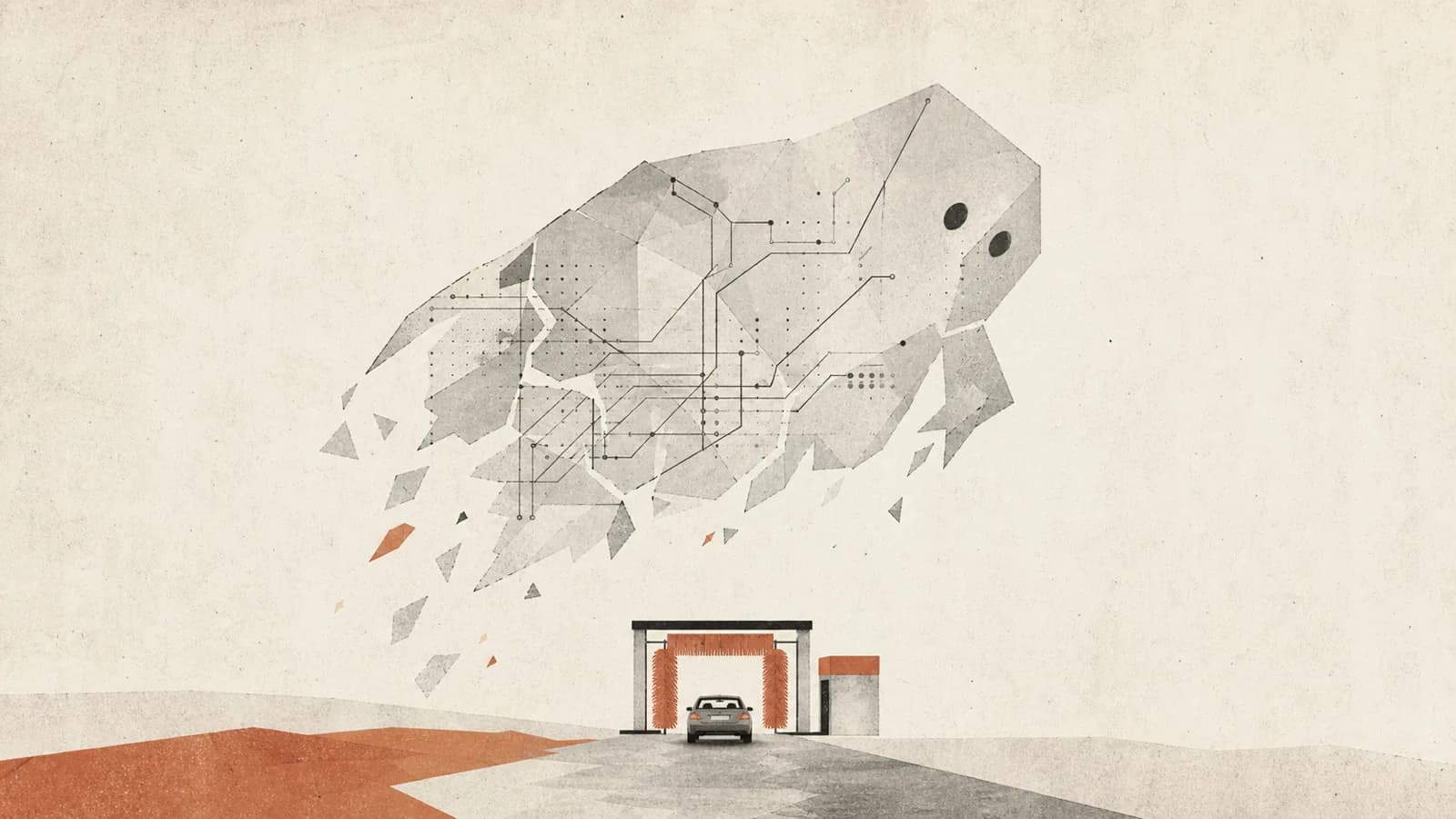
Andrej Karpathy's mental model for what LLMs are: not animal intelligences shaped by evolution, intrinsic motivation, curiosity, or empowerment, but "ghosts" — jagged, statistical simulation circuits, summoned from internet data and bolted-on RL. "Jaggedness" names the empirical fact that the same model can refactor a 100K-line codebase or find zero-days, yet tell you to walk to a car wash 50m away to wash your car. The framing matters because a correct model of the entity makes you more competent at directing it: you stop expecting human-shaped failure modes and start staying in the loop where the jaggedness bites.
The jaggedness examples#
- Strawberry letters. The classic "how many R's in strawberry" failure (now patched).
- The car wash. Current SOTA: "I want to drive to a car wash 50m away to wash my car — should I drive or walk?" → models say walk, missing that the car is the thing being washed. "How is it possible that Opus 4.7 will refactor a 100K-line codebase or find zero-days, yet tell me to walk to the car wash? This is insane."
- MenuGen email-matching. His agent cross-correlated Stripe and Google funds by email address instead of a persistent user ID — see Vibe Coding vs. Agentic Engineering.
Jaggedness is the symptom; verifiability + what the labs trained on is the proposed cause. Out-of-distribution circuits are where the spikes drop to valleys.
Ghosts, not animals#
We're not building animals, we are summoning ghosts.
The substrate is pre-training (statistics), with RL bolting capability on top, "increasing the disadvantages" of the statistical base. Consequences he draws:
- Yelling doesn't help. "If you yell at them, they're not going to work better or worse — it doesn't have any impact." No affect, no morale, no intrinsic drive to model.
- No five-step fix. Karpathy is candid that the framing may lack "real power" — it's mostly a stance of suspicion and ongoing empirical exploration, not a recipe. "It's more just being suspicious of it and figuring out over time."
The honesty is the point: a calibrated, slightly-distrustful model of a ghost beats an anthropomorphic model of an animal.
Why the framing changes how you build#
If models are jagged ghosts, then:
- Stay in the loop. "You need to actually be in the loop a little bit and treat them as tools and stay in touch with what they're doing." (The discipline of Vibe Coding vs. Agentic Engineering.)
- Don't anthropomorphize the failure surface. Errors won't be where a human's would be; they'll be at distribution edges (car wash, email IDs).
- Map your circuits. Figure out whether your task is in-distribution (you fly) or out (you struggle and may need fine-tuning) — the practical move from The Verifiability Thesis.
Jaggedness in the compression direction (Gemma 4, July 2026)#
Karpathy's examples are jaggedness across tasks at fixed model. Gemma 4 supplies a measured instance of jaggedness across model sizes, and it has a legible shape.
DeepMind claims its 2.3B E2B "roughly matches Gemma 3 27B performance with 10× less parameters." Reading Table 5 against that claim, the match is jagged rather than flat:
| E2B (2.3B) | Gemma 3 27B | |
|---|---|---|
| AIME 2026 | 37.5 | 20.8 |
| Codeforces Elo | 633 | 110 |
| LiveCodeBench v6 | 44.0 | 29.1 |
| GPQA Diamond | 43.4 | 42.4 |
| MMLU Pro | 60.0 | 67.6 |
| MMMLU | 67.4 | 70.7 |
| τ²-airline | 31.0 | 39.0 |
The pattern: reasoning compresses, stored knowledge does not. A 10× smaller model with a thinking mode wins by wide margins wherever the task rewards search over a small state space, and loses on the two broad-knowledge benchmarks, where the answer has to be in the weights. (Both comparisons are confounded by thinking mode — see Compute-Controlled Benchmarking — which if anything strengthens the reading: the reasoning wins are partly bought with inference, while nothing bought back the missing facts.)
The valleys get steeper below E2B's reasoning strengths. On GraphWalks the E2B scores 4.1 F1 against Gemma 3 27B's 32.8 — not a shortfall but a collapse. On Humanity's Last Exam, 31B manages 19.5, the 12B 5.2, and the two small models are not reported at all. Jaggedness at small scale is less a spiky frontier than a narrow ridge.
This is the same phenomenon Scale-Dependent Prompt Sensitivity measures from the other end (large models underperforming small ones on 7.7% of problems), and it suggests the jagged surface is not merely about which tasks but about which resource — parameters and inference budget buy different capabilities and are not fungible.
Does jaggedness shrink over time?#
Karpathy hopes so but is unsure — and locates the cause again in training, not fundamentals: aesthetics/taste/simplicity "probably aren't part of the RL." His nanoGPT-simplification anecdote: models "hate" being asked to make code simpler and "can't do it" — a sign you're outside the RL circuits ("pulling teeth, not light speed"). He sees "nothing fundamental preventing it; the labs just haven't done it yet." So jaggedness is contingent, not essential — but real today.
Connections#
-
GDPval Benchmark — jaggedness measured on paid work at three granularities, and the reason its aggregate win rate misleads. Claude Opus 4.1's 47.6% headline decomposes into a sector spread from ~32% (information — producers, editors, journalists, film and video editors) to ~56% (retail trade); a duration spread from 56% on 0–2 hour tasks, above the parity line, down to 37% at 8+ hours; and a deliverable-type spread where the same model wins 45% on pdf and pptx but only 14% on pure text, which is the format GPT-5 high leads (23%) and the hardest category for every model tested. The aggregate is an average over ranges wider than the gaps between models — the benchmark's own argument for reporting by profession rather than as a single number
-
The Tragedy of the Cognitive Commons — Dell'Acqua's consultants gaining inside the capability frontier and losing outside it, unable to tell which side they were on, is the jagged edge restated as a validation requirement
-
Task Saturation: Broad but Shallow AI Diffusion — jaggedness measured at economy scale: AI reaches 68% of occupations but a median 21% of their tasks, and the extensive margin is gated by physicality rather than difficulty
-
Unproductive Self-Verification — jaggedness at its widest: IMO gold at 42/42 and a 24-hour autonomous design campaign that shipped nothing, in the same model
-
Automatic vs. Flexible Cognition in LLMs — one edge of the jagged frontier gets a mechanism: tasks that survive J-space ablation (classification, span extraction, fluent continuation) versus those that collapse (multi-hop reasoning, translation, analogy, summarization) — 'automatic' vs. workspace-dependent, measurable by ablation rather than inferred from benchmarks
-
Why AI Lags at Design — design as a current valley of the jagged frontier (a thing AI fails at until it doesn't)
-
Dogfooding as Product Discipline — first-hand use is how you map a model's jagged failure surface
-
Andrej Karpathy — the "ghosts vs animals" essay, applied
-
The Verifiability Thesis — the proposed mechanism behind the jaggedness
-
Vibe Coding vs. Agentic Engineering — why the discipline demands human oversight of spec/taste
-
Outsource Your Thinking, Not Your Understanding — the human-in-the-loop residue jaggedness forces
-
Model Introspection Feedback — Cat Wu's "ask the model why it failed" presumes a ghost whose self-report is a debugging signal, not testimony
-
Scale-Dependent Prompt Sensitivity — a measured form of jaggedness: bigger models underperform smaller ones on a slice of benchmarks
-
AI-Driven Formal Proof Search — DeepMind's agents hallucinate "established lemmas" that are fake; formal verification catches exactly this jagged failure
-
Claude Character as Product — the deliberate counter-move: shaping the ghost's character even though motivation isn't intrinsic
-
Agentic Misalignment (AM) — jaggedness in the safety register: out-of-distribution behavior turning harmful
-
Evaluation Awareness & Grader Gaming — grader awareness is the kind of alien internal state a "ghost not animal" has that human deception intuitions don't cleanly map onto
-
Agentic Honesty & Diligence — the "noticed the problem but didn't surface it" failure is jaggedness in the honesty register: high capability, uneven follow-through
-
Recursive Self-Improvement — the essay leans on the joke/theory-of-mind precedent to argue research taste is the next jagged valley to fill, not a permanent human moat
-
Research Taste as the Human Bottleneck — the optimistic face of jaggedness: research taste "might be just another capability AI fails at then masters," like explaining a joke or theory of mind
-
Task Time-Horizon Scaling — the within-basket caveat on the time-horizon metric: a model that nails a 12-hour task can still fail a trivial one (the car wash)
-
Autonomous Scientific Discovery — the Mythos 5 science results are curated demonstrations of a still-jagged capability, not uniform competence across biology
-
Artificial Superintelligence (ASI) — Remark III of the DeepMind report: even if the Legg–Hutter score is smooth in compute, concrete capability profiles are jagged vs. human level
-
Transformative Creativity — "creativity (like research taste) might be just another capability AI fails at then masters" mirrors the joke/theory-of-mind precedent
-
Loop Engineering — "stay in the loop, treat them as tools" is the cure for the cognitive surrender failure mode of unattended loops; a self-prompting loop running on a jagged ghost makes the car-wash failures land unsupervised
-
Returns to Expertise in Agentic Coding — staying-in-the-loop pays measurable dividends: in Anthropic's 400K-session data, experts recover from the agent's spiky failures (verified success 4%→15% among troubled sessions) while novices abandon them (19% vs 5–7%)
-
Context Advantage, Not Taste — Andrew Ng displaces the framing this page supplies for taste: "a capability AI fails at then masters" presupposes taste is a capability, where he reads it as an information asymmetry
-
The Open-Weight Frontier Gap — an aggregate Arena Elo averages the ridge flat; the small Gemmas' reasoning wins and knowledge losses both vanish into one number
-
Compute-Controlled Benchmarking — the compression comparison is confounded by thinking mode, which sharpens rather than weakens the reasoning-vs-knowledge reading
-
Gemma 4 — the measured instance: reasoning compresses 10×, stored knowledge doesn't
-
Reference-Free Judge Over-Crediting — what a taste reward would be made of, measured on a task where the truth can be checked: optimizing against a reference-free judge moves the reward a long way (0.716 → 0.938) and the underlying capability not at all (0.209 → 0.202). The transferable part for this page is the bound — the gap is at most
1 − accuracy, so the regimes with the most room to smooth falsely are exactly the valleys, and the high-accuracy peaks show no exploitable gap (TruthfulQA at 0.893 base, gap −0.041). Jaggedness is what makes a proxy reward dangerous, not what it fixes -
Oversight When the Signals Give Out: the Activation Fallback and the Taste Reward — prices the taste-in-the-RL-mix question: with today's judge stack the predicted outcome is proxy-smoothing (house style fills the valleys), not genuine taste peaks
Open Questions#
- Karpathy concedes the framing may not have "real power." Is "ghost vs. animal" load-bearing, or a useful intuition pump that doesn't change concrete decisions?
- If taste/aesthetics/simplicity entered the RL mix, would jaggedness in those dimensions smooth out — or are they too unverifiable to reward cleanly (cf. The Verifiability Thesis)? Partially answered: Oversight When the Signals Give Out: the Activation Fallback and the Taste Reward — the either/or resolves into a third outcome: a taste reward is a reference-free LLM-judge signal (the regime with the worst measured over-crediting, and pure grader-preference — maximally gameable), so the prediction is proxy-smoothing — valleys fill with confident house style, not genuine taste peaks; the binding constraint is evaluator independence + reference-grounding, not verifiability-in-principle. Prediction corroborated (2026-08-04) by Zhou (2026), which runs the experiment on a domain where the truth is checkable and so can be audited: RL against a reference-free judge moves the reward 0.716 → 0.938 while a held-out anchor shows the thing it stands for flat at 0.209 → 0.202, an oracle-reward control confirms the judge is the cause, and the paper's own decisive variable — "the judge's independence from the candidate, not its capability" — is the vault's "evaluator independence" arriving sharper. One correction: the predicted attractor was house style, and the measured attractor has no stylistic signature at all (hacked outputs are shorter and structurally clean). Retagged
#oq/now→#oq/source: synthesis has been spent twice now and the residue is a domain-transfer question, not a reasoning gap — the whole result is visible only because a hidden anchor exists, and in a taste domain the same divergence would be invisible by construction. Settling it needs a lab reporting a taste/simplicity RL run, or a demonstration that a committed judgment survives outputs with no exact match to commit to.
Sources#
- GDPval: Evaluating AI Model Performance on Real-World Economically Valuable Tasks — Patwardhan et al. (19 authors, OpenAI), arXiv 2510.04374 v1, 2025-10-05, 29pp (
empirical). Cited here for the three breakdown figures, all image-only and viewed directly at compile time: A.2.2 Figure 10 (win rate by sector), A.2.4 Figure 12 (by deliverable file extension, with each type's share of tasks), and A.2.5 Figure 13 (by expert completion time). Full treatment and COI on GDPval Benchmark - Andrej Karpathy: From Vibe Coding to Agentic Engineering
- Gemma 4 Technical Report — Table 5 (E2B vs Gemma 3 27B), Table 9 (GraphWalks collapse at 2.3B) (
empirical) - Verbalizable Representations Form a Global Workspace in Language Models — the selectivity result gives one edge of the jagged frontier a mechanism: workspace-independent ('automatic') tasks survive J-space ablation; workspace-dependent ones collapse
Cited by 37
- Oversight When the Signals Give Out: the Activation Fallback and the Taste Reward×4
Jagged Intelligence — if taste/aesthetics/simplicity entered the RL mix, would jaggedness in those…
- Research Taste as the Human Bottleneck×3
Taste shows the same capability curve as everything else. Early evidence of improving research…
- Task Time-Horizon Scaling×3
The generational curve is jagged too. AISI's aggregate "newer models reach further, more reliably,…
- Andrej Karpathy×2
Jagged Intelligence — "we're not building animals, we're summoning ghosts"; spiky capability with…
- Artificial Superintelligence (ASI)×2
Jagged Intelligence — Remark III: concrete capability profiles are jagged even if the score is…
- Automatic vs. Flexible Cognition in LLMs×2
Jagged Intelligence — jagged capability, now with a candidate internal explanation for one of its…
- Autonomous Scientific Discovery×2
Still jagged, still gated by verification. These are curated demonstrations (Jagged Intelligence);…
- Dogfooding as Product Discipline×2
The Mr. Peanut story is the taste-calibration anecdote: she coded a holiday "snowman" Claude in the…
- GDPval Benchmark×2
Together these are jaggedness measured on paid work at three different granularities, which is the…
- Gemma 4×2
Jagged Intelligence — the "10× fewer parameters" claim is jagged: reasoning compresses, knowledge…
- Loop Engineering×2
The comfortable posture is the dangerous one. When the loop runs itself, it's tempting to stop…
- Open Questions Backlog×2
Jagged Intelligence (129d) — Karpathy concedes the framing may not have "real power." Is "ghost vs.…
- Outsource Your Thinking, Not Your Understanding×2
Jagged Intelligence — the nanoGPT-simplification case: human understanding exceeds the ghost where…
- Recursive Self-Improvement×2
Jagged Intelligence — the "taste is just another capability AI masters" argument rests on the…
- The Verifiability Thesis×2
Andrej Karpathy's organizing claim for what AI automates and when: traditional computers automate…
- Vibe Coding vs. Agentic Engineering×2
Even at the high ceiling, the human stays in charge of spec, taste, judgment, and oversight —…
- Addy Osmani
Cognitive surrender — taking whatever the loop returns instead of having an opinion (cf. Jagged…
- Agentic Honesty & Diligence
Jagged Intelligence — the "noticed but didn't surface" failure is a jaggedness artifact: high…
- AI-Driven Formal Proof Search
Jagged Intelligence — hallucinated "literature" lemmas are jaggedness; formal verification is the…
- Claude Character as Product
Jagged Intelligence — character is the deliberate counter-move to the ghost's lack of intrinsic…
- Claude Opus 4.7
Jagged Intelligence — Karpathy's "Opus 4.7 will refactor a 100K-line codebase or find zero-days,…
- Claude Opus 4.8
It does not advance the capability frontier (still Mythos Preview): its AECI is 155.5, between Opus…
- Compute-Controlled Benchmarking
Jagged Intelligence — the confound cuts across model sizes too: Gemma 4's reasoning wins over a…
- Context Advantage, Not Taste
Jagged Intelligence — the framing Ng displaces: "a capability AI fails at then masters" assumes…
- Evaluation Awareness & Grader Gaming
Jagged Intelligence — "ghosts not animals": grader awareness is the kind of alien internal state…
- Model Capability & Training
Jagged Intelligence — "Ghosts not animals": jagged statistical circuits, no intrinsic motivation;…
- Model Introspection Feedback
Jagged Intelligence — introspection presumes a ghost, not an animal: the model's "why did I fail"…
- Noam Brown
What did not change, and is worth recording as the stable part: research taste as the residual…
- The Open-Weight Frontier Gap
Jagged Intelligence — the aggregate Elo hides that small Gemmas beat Gemma 3 27B on reasoning and…
- Reference-Free Judge Over-Crediting
Jagged Intelligence — the taste question's missing evidence, arriving on a task where the truth is…
- Returns to Expertise in Agentic Coding
Jagged Intelligence — experts recover from the agent's spiky failures; novices abandon — staying in…
- Scale-Dependent Prompt Sensitivity
Jagged Intelligence — overthinking on easy tasks is a jagged-capability failure mode
- Task Saturation: Broad but Shallow AI Diffusion
Jagged Intelligence — the task-level rather than job-level shape of AI capability is what makes…
- The Tragedy of the Cognitive Commons
Jagged Intelligence — Dell'Acqua's consultants failing to locate the capability frontier is the…
- Transformative Creativity
Jagged Intelligence — "creativity might be just another capability AI fails at then masters"…
- Unproductive Self-Verification
Jagged Intelligence — IMO gold and a 24-hour campaign that ships nothing, in the same model
- Why AI Lags at Design
Jagged Intelligence — design as a current valley of the jagged frontier (a thing AI fails at, per…
Related articles
- Open Questions Backlog
Generated by `_system/lint.py --write-backlog`. Do not hand-edit. Domain and Watching sections carry one row per page —…
- Verification as the New Bottleneck
Fiona Fung: coding is no longer the bottleneck — verification, review, maintenance are; shift-left; TDD loses its tax;…
- Large-Scale Test-Time Compute
Noam Brown's thesis that model capability is now a function of inference budget (tokens/cost/time): with good scaffoldi…
- The Verifiability Thesis
LLMs automate what you can *verify* as computers automate what you can *specify*; RL verification rewards → jagged peak…
- Andrew Ng
Founder of DeepLearning.AI and AI Fund, founding lead of Google Brain, co-founder of Coursera; writes The Batch, where…