Sources#
Summary#
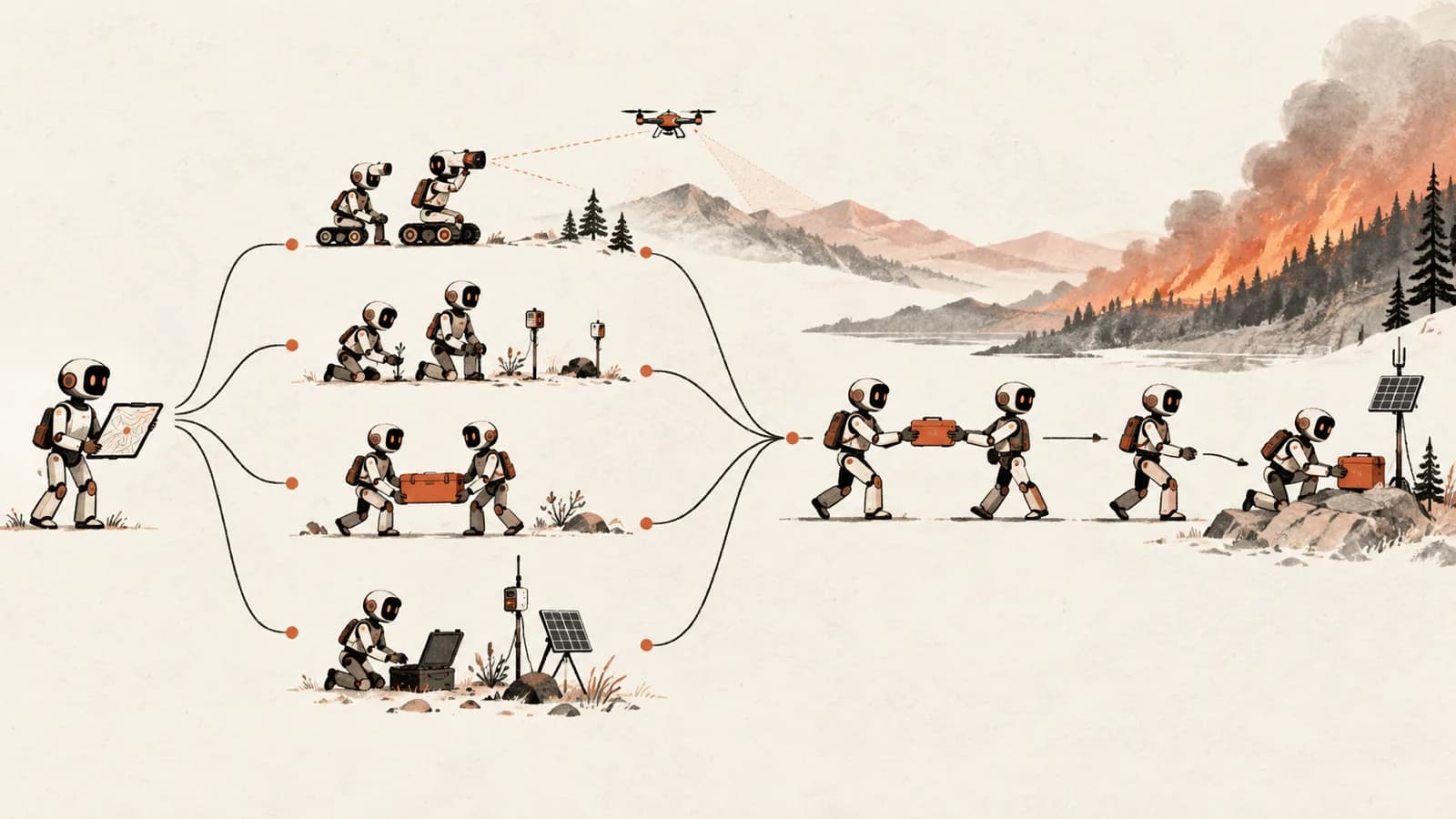
Most embodied multi-agent LLM systems pick a communication topology (flat, centralized, manager/worker) once and apply it to every mission regardless of scale or task structure. ORCH (Zhengran Ji, Jonathan Hyun & Boyuan Chen, Duke, arXiv 2609.11737, 2026-09-10, empirical) instead operationalizes two constructs from human organization theory — pooled interdependence (independent, concurrent contributions to a shared outcome) and sequential interdependence (ordered work where one stage's output is the next stage's prerequisite) — as two composable manager types, and builds a hierarchy G = H(T, W, C) tailored to the task description T, the available workers W, and their capabilities C, either by a human expert or by an LLM with a critic.
Tested on an extended CREW-Wildfire benchmark — 25 wildfire-response missions (up from the original 16), up to 50 heterogeneous embodied agents across four worker types, five seeds, eight base LLMs — against four representative fixed-structure baselines (CAMON, COELA, HMAS-2, Embodied), human-designed ORCH hierarchies improve final score by 63.97% and execution efficiency by 74.29% on average; critic-supervised LLM-generated hierarchies improve the same measures by 43.63% and 52.53%. The gain does not interact significantly with which LLM runs it (Type-II ANOVA), and it does not track model scale.
The mechanism: two manager types, not a role label#
- Horizontal manager (pooled interdependence) assigns concurrent tasks to its children — workers or sub-managers — as
T_h = f_h(M, P, R): missionM, estimated progressP, and children's reportsRin, a set of (child, task) assignments out. - Vertical manager (sequential interdependence) does not assign directly. It first decomposes the mission into an ordered sequence of phases
Φ = {φ_1 … φ_K} = f_v(M, P_m, R), activates only the current phase, generates assignments for it, and advances to the next phase only once that phase's completion condition is satisfied. - The two compose recursively — a vertical manager can supervise horizontal managers coordinating concurrent work within a phase, and a horizontal manager can supervise sub-teams that are themselves vertical/horizontal hybrids — producing "teams of teams" for complex missions while staying a single flat manager for simple ones.
- Communication is bidirectional and runs every environment timestep, not once at setup. Bottom-up: each worker reports completion/status/urgent information; each manager aggregates its children's reports to estimate progress and decide continue / revise / advance-phase / mission-complete. Top-down: decisions propagate root→leaves; before a new plan is finalized, children evaluate whether their assignment is feasible and can raise actionable objections that force a revision before anything is executed.
- For automated generation, a language model proposes the hierarchy and a critic model checks worker count, capability-to-responsibility matching, unnecessary layers, and whether proposed groups correspond to genuine sub-goals; the proposal is revised against the critique until convergence or timeout.
This is a structural distinction worth keeping precise against the rest of the corpus's coordination-architecture cluster: horizontal and vertical managers are different planning functions and different communication cadences (a vertical manager's phase-gate literally withholds the next set of assignments until a condition is met), not a "you are the CEO" instruction layered onto one otherwise-flat loop. See Parallel Agent Orchestration below for the direct contrast.
Benchmark and baselines#
The extended CREW-Wildfire suite spans 25 missions from 3-agent single-role tasks to 50-agent, four-worker-type, 200-timestep missions, with explicit mid-mission shocks (a drone lost, a helicopter failing, new civilians appearing, a second fire). Four worker types have complementary, non-overlapping capabilities: firefighters (general-purpose: cut vegetation, rescue, refill water, suppress fire), bulldozers (fast vegetation clearing only), drones (reconnaissance only), helicopters (long-range transport and water operations). Six evaluation measures were tracked per run — final score, execution efficiency (AUC of performance vs. progress), exploration (area covered), and three cost measures (API calls, input tokens, output tokens per step) — aggregated with task-difficulty weights and averaged across eight LLMs (ChatGPT-5.4, Gemma-4-it, Llama-4-Scout-16E, ERNIE-4.5, Qwen-3.6, Nemotron-3-Super, GLM-5.1, DeepSeek-V4-Pro).
The four baselines span the field's major coordination architectures: CAMON (decentralized, communication-triggered dynamic leadership), COELA (decentralized, modular cognitive architecture with independent planning/memory/communication), HMAS-2 (hybrid centralized-decentralized: a global planner refined by worker feedback), Embodied (fixed, prompt-imposed organizational structure).
Results#
- Headline, prose-stated: "Human-designed ORCH organizations improved final score by 63.97% and execution efficiency by 74.29% on average relative to the four prior frameworks. Organizations generated automatically by language models improved these measures by 43.63% and 52.53%, respectively."
- First-place rank share across every LLM-task-seed combination: human-ORCH 32.6% (final score) / 31.1% (efficiency); LLM-ORCH 26.2% / 25.0%; CAMON 16.2% / 19.5%; Embodied 12.1% / 13.3%; HMAS-2 5.8% / 6.3%; COELA 7.2% / 4.8%.
- Type-II ANOVA: algorithm has a significant main effect on final score (F₄,₉₃₆ = 9.21, p < 0.01) and efficiency (F₄,₈₉₃₆ = 6.68, p < 0.01 — the degrees-of-freedom jump between the two F-statistics is in the source text and unexplained there); language model and task are also significant on both measures; the algorithm × model interaction is not significant (F₃₂,₉₃₆ = 0.90, p = 0.62 for final score; F₃₂,₉₃₆ = 0.63, p = 0.93 for efficiency) — ORCH's advantage generalizes across the eight LLMs rather than being carried by one favorable pairing.
- Collective performance is not monotonic in model scale. Gemma-4-it and Qwen-3.6 — moderate-sized models — produced the strongest aggregate ORCH performance, ahead of ChatGPT-5.4, GLM-5.1 and DeepSeek-V4-Pro, despite the larger models leading on coding and mathematical-reasoning benchmarks elsewhere. The paper's own reading: model scale and collective capability are not interchangeable; what a collective needs (role adherence, concise state summaries, distinguishing parallel from sequential work, translating instructions into feasible actions) is not what single-model benchmarks measure.
- Structural quality tracks outcome quality. Six tree-based metrics over the generated hierarchies (depth, average worker depth, average span of control, span-of-control variance, manager count, worker-depth variance) show a consistent ordering: human-designed hierarchies are shallowest and most balanced (tree depth 1.20, span-of-control variance 1.48, worker-depth variance 0.00), critic-supervised LLM hierarchies are close behind (1.31, 5.08, 0.025), and hierarchies generated without the critic are deeper and more uneven (1.56, 7.48, 0.031, with the most managers at 2.08) — inspection showed critic-free generation introducing unnecessary managers and layers.
- Failure-mode analysis (1,000 runs per method, classified by DeepSeek-V4-Pro reading the full communication history into one of five categories): success rates are 53.1% / 42.2% / 35.2% for human / critic-LLM / no-critic-LLM ORCH, against 6.9–13.5% for the four baselines. Baseline failures are dominated by worker execution (51.2–64.5%) and incorrect task allocation (14.7–28.1%); ORCH substantially reduces worker-execution failures (to 13.1–20.7%) but shifts the remaining failures upward, into task allocation (8.4% human → 21.0% critic-LLM → 29.6% no-critic) and adaptation (13.6% → 17.6% → 18.8%). Coordination/communication failures stay low across all three ORCH variants (0.7%) versus up to 7.1% for baselines.
- Worked example (Scale Level Complex, the hardest task): 50 agents (25 firefighters, 10 drones, 10 helicopters, 5 bulldozers) on a 200×200 map. The human-designed hierarchy is one vertical manager over five horizontal managers, decomposing the mission into four sequential phases (scout for fire/water/civilians → aerial confirm-and-monitor → refill and position ground units → construct firebreaks and suppress), with each phase running pooled, concurrent work inside the relevant horizontal-manager groups.
What this adds to the corpus#
A new domain for the "does organization form matter" question, and a large one. Multi-Agent Collective Intelligence's open question about whether multi-agent scaling depends on organization form or task complexity has so far been answered mostly from software-agent orchestration (OrchBench's simulated plans, Anthropic's fantasy-game swarms), social-dilemma games (Shi et al.'s mixed-provider social dilemmas), and a control-theoretic testbed with no LLM agents at all. ORCH supplies 6,000 runs (5 seeds × 8 LLMs × 25 tasks × 6 algorithms) of real embodied-agent execution in a fifth domain, and its answer is unambiguous on the form axis: matching hierarchy shape to the task's interdependence structure beats a fixed structure by a wide, cross-model-stable margin, in a setting (physical missions with hard resource and timing dependencies) where the coordination requirements are arguably closer to the pathway's original human-organization analogy than any prior source in this cluster.
Mechanism, not prompt text — a second domain confirming the same split. Parallel Agent Orchestration already carries a negative result from Anthropic's Frontier Red Team: layering "prescriptive roles" or "CEO hierarchy" prompt text onto an otherwise-flat 12-hour agent swarm "did not make much difference," while Cursor's purpose-built coordination machinery (a typed, compiler-enforced reference from code back to a design doc; a neutral merge-mediator agent) measurably did. ORCH is a second, cross-domain data point on the same side of that split: its horizontal/vertical managers are distinct planning functions and an enforced phase-gate, not role text bolted onto one loop, and the gain (63.97%/74.29%) is far larger than anything a prompt-only intervention has produced anywhere else in the corpus. This is not a controlled ablation of "structure vs. text" within one system — ORCH never tests a text-only variant of its own harness, and Anthropic never tests a structural hierarchy on its swarm — so the comparison is corroborating, not decisive.
Automated coordination-structure design needs an external check, again. Critic-supervised LLM-generated hierarchies close most but not all of the gap to human design (43.63%/52.53% vs. 63.97%/74.29% over the same baselines), and the shortfall is visible in the tree-structure metrics (deeper, less balanced) before it shows up in outcome scores. That is the same shape OrchBench reports from its own LLM-generated task DAGs, 34.3% of which its own LLM judges rejected before use — model-proposed coordination structure is usable but not yet self-certifying, in two different domains and two different senses of "structure."
Limits and caveats#
- No structure-only ablation. The paper isolates critic-vs-no-critic cleanly, but nothing separates the gain into "task-specific hierarchy" vs. "phase-gated sequencing" vs. "bidirectional feedback with objections" — the four baselines differ from ORCH on all of these simultaneously, and from each other architecturally as well.
- The hierarchy is fixed at construction. Plans, phases, and assignments adapt during execution; the tree shape itself does not restructure mid-mission — named explicitly as future work by the authors.
- The failure taxonomy is LLM-generated and not independently validated — DeepSeek-V4-Pro classifies its own and every other method's failures from communication history, with no human-rater check, which the authors also flag.
- Single lab, single benchmark family.
empiricaltier is warranted (controlled, multi-seed, multi-model, statistically tested), but CREW-Wildfire and its extension are this group's own testbed; code is public (github.com/generalroboticslab/ORCH) but not yet independently re-run as of this ingest. - Parse note.
doclingflaggedtable-collapseon 11 cells across the raw's 8 detected tables. The three data tables that carry citable numbers (S1: task configurations; S2: score formulas; S3: symbol definitions) were reconciled againstpdftotext -f 60 -l 62 -layouton the source PDF and match the raw markdown digit-for-digit, including the Scale Level Complex row (25 firefighter / 5 bulldozer / 10 drone / 10 helicopter) cross-checked against the prose worked example above. The remaining flagged cells sit inside Algorithm 1's pseudocode, rendered as several small pipe-tables in the parse; none of its content is cited here (the algorithm is described from prose and the Equations above instead), so the flag does not bear on any figure in this article.
Connections#
- Multi-Agent Collective Intelligence — supplies a fifth, embodied-agent domain for the "does multi-agent scaling depend on organization form or task complexity" open question, with the largest cross-model dataset in that cluster and an unambiguous answer on the form axis (task-specific beats fixed); also a second, independent case of collective performance not tracking model scale
- Parallel Agent Orchestration — the mechanism-vs-prompt-text contrast: Anthropic's "prescriptive roles"/"CEO hierarchy" prompt text over a flat swarm changed little; ORCH's structurally distinct horizontal/vertical manager types, in a different domain, move outcomes by tens of percentage points — corroborating, not a controlled ablation of the same system
- Orchestration-Plan Simulation — the same critic-needed-for-automated-structure pattern in a different domain: OrchBench's own LLM-generated task DAGs were rejected by an LLM judge 34.3% of the time before use; ORCH's critic-free hierarchies are structurally worse (deeper, less balanced) and score worse, and its critic closes most but not all of the resulting gap to human design
Open Questions#
- Nothing here ablates task-specific hierarchy shape independently of critic supervision, phase-gating, or the objection-and-revision feedback loop — which of these carries ORCH's advantage over the four baselines?
- The hierarchy is fixed once built; only plans, phases and assignments adapt during execution. Would restructuring the tree itself mid-mission close more of the human-vs-LLM-generated gap, or does design-time quality dominate regardless of runtime adaptation?
Sources#
- Organizational Principles Enable Collective Intelligence in Embodied AI — Ji, Hyun & Chen (Duke University), Organizational principles enable collective intelligence in embodied AI, arXiv 2609.11737, 2026-09-10,
empirical, 100pp. Main text: Introduction and "The challenge of organizing embodied artificial collectives" for the motivation and the flat/single-manager failure modes; "A testbed for organizational intelligence" for the CREW-Wildfire extension (25 missions, four worker types, mid-mission shocks); "Organizing agents through pooled and sequential interdependence" and "Task-specific organizational hierarchies" for the horizontal/vertical manager formalism (Eq. 1–3) and the critic-supervised generation process; "Closed-loop execution through hierarchical communication" for the bottom-up/top-down protocol and the objection-and-revision step; "Results" section in full for the headline percentages, the ANOVA table, the model-scale non-monotonicity, the tree-metric comparison (Figure 5B), and the failure-mode breakdown (Figure 5C); "Discussions" for the authors' own framing of the model-scale finding and the stated future-work limits (no mid-mission restructuring, taxonomy not human-validated). Supplementary Text §S1 (Algorithm 1, full pseudocode) cross-checked against the main-text equations; Table S1 (task configurations) verified againstpdftotext -f 60 -layout— see Limits and caveats above. Parse warning: verify flaggedtable-collapseon 11 cells across the raw's 8 detected tables; the load-bearing data tables (S1–S3) were reconciled clean and are the only tables this article draws numbers from — Algorithm 1's pseudocode pipe-tables carry the flagged cells and are not cited
Cited by 5
- Parallel Agent Orchestration×4
Task Specific Organizational Hierarchies — the mechanism-beats-text split reproduced in an embodied…
- Multi-Agent Collective Intelligence×3
Task Specific Organizational Hierarchies — a fifth domain (embodied wildfire-response robotics) for…
- Open Questions Backlog×2
Task Specific Organizational Hierarchies: The hierarchy is fixed once built; only plans, phases and…
- Agent Systems & Harness Engineering
Task Specific Organizational Hierarchies — ORCH (Ji, Hyun & Chen, Duke): human-organization-theory…
- Orchestration-Plan Simulation
Task Specific Organizational Hierarchies — the same critic-needed-for-automated-structure pattern…
Related articles
- Open-Ended Discovery Harnesses
Harness designs for hours-long agent runs on problems with no known optimum, where the recurring failure is idea collap…
- Client-Side Agent Optimization
AgentOpt's framing of developer-controlled agent optimization (model-per-role, budget, routing) as distinct from server…
- Dynamic Workflows: An Algebra for Agents
Claude Code's sandboxed orchestration primitive: Claude writes and runs a program that composes agents in sequence and…
- Parallel Agent Orchestration
One human overseeing a team of concurrent agents: OpenAI Codex telemetry's first hard numbers (28.6% of staff peaked at…
- Ticket-Driven Agent Orchestration
The inversion that makes Symphony work: tickets as units of work (not sessions/PRs), DAG dependencies, agent-extensible…