Sources#
Summary#
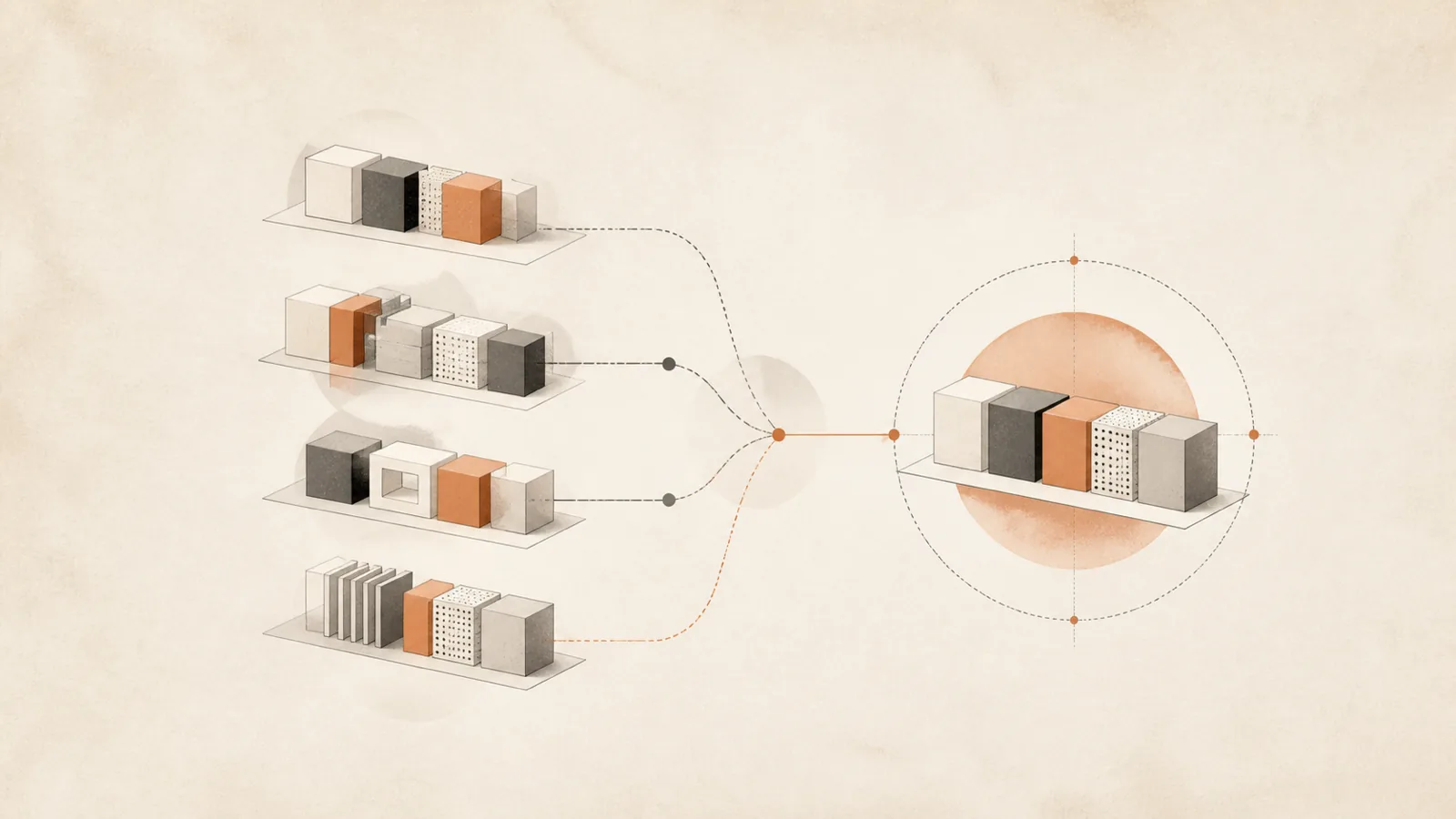
Once you accept that capability is a function of inference budget, the next question is not how much to spend but what shape to spend it in. Archon — presented by Azalia Mirhoseini in CS329A lecture 2 (delivered 2025-09-26, published 2026-08-03, practitioner-opinion recounting her lab's own work) — answers it by making the shape itself the object of search: an inference-time architecture is a stack of layers, each layer one prompting-only operation applied across a pool of models, and the stack is searched for automatically against a target benchmark under an inference-call budget.
The framing: inputs are (a) a set of target benchmarks, (b) an inference-call budget, (c) a set of available LLMs, and (d) a set of inference-time techniques. The optimizer, ITAS (Inference-Time Architecture Search), returns an architecture — which models, which operations, in which order, how wide — that maximizes accuracy for the budget. The whole system is prompting; nothing is fine-tuned. "We don't have — we haven't trained the model to do this specific test-time scaling task."
The operation set#
Every operation is a prompt, which is what makes the search space cheap to instantiate and expensive to evaluate:
| Operation | What it does |
|---|---|
| Generation | Sample n responses from a model — the repeated-sampling primitive |
| Fusion | Give an LLM the question plus all k responses and ask it to synthesize one output answer |
| Critic | For a given response, describe its strengths and weaknesses |
| Ranker | Rank the previous layer's responses (LLM-as-a-Judge) |
| Verifier | Score a response and return the reasoning behind the score |
| Unit-test generation | Have the model write unit tests for the problem (coding, maths, reasoning) |
| Unit-test evaluation | Have the model judge a candidate answer against those tests — without running them |
The last pair is the notable one: unit-test evaluation replaces execution with a second model judgment, which pushes a domain with a hard verifier back into the soft-verifier regime in exchange for applying to maths and reasoning as well as code. It is CodeMonkeys's self-generated-test idea with the interpreter taken out.
Fusion beats oracle selection#
The single result on this page most worth carrying, because it breaks a ceiling everything else on the test-time-compute cluster treats as fixed.
On a reasoning/QA benchmark, sweeping 1→10 samples from one model, win rate orders as:
- Random selection — pick any sample. The floor.
- Model ranking — ask the model to rank and take the top. Already beats random.
- Oracle selection — a perfect verifier picks the best of the k. Beats ranking, as it must.
- Fusion — hand all k to a model and ask for one synthesized answer. Beats oracle selection.
- Rank-then-fuse — filter to the top 5, then fuse. Best of all.
Why this matters: the generation–verification gap is defined as the distance between what selection methods achieve and what an oracle selector would achieve. Coverage is the ceiling only if the output must be one of the samples. Fusion's output need not be — it can assemble a correct answer from parts of several wrong ones, or use the spread of candidates as evidence about the answer. Mirhoseini's read: "this paradigm is so powerful that it can on its own improve the quality of responses over oracle selection." The gap is real for selectors; it is not a bound on what a fixed sample budget is worth.
The same trend survives replacing the k samples-from-one-model with k different models (a heterogeneous ensemble, added best-model-first). The random baseline gets worse — the ensemble's later members are weaker — but the ordering above is unchanged. The fuser and ranker are the strongest model in the pool (Multi-Agent Collective Intelligence).
Depth in the stack behaves like depth in a network#
Archon's searched architectures are not two-step pipelines. A typical one: generation from several models → critic → ranker → a bank of fusers, each fusing responses into one output → critic → ranker again. For coding, the optimizer instead finds generate-many-samples → generate unit tests → evaluate.
Stacking more layers keeps helping. The best configuration reported is a model ensemble with three critique+fuser layers plus a final fuser layer, "significantly better across many of these tasks" than either the best model once or the best model eight times with a single fusion layer. Mirhoseini's analogy is explicit: "just like in deep learning we are adding layers and pre-training and the model gets better."
This is the closest thing in the corpus to a depth claim for inference-time composition, and it is why the framing is "architecture" rather than "pipeline." Held at practitioner-opinion from a slide read in an auto-caption transcript, and untested against a compute-matched flat baseline (see the caveat below).
Searching the space without paying for it#
Evaluating a candidate architecture means running a lot of inference, so ITAS spends most of its design effort shrinking the space before searching it:
- Offline pre-processing. The sequence generation → critic → ranker → fuser was found to work well offline, and the search space was restricted around it.
- Hand constraints. One inference-time technique per layer; the first layer is always the generator; a critic must precede any ranker or fuser; a unit-test generator must be immediately followed by an evaluator.
- Bayesian optimization over the remainder, against a held-out training split, with the objective being accuracy at a given inference-call budget — an accuracy-versus-calls frontier, not a single number. It is "much more sample efficient" than greedy search or random selection over configurations.
The constraint list is the honest part of the result: the search does not discover that critics belong before rankers, it is told. What it discovers is width, depth, and model assignment.
The headline number, and why to hold it loosely#
Using only open-source models, Archon matched or exceeded the closed frontier models of the time on pass@1, +14.1% on average over GPT-4o and Claude 3.5 Sonnet across instruction-following, reasoning, maths and coding. Both variants work: a task-specific Archon (Bayesian search run on one task) and a general-purpose Archon optimized to do well across many tasks, which still beat the frontier models on tasks it was not tuned for — the generalization claim the lecture treats as the surprising part.
Note the design choice that makes the comparison meaningful at all: Archon emits exactly one response, so it is optimizing pass@1, not pass@k. That is the discipline Compute-Controlled Benchmarking demands — "a gain visible only in pass@k is a gain in attempts, not capability."
But the same page's other demand is not met. Brown's benchmark-maxxing critique names precisely this construction — "run the model five times and take the best answer; add an LLM judge to pick the strongest of N" — as a way to look better on paper that evaporates "once you control for the amount of test-time compute." A single-model GPT-4o call and a multi-layer multi-model Archon stack are not compute-matched, and the lecture reports no such control. Archon does plot accuracy against inference calls within its own search, which is more than the benchmark grid does; it does not put the frontier baselines on that axis. Read the 14.1% as this architecture at this budget beats that model at one call, which is a real and useful statement about cheap models plus structure, and not as a capability comparison. It is also a late-2025 number against late-2025 models.
Where this sits against harness self-modification#
Archon and agent-authored harness optimization are the same idea one level apart, and the corpus's later empirical work cuts between them:
- Archon searches over a closed, hand-specified operation vocabulary with an external Bayesian optimizer, offline, against a held-out split. The thing being searched is a composition, not code.
- Harness evolution has a meta-agent rewrite the scaffold's source with no vocabulary at all. Wang, Zhu, Hu et al. (arXiv 2607.12227,
empirical) budget-match that against plain parallel sampling at K = 5 and find it loses to doing nothing (67.4 vs a 68.2 baseline), with +0.6pp held-out transfer.
The reconciliation this suggests — untested, and worth stating as a hypothesis rather than a finding — is that the constraint is the value. Archon's restricted space and offline-validated layer ordering are what make its search cheap enough to be worth running; an unconstrained meta-agent spends the same budget rediscovering that structure and usually fails. It also means Archon inherits the second charge Wang et al. level: searching and reporting on the same benchmark family risks measuring adaptation to task patterns rather than architecture quality, which the general-purpose variant's cross-task result partly but not fully answers.
Connections#
- Large-Scale Test-Time Compute — the hub: this page is the "what shape" question under its "how much" thesis, and fusion is the one operation on it that beats a perfect selector
- The Verifiability Thesis — fusion is the first thing in the corpus that routes around the generation–verification gap rather than trying to close it, because its output is not constrained to be one of the samples
- Latent Capability Overhang — the generation layer is repeated sampling; Archon is a proposal for what to do with the samples once you have them
- LLM-as-a-Judge — the ranker, critic, verifier and unit-test-evaluator ops are all judges, stacked rather than used once
- Multi-Agent Collective Intelligence — the heterogeneous-ensemble arm: k different models fused by the strongest one, with the ordering unchanged from the single-model case
- Agent-Authored Harness Optimization — the unconstrained sibling: a meta-agent rewriting harness source rather than composing a fixed operation vocabulary, and the arm that loses under budget matching
- Compute-Controlled Benchmarking — the discipline Archon half-observes (pass@1 output, accuracy-vs-calls objective) and half-violates (frontier baselines not compute-matched)
- Open-Ended Discovery Harnesses — the 2026 descendant of the same question: how to shape a fixed budget across width and depth, answered adaptively at run time rather than by offline search
- Azalia Mirhoseini — the lab; Archon is the third result in the Monkeys line after Large Language Monkeys and CodeMonkeys
- CS329A: Self-Improving AI Agents (Stanford) — lecture 2, where this is taught as the constructive answer to the generation–verification gap
- Process vs Outcome Reward Models — what the verifier and unit-test-evaluator operations are made of, from the same course one lecture later: the ORM/PRM literature Archon treats as an off-the-shelf layer
- Weak-Verifier Ensembling — the sibling from the same lab and the next lecture, dividing cleanly: Archon composes inference operations into a searched architecture, Weaver composes verifier models into one aggregated score. Both bet that the shape of a fixed budget matters more than its size, and both are composition rather than training
- Tree Search over Agent Trajectories (LATS) — search at a lower altitude and from the same course: Archon searches offline over pipelines of inference operations, LATS searches online over trajectories of environment actions
- Selection Under a Submission Budget — the ceiling fusion goes around, measured on a second system. AlphaCode's pipeline is pure selection (filter, cluster, submit ten), so it is bounded by coverage by construction; the lecture puts the gap at roughly 30% under a ten-submission cap against above 40% with unlimited attempts. Archon's fusion is the operation that pipeline has no analogue of
Open Questions#
- Does fusion still beat oracle selection when the two are compute-matched — fusion costs an extra long-context call over all k samples, oracle selection costs nothing beyond the samples? The lecture plots both against sample count, not against tokens spent.
- Why does fusion beat an oracle? Two mechanisms are compatible with the result — the fuser assembles a correct answer from fragments of individually-wrong candidates, or the distribution of candidates carries information a per-candidate selector discards — and they imply different scaling behaviour as k grows. Nothing here distinguishes them.
Sources#
- CS329A Self-Improving AI Agents — Part 2: Test-Time Compute Scaling — Stanford CS329A lecture 2, Azalia Mirhoseini (delivered 2025-09-26, published 2026-08-03,
practitioner-opinion, YouTube auto-caption transcript, ~9.7k words). The Archon walkthrough: the ITAS framing and its four inputs, the seven-operation vocabulary, the fusion-beats-oracle win-rate curve and its model-ensemble twin, the layer-depth result, the Bayesian optimizer and its hand constraints, and the +14.1% pass@1 average over GPT-4o and Claude 3.5 Sonnet. Every figure is read off a slide in an auto-caption transcript and is approximate; the underlying paper was not compiled. The lecturer is a co-author, and the course TA is a co-author of the paper — a stated COI
Cited by 16
- Tree Search over Agent Trajectories (LATS)×2
Inference Time Architecture Search — search at a different altitude: Archon searches over pipelines…
- Azalia Mirhoseini×2
Inference Time Architecture Search — Archon, her lab's third step in the line: search over composed…
- CS329A: Self-Improving AI Agents (Stanford)×2
Constructive answers. Snell et al.'s parallel-vs-sequential-vs-PRM-guided-search comparison and its…
- Weak-Verifier Ensembling×2
That makes it a sibling of Archon from the same lab and the previous lecture, and the pair divides…
- Agent-Authored Harness Optimization
Inference Time Architecture Search — the constrained ancestor. Archon (2024) searches the same kind…
- Compute-Controlled Benchmarking
Inference Time Architecture Search — a specimen that half-obeys this page and half-embodies its…
- Large-Scale Test-Time Compute
Inference Time Architecture Search — the "what shape" question made searchable: Archon composes…
- Latent Capability Overhang
Inference Time Architecture Search — what to do with the samples once you have them: Archon…
- LLM-as-a-Judge
Inference Time Architecture Search — judges used as composable operations rather than as a final…
- Model Capability & Training
Inference Time Architecture Search — Archon (Mirhoseini's lab, 2024): treat test-time scaling as an…
- Multi-Agent Collective Intelligence
Inference Time Architecture Search — a small, concrete datum for this page's "does a homogeneous…
- Open-Ended Discovery Harnesses
Inference Time Architecture Search — the 2024 ancestor of the same question. Archon searches…
- Open Questions Backlog
Inference Time Architecture Search ×2 (oldest 43d) — Does fusion still beat oracle selection when…
- Process vs Outcome Reward Models
Inference Time Architecture Search — Archon's verifier and unit-test-evaluator operations are these…
- Selection Under a Submission Budget
Inference Time Architecture Search — the operation this pipeline lacks. Archon's fusion synthesizes…
- The Verifiability Thesis
The one thing on this page that goes around the gap rather than at it: fusion. Coverage bounds what…
Related articles
- Large-Scale Test-Time Compute
Noam Brown's thesis that model capability is now a function of inference budget (tokens/cost/time): with good scaffoldi…
- Process vs Outcome Reward Models
The four-year arc of trained LLM verifiers as taught in CS329A lecture 3: OpenAI's GSM8K verifier (score the finished s…
- Compute-Controlled Benchmarking
Noam Brown's critique: the single-number benchmark grid is broken because it ignores test-time compute — plot performan…
- CS329A: Self-Improving AI Agents (Stanford)
Stanford's graduate course on self-improving agents, taught by Azalia Mirhoseini and Aakanksha Chowdhery (Autumn 2025,…
- Latent Capability Overhang
Noam Brown's claim that already-released models can do far more than anyone has extracted, because nobody spends enough…