Sources#
Summary#
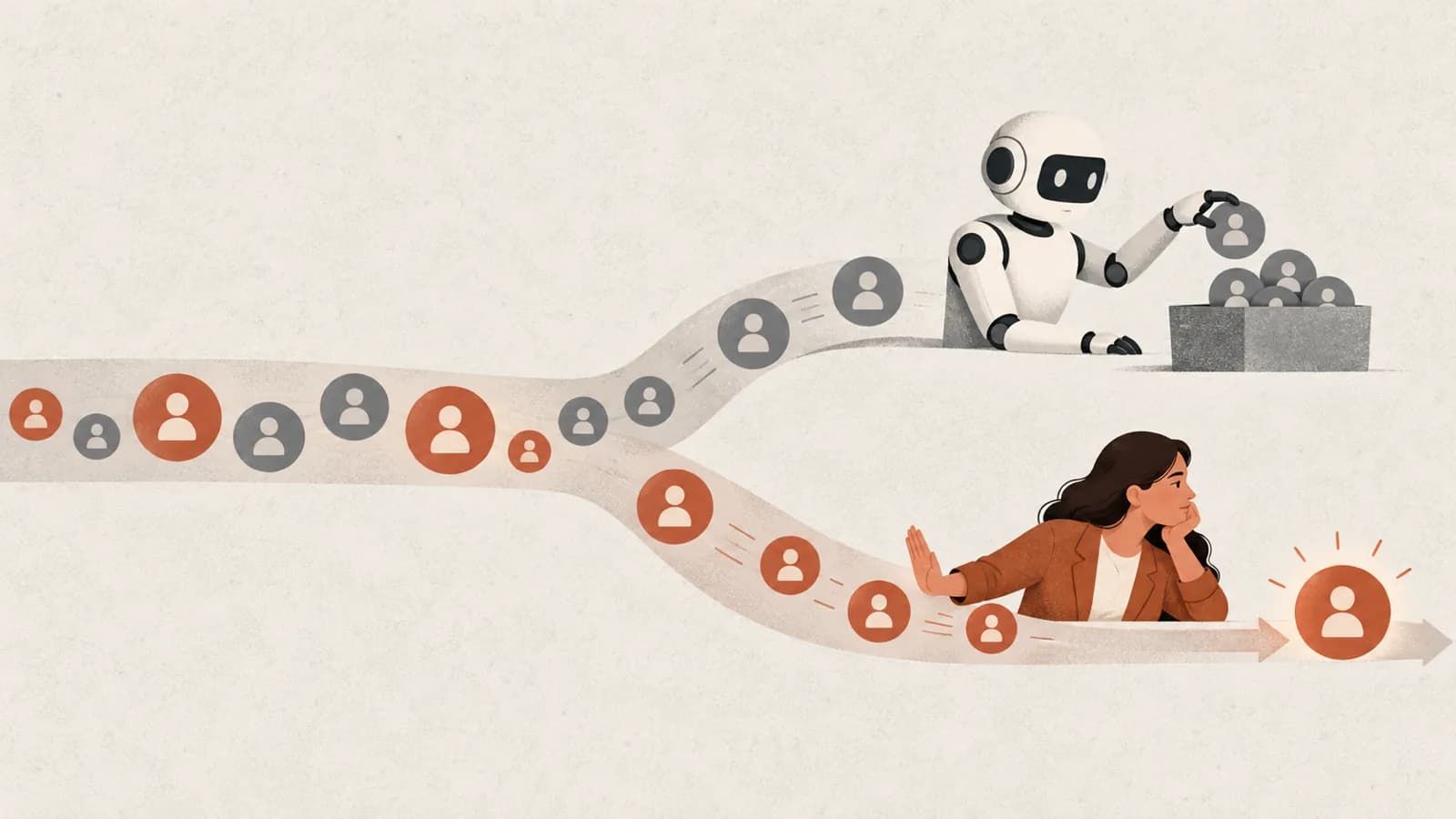
Most of the vault's evidence on AI and workers puts the AI inside the human's task: an assistant drafting, an agent conducting the interview, a model whose output the human reviews. Fu et al. (October 2026) study a deployment where the AI never enters the human task at all. In it, an AI voice agent and human sales agents draw from one shared lead pool, and the routing rule sends cold leads to the AI and keeps hot leads for humans. The managerial expectation is mechanical. If the AI absorbs the least promising work, the work left for humans is better, and human output should rise.
It did not rise. When the firm switched the AI from backup to default handler of cold leads on 2024-08-28, its share of cold leads jumped from about 25% to above 60%. Human agents' early-shift calls became far more likely to be hot leads, and their conversion on exactly those calls fell. The authors' explanation is sequential search theory (Stigler 1961; McCall 1970). A worker decides whether to keep working the lead in hand by comparing it with what they expect to draw next. Improve the expected next draw and the reservation value for continuing rises, so a hard but winnable lead is released sooner and worked less. The prediction that makes it testable is position-graded: the response should be strongest at the start of the shift, when many draws remain, and should fade as the remaining horizon shrinks.
Evidence note.
empirical: a regression discontinuity in time on administrative call records (409,622 human-handled and 157,468 AI-handled calls, about 13,000 agent-days, ±60 days around the cutoff with a ±10-day donut). It is one firm and one cutoff, with no randomization, and the data are under an NDA, so the result cannot be replicated. Conflict of interest: co-author Peng Shen is at the Waterdrop Research Institute, and his email domain isshuidi-inc.com. The paper pseudonymizes the firm as "Platform X", a licensed online health-insurance brokerage founded in 2017 whose leads come partly from "affiliated digital health platforms in the firm's broader ecosystem". That description fits Waterdrop's own insurance-brokerage business, so the data partner is very likely the author's employer. This is an inference; the paper does not say so. The findings are partly unflattering to the deployment, but the practical recommendation lands where a deploying firm would want it: keep the AI and re-pace the routing ("The lesson is not that firms should … reverse AI deployment"). Not peer-reviewed. The draft is marked "please do not circulate".
The design, and what the estimand is#
The identification depends on two position-graded patterns lining up, not on a level jump at the cutoff:
- A position-graded first stage. The probability that a human-handled call is a hot lead jumps by +23.4pp at positions 1–3, +15.7 at 4–6, +11.7 at 7–9 and +10.9 at 10–12, and is −0.8pp (n.s.) at positions 81–120. Early in the shift the pool improves most; at the end-of-shift tail it does not improve at all.
- A matching position-graded response. Hot-lead conversion moves −4.5pp at positions 1–3 and −2.5pp at 4–6 (both p<0.01), about zero at 7–12, and +3.4pp at 81–120.
The authors' argument is that a confounder varying by date (marketing, cohort, morale, awareness of AI) would shift every position bin equally, and would not produce an effect that vanishes where the first stage vanishes.
Read the −4.5pp correctly. Every outcome is first residualized on agent, calendar-date and hour-of-day fixed effects (Hausman & Rapson 2018). Each bin's estimate is therefore a change relative to the same-day average, which makes it a change in the shape of the within-day profile, not an absolute drop. Appendix H.2 says so plainly: a negative early-position estimate "does not necessarily imply that the absolute conversion rate at that position declines by the same magnitude". The abstract's "customer acquisition … falling about 5 percentage points" drops that qualifier. The summary tests carry it properly. Average hot-lead conversion is unchanged (+0.1pp, n.s.), while the profile slope flattens (+0.5pp per bin against a pre-period slope of −1.1, p<0.01). The day-level RDiT on hot calls is +0.011 (n.s.). What the AI changed was the shape of the day, not its total.
The same caveat explains a puzzle the paper resolves well. In the raw descriptives the hot-lead share barely moves at positions 1–3 (0.862 → 0.895), because it is already near its ceiling there. It moves most at the tail (0.379 → 0.558). The residualized estimates order the bins the opposite way. Raw levels and same-day-relative discontinuities are different estimands. Appendix Figure B3 plots the two side by side.
The two behavioral margins#
After an unconverted call, an agent can reallocate the lead (return it to the shared queue for another human; this costs nothing and does not enter performance evaluations), keep working it, or drop it. The AI is not in this loop: hot leads stay with humans and cold leads stay with the AI.
- Reallocation rises +8.1pp at positions 1–3 against a pre-period mean of about 25%, roughly a 32% increase (p<0.10), and +7.2pp at 4–6. Conditioning on no conversion barely moves it (+7.5pp), so it is not the conversion drop mechanically enlarging the eligible base. This is a human-to-human release, made with no commission share if a colleague later closes the lead, so it is a genuine forgone-value decision.
- Log call duration falls 0.145 at positions 1–3 (≈−13%, p<0.01). The late-position estimates are about zero, so the early-position effort advantage compresses.
What the margins do not explain. The paper runs a Gelbach (2016) decomposition on the pooled first nine positions. The total effect is −0.026. Duration contributes −0.0066 (CI excludes zero). Reallocation contributes +0.0032, with the wrong sign: reallocated leads convert more downstream, so releasing them partly enriches the early pool. The total indirect effect is −0.0034, with a CI spanning zero, so the two observed margins account for about 13% of the early decline, and the direct effect retains −0.022. The authors are candid that the residual "may reflect … persuasion intensity, patience in handling objections … but it may also incorporate within-hot-lead compositional changes, measurement error, or other omitted factors." The reservation-value story is therefore supported by the gradient shared by conversion, reallocation and duration. It is not supported by the mediation. The firm-level decomposition below labels its large negative term "Conduct Effect (reallocation + effort)", but by the paper's own admission that term is a residual, not those two mediators.
Who releases what. In the pooled data, reallocated leads later convert at 5.7% vs 3.0% for retained ones. With agent fixed effects the gap collapses (0.6pp, p=0.73). So the pooled gap is a between-agent pattern (agents who reallocate more also convert more), not agents knowingly dumping their worst leads. The six-month do-not-call rule makes releasing a lead the cheap way to disengage, because it preserves the firm's option on the customer.
Alternatives the gradient rules out, and those it does not#
- Slower pace is rejected. The inter-call gap is flat at positions 1–6 and shorter at 7–12.
- Learning is rejected. The early–late conversion gap moves about 3pp within the first 30 post-cutoff days and then holds; window-by-window estimates are not distinguishable (p=0.24); and the response is similar across tenure.
- Customer-side response is rejected. There is no short-call discontinuity at positions 1–6, no heterogeneity by customer gender, and customer gender is balanced within each bin.
- Observable lead composition (prior-attempt count, a strong predictor of conversion) explains 6.2% and 5.1% of the early-bin declines, with an upper bound of about 17% at positions 1–3, but 13% of the late-tail gain. Composition moves where the interpretation says it should and not where it should not.
- Awareness of AI alone is weakened. The June 2024 trial launch (AI as overflow only, weak first stage) produced the same direction at smaller magnitudes, and reallocation went the wrong way at positions 4–9.
- Not ruled out: unobserved within-hot-lead quality (the paper concedes this for the late-tail gain), and any confounder that happens to share the position gradient. The robustness summary is honest about which results hold up. Conversion is the robust result. Reallocation and duration are "directionally supportive but less monotonic": reallocation at positions 1–3 loses significance under the fixed ±60-day bandwidth (0.057, n.s.) and under 5-call bins.
What it costs the firm, on an accounting model#
Section 5 is a calibrated accounting decomposition, not a causal estimate, and its numbers should travel with that label. On hot-lead yield over positions 1–50 it gives an ordering effect of +0.58% (the mechanical gain from better-sequenced hot leads) and a conduct effect of −17.58%, for a net of −17.0% (0.0452 → 0.0375). In the authors' words, the behavioral term is "about thirty times" the mechanical one.
Two firm-level accounting statements in §5 need their denominators kept. First, "System conversions per 50 human calls rose 6.3%" while "total conversions fell 27.5%". Human call volume fell 31.8% across windows of unequal agent-days (7,492 vs 5,561), so the 27.5% mixes staffing volume with behavior. The identified day-level effect (Appendix Table C1) is null, and the paper's own headline says aggregate impact is "close to zero". Second, "Humans lose 50.5 hot-lead conversions per day against 7.7 recovered by AI on cold leads" is accounting at daily volume, not an effect estimate.
The prescriptive result is the rhythm counterfactual. In the calibrated model, AI routing steepened the within-day front-loading of hot leads (calibrated rhythm φ 0.10 → 0.22). Returning to the pre-expansion rhythm while keeping the AI raises predicted conversions per call by 13.5% (bootstrap 95% interval 10.5–16.6%). The levers named are staggered hot-lead release and batching some low-value work. This is a model output, extrapolated from two observed regimes with linear interpolation of the conduct profiles. The firm has not run it.
Heterogeneity (exploratory, causal forest). The bottom tercile of agents by predicted effect loses 2.4pp and the top tercile gains 2.0pp. The only robust moderator is the agent's pre-expansion reallocation rate: an interquartile increase gives a 1.4pp more positive response. Tenure, volume and duration do not moderate it. Agents who already worked the shared pool actively did best under AI routing.
Where this sits in the vault#
- It is an organizational-complements result, but not the one that page's open question asks about. That page's question is which complement (access, skills, review capacity, institutions) binds. This paper does not weight any of them. It adds a candidate the list lacks, the temporal design of the work left for humans (how the remaining tasks are sequenced and released), and it is the vault's first case where the missing complement does not merely move the bill elsewhere, as in Jabarian & Henkel. Here it cancels the gain. It also bears directly on that page's HAT model. HAT holds each agent's per-task cost and benefit fixed while reallocating tasks between them. Here, moving the cheapest tasks to the AI changed the human's productivity on the tasks that remained.
- Controlled Variance: AI's Edge as Reduced Dispersion is the same technology, an AI voice agent in a high-volume customer-facing funnel, used in the opposite configuration. There the AI took over one stage and humans kept the decision. Here the AI and humans work in parallel on different slices of one pool. Both deployments move a human discretion margin: there it is the recruiter's discretion to abort an interview (25% vs the AI's 7%), here the agent's discretion to release a lead.
- AI Employee Framing is the contrast in mechanism. Kropp et al. move accountability and error-catching with labels alone. Here agents get no announcement and no framing ("agents perceive the pool change through the composition of leads they are assigned"), and behavior still moves. Deployment design is a behavioral intervention even when nothing is said about AI.
- Human-AI Accountability Redesign, pillar 3, is the performance-management reset. The paper's institutional detail is the hinge: reallocation "did not enter performance evaluations", and commission paid only on personal closes. Under those rules, releasing a hard lead costs the agent nothing that is measured.
Open Questions#
- Does the position-graded reservation-value response replicate in a second parallel-routing deployment with a shared pool and worker discretion to release (claims processing, content moderation, customer triage)? In particular, does it show up where a shift endpoint is explicit or remaining-queue expectations are measured, so that the "remaining horizon" is observed rather than proxied by call position? One firm and one cutoff carry the whole claim.
- The measured margins (reallocation, duration) explain ~13% of the early-position conversion decline, and the reallocation channel enters with the wrong sign. With call-content data (transcripts scored for persuasion effort or objection handling), does the residual turn out to be within-call effort, as the mechanism needs, or unobserved within-hot-lead composition, which would make the backfire partly a sorting artifact?
- The 13.5% rhythm gain is a calibrated-model counterfactual extrapolated from two observed regimes. When a firm actually staggers high-intent release under parallel AI routing, does realized human conversion recover? And does putting a price on reallocation (counting it in evaluations) shrink the early-position effect, as the reservation-value account implies it should?
Connections#
- Organizational Complements to AI — the thesis this case extends: the complement here is the temporal design of the residual human workload, and its absence cancels rather than relocates the gain; also the HAT model's fixed-per-task-cost assumption that this paper's data contradict
- Controlled Variance: AI's Edge as Reduced Dispersion — the same voice-agent technology in the opposite configuration (stage substitution vs parallel routing), and the other discretion margin (abort vs release) that a deployment moves
- AI Employee Framing — the label channel; this paper is the no-label channel, where behavior moves through the opportunity environment alone
- Human-AI Accountability Redesign — pillar 3 (performance management): an unmeasured, costless release option is what lets the reservation-value response express itself
Sources#
- When Better Opportunities Backfire: Service Worker Responses to Parallel AI Deployment in Customer Acquisition — Xinyu Fu (Georgia State), Shulong Luo (Renmin), Narayan Ramasubbu (Pittsburgh), Peng Shen (Waterdrop Research Institute), Xincheng Wang (PolyU), Yucheng Wang (Sydney), When Better Opportunities Backfire: Service Worker Responses to Parallel AI Deployment in Customer Acquisition, arXiv 2610.25603 (2026-10-19; "This version: September 2026"), 62pp with online appendix,
empirical. Cited for: §3.1 (routing rule, reallocation institutions, incentives); §3.3 and Appendix H (the residualized RDiT estimand); Table 2 (first stage); Table 3 (conversion: average, slope, early–late contrast, position bins); Table 4 (reallocation, reallocation given no conversion, log duration); §4.3.2 and Figure 7 (downstream outcomes of reallocated leads, and their collapse under agent FE); §4.4 and Appendix D (pace, learning, customer-side and prior-attempt tests); Table 5 and Appendix E (robustness, incl. E1's reallocation 0.057 n.s. and E3's June cutoff); Table E7 (Gelbach decomposition); §5, Table 6 and Appendix F (accounting decomposition and rhythm counterfactual); §4.5 and Appendix G (causal forest). Parse warning: PDF-derived (docling 2.126.0, MLX layout and table stages; 62pp, 40 tables, confidenceexcellent). Ingest flaggedtable-collapse(4 cells),table-shift(7) andtable-weld(4). Table 2 is split by docling into a header-only table and a separate values table, with the notes between them. Table 3's last FE row falls outside the grid. Table 6's Panel B label "Conduct Effect (reallocation + effort)" is wrapped. Tables D.3.3 and E7 carry duplicated cells. Every table figure quoted here was reconciled againstpdftotext -layouton: Table 2 (0.234/0.157/0.117/0.109/−0.008), Table 4 (all three columns), Table 6 (both panels) and Table E7 (Panel A) match exactly, and each also matches the prose. Source-internal inconsistencies, flagged rather than repeated: (1) §4.3.1 says early-position call duration "falls by roughly half" in Figure 6, but the RDiT is −13%, and Table 1's raw log duration at positions 1–3 moves only 4.118 → 4.058 (≈−6%). (2) Appendix E7's prose cites "Section 4.3.3", which does not exist (the material is §4.3.2). (3) The abstract's "falling about 5 percentage points" omits the same-date-relative qualifier that Appendix H.2 states.
Cited by 6
- Organizational Complements to AI×4
Which complement is the true binding constraint — access/permissions, skills, or review capacity?…
- Controlled Variance: AI's Edge as Reduced Dispersion×3
Answered, bounded (2026-10-21), on whether the lower AI screen-out rate is the effect: no, the arms…
- Human-AI Accountability Redesign×3
Every pillar above assumes the AI is somewhere in the human's work, as drafter, interviewer or…
- AI Employee Framing×2
when better opportunities backfire ai service workers — Fu et al., arXiv 2610.25603 (2026-10-19,…
- AI Economics & Labor
Parallel Ai Routing Reservation Value — Fu, Luo, Ramasubbu, Shen, Wang & Wang (arXiv 2610.25603,…
- Open Questions Backlog
Parallel Ai Routing Reservation Value ×3 (oldest 0d) — Does the position-graded reservation-value…
Related articles
- The Automation–Optimism Link
AEI Cadences survey finding: people who use Claude in more automated ways are MORE optimistic across all six job-qualit…
- Controlled Variance: AI's Edge as Reduced Dispersion
Jabarian & Henkel (arXiv 2607.28222): a pre-registered natural field experiment randomizing 70,884 job applicants betwe…
- The Household Production Boundary
Google ATLAS's most novel contribution — 86.5% of conversational AI usage happens outside formal work, human time alloc…
- Organizational Complements to AI
The general-purpose-technology argument: AI productivity gains depend on complementary workflow, skill, and org-design…
- Returns to Expertise in Agentic Coding
Anthropic's 400K-session study: domain expertise (not coding skill) is what amplifies an agent — experts get 2× the act…