Sources#
Summary#
A systematic macro hedge fund, ~50 years old. It enters this wiki as an expert-user AI deployment case with an unusual precondition: the domain context an agent needs was already written down, in machine-readable form, decades before anyone needed it for an agent.
The corpus is thick with accounts of building context for agents. Bridgewater's is the first that begins with the context already existing as a byproduct of how the firm has always worked.
The 1980 legal pad, and why it is the point#
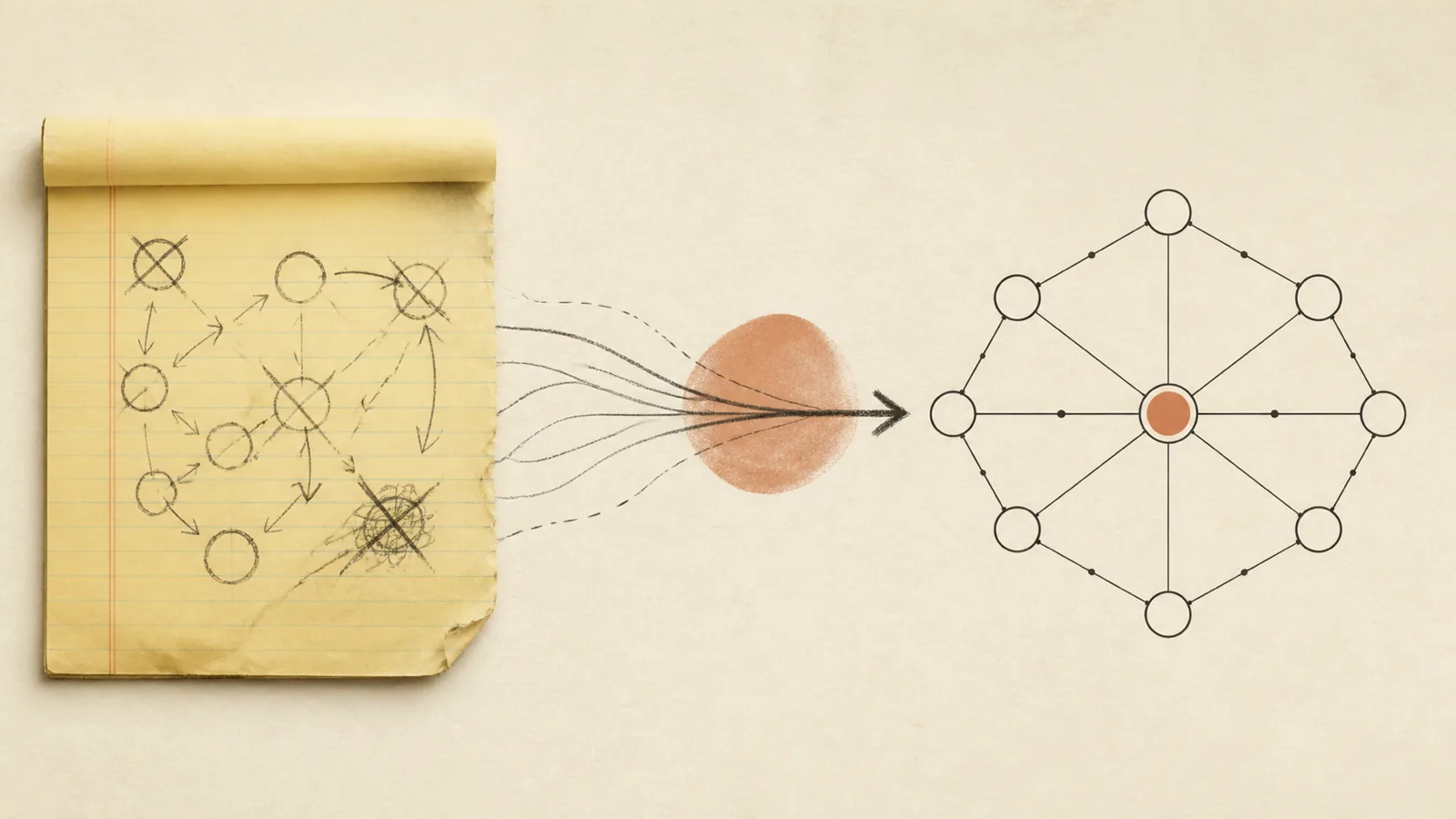
Brendan McManus, team lead of the applied AI team, opens with a photograph of the firm's 1980 bond system, written on a yellow legal pad. The discipline it records is simple: every time you want to make a trade, write down the exact causal logic for why the trade makes sense. The immediate payoff was social — another investor can read what you wrote, find where you went wrong, and improve it — and the compounding payoff is a rule base that gets amended rather than replaced ("you scratch out a rule, you write down a new one").
Over five decades this was codified into an expert system that is both machine-readable and human-readable: every methodology, every rule about which trades the firm makes and why. McManus states the consequence directly:
"All of this data is really what sets us up well for the AI era. We didn't have to go back and write down everything for agents. It was already there for us to draw upon."
This is worth isolating as a claim about what the scarce input to an agent deployment actually is. The talk's implicit argument is that PAT was buildable not because of model capability or harness sophistication but because the firm had a fifty-year head start on the corpus that a domain agent has to be grounded in — the asset that Knowledge-Centric Self-Improvement argues is the thing worth making persistent, arrived at by accident of institutional habit rather than by design. It also puts a floor under how transferable the case study is: a firm without the legal pads is not one harness away from PAT.
Two postures toward AI: as investors, as practitioners#
McManus separates these deliberately.
- As investors, understanding AI is table stakes — the shape of the supply-demand mismatch, what drives the buildout, how it hits markets — treated the same way the firm treated COVID or the recent oil supply shock. This is AI as a subject of analysis, and nothing in the talk elaborates it.
- As practitioners, AI is applied across the research process, with the stated end goal of an artificial investor capable of the full range of what human investors do daily.
The roadmap for the second is organized around what they call the research circle — the loop human investors run: perceive what is happening in the world, formulate questions about what is true and what they might be missing, perform analytical investigations, synthesize findings, and put what was learned back into the compounded understanding. That last step is the one McManus flags as key, because it is what makes the shared memory grow rather than merely be consulted.
The build strategy follows the loop's shape: discrete sub-agents for each segment of the research circle, all drawing on the same fifty-year understanding. PAT covers exactly one segment — investigation — and the others are unbuilt or undescribed. Note the structural resemblance to Knowledge-Centric Self-Improvement's inversion: the persistent object is the shared understanding, and the agents around it are specialized and swappable.
PAT (Pocket Analyst Tool)#
An internal AI analyst, deployed several months before the July 2026 talk, used daily by hundreds of investors — not a prototype. Its scope is deliberately bounded: PAT "is not about how we trade," but about deep exploratory research, "enabling our investors to go after questions that they never would have had the bandwidth to pursue before." The claimed compression is hours or days of analyst work into minutes.
The day-one spec, per McManus, had five requirements, and they map cleanly onto the corpus's usual failure axes:
- All the data — search and read across structured time series (tens of millions of series modeled internally over 50 years, mixing external data like the oil price with internally-derived concepts like the firm's 12-month-forward inflation view) and unstructured content (millions of documents: broker pieces, earnings transcripts, internal memos and emails, thousands arriving daily in near real time).
- All the tools the human analysts have — proprietary visualization, diagnostics, and indicator-quality evaluation.
- Diagnosable analyses — because the work is hours-of-a-human complex, every analysis must be inspectable "not just for humans, but also for agents running in the background, reading through the traces" and verifying each calculation.
- All the context — investment processes and frameworks, i.e. the legal-pad inheritance.
- Learning — compounding not for one investor but for every investor at the firm.
Two architectural properties of the deployment are treated in depth elsewhere: the compiler-shaped coding pipeline on Agentic Code Generation as Compilation, and the per-user entitlement-scoped harness on Capability Gating Is Not Authorization.
One design detail deserves naming here because it is an organizational decision as much as a technical one: PAT's outputs land in the same time-series database its inputs came from. Ran draws out both consequences — a PAT output is "indistinguishable from any of the human-uploaded series that we've been producing for many years," and any PAT output can be the input to a subsequent analysis. The effect is a single substrate on which humans and agents compound each other's work, rather than an agent sandbox that has to be harvested. The unexamined half is provenance: nothing in the talk says whether a consumer of a series can tell it was machine-derived, which is the property that would let a bad analysis propagate silently.
How a 50-year-old firm shipped it#
McManus answers the question he says he is asked most, and the answer is entirely organizational:
- An internal applied-AI startup, incubated inside the firm, able to move quickly while drawing on the parent's resources.
- Multi-archetype teams — investors, technologists, and scientists sitting side by side. His division of labor: investors bring domain context, technologists bring architectural capability, scientists bring rigor. He states this as a necessary condition for building AI systems for expert users, not a nice-to-have.
- Hundreds of internal expert users across the firm's AI tools, generating daily signal on what to improve — the input to the learning loop on Production-Sourced Evaluation.
- A compounding ecosystem — 50 years of shared data, tooling and methodology, built for human analysts and now reused by agents.
The Returns to Expertise in Agentic Coding reading is direct: the deployment's leverage comes from expert users who can tell a good analysis from a plausible one, and the org design exists to keep those experts inside the build loop rather than downstream of it. Santi Weight's version, from the technical side, is blunter — "your user is better at writing context than you are, most likely," offered as an argument for letting investors contribute context directly, "like a developer on the codebase," and for having low ego about it.
Connections#
- Agentic Code Generation as Compilation — the architecture PAT's coding agent is built on, and the firm's most transferable technical contribution to this corpus
- Production-Sourced Evaluation — PAT's learning loop, in both its autonomous form (background agents mining completed conversations) and its user-triggered form (the Teach button), is a production instance of building benchmarks from real usage
- Agent-Authored Harness Optimization — the loop's back half: an agent that edits PAT's own context repositories and harness until a generated benchmark passes, then opens a pull request
- Returns to Expertise in Agentic Coding — a deployment whose entire premise is amplifying experts rather than substituting for them, with an org structure built to match
- Knowledge-Centric Self-Improvement — the firm's fifty-year expert system as an accidental instance of the thesis that the curated knowledge base, not the agent, is the object worth making persistent
Sources#
- How Bridgewater Built an AI Analyst That Does Hours of Expert Research in Minutes — McManus, Ran & Weight, LangChain channel, 2026-07-24, 25:44 talk,
case-study. First-party throughout: a vendor-adjacent conference talk by the team that built the product, with no external verification of the deployment scale ("hundreds of investors"), the time compression, or any performance figure. The firm's own disclaimer, appended to the video, states there is no guarantee that discussed capabilities or anticipated benefits will be achieved. Slide visuals — including the 1980 legal pad, the research-circle diagram, and the live demo — are not captured in the transcript
Cited by 6
- Agent-Authored Harness Optimization×2
Bridgewater Associates's PAT (bridgewater pat ai analyst, case-study, first-party conference talk,…
- Capability Gating Is Not Authorization×2
Everything above authorizes a call at the boundary. Bridgewater Associates's PAT (bridgewater pat…
- Production-Sourced Evaluation×2
bridgewater pat ai analyst — McManus, Ran & Weight (Bridgewater Associates), LangChain channel,…
- Retrieval Inside the Reasoning Chain×2
The ladder above is built on documents, where "reason in the retrieved thing" means reading prose.…
- Agentic Code Generation as Compilation
Bridgewater Associates — the organization, the 50 years of written-down investment logic that made…
- Entities — People, Orgs, Tools & Projects
Bridgewater Associates — The systematic macro hedge fund whose 50-year habit of writing down the…
Related articles
- Deterministic Pre-Execution Gates
Reddy et al.: silent policy violations on policy-permissive tools are a distinct failure class (78% of τ²-bench airline…
- Measuring Beyond Accuracy Saturation
Princeton-led case study (arXiv 2606.26158): accuracy saturation is not benchmark saturation — re-instrument a saturate…
- Open Questions Backlog
Generated by `_system/lint.py --write-backlog`. Do not hand-edit. Domain and Watching sections carry one row per page —…
- Agent Quality Flywheel
Google's eval-fix loop packaged as a skill your coding agent drives: Build & Test → Ship & Monitor → Learn & Refine, ex…
- Cost-per-Task Over Cost-per-Token
Anthropic's inverted model-selection default: start with the most capable model and dial effort down — a stronger model…